
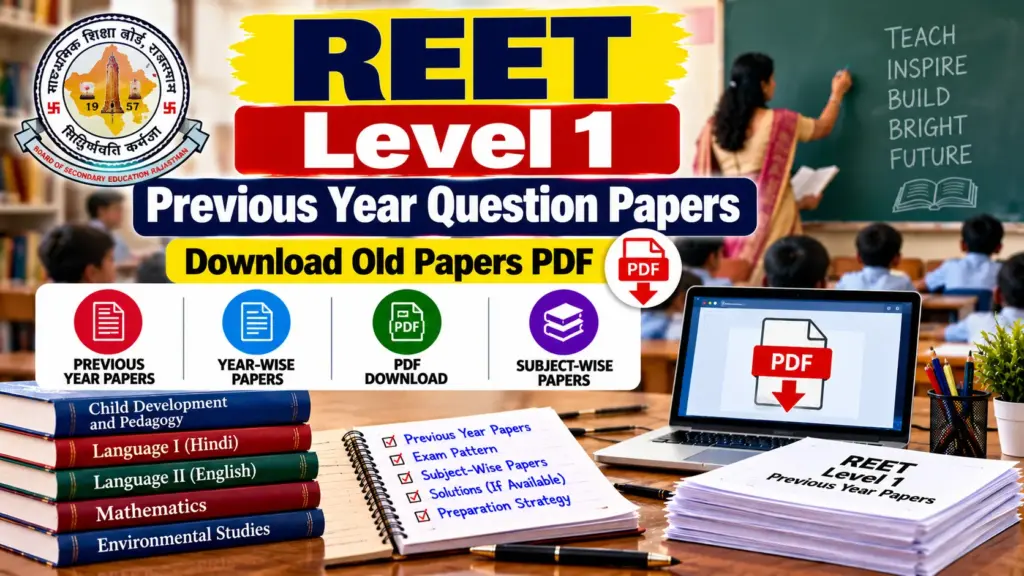
REET Level 1 Previous Year Question Papers: Download Old Papers PDF.Preparing for the REET Level 1 examination becomes much easier when candidates understand what they are actually going to face in the exam. Completing the syllabus and reading study material are important, but previous year question papers provide something different — a chance to practise questions in the same style as an actual examination.
For REET Level 1 aspirants, old question papers can be useful for understanding the question pattern, checking preparation, improving speed and finding topics that need more revision. Instead of waiting until the last few days, candidates can include previous year papers in their regular preparation routine.
REET Level 1 Previous Year Question Papers
REET Level 1 Previous Year Question Papers are useful for candidates preparing for the teaching eligibility examination at the primary level. The available previous-paper collections cover several examination years and can be used for both subject-wise practice and full-length tests.
The major areas covered in Level 1 preparation include:
- Child Development and Pedagogy
- Language-I
- Language-II
- Mathematics
- Environmental Studies
Candidates should not simply collect question paper PDFs. The real benefit comes when each paper is attempted seriously and the mistakes are analysed afterwards.
REET Level 1 Previous Year Papers
Previous year Level 1 papers are available from different examination years, including 2022, 2021, 2017, 2015, 2013, 2012 and 2011.
Each paper can give candidates a different kind of practice. Recent papers can help aspirants become familiar with the more recent style of questions, while older papers provide additional questions for revision and concept practice.
REET Level 1 2022 Question Paper
The REET 2022 Level 1 question paper is useful for candidates who want to practise a relatively recent examination paper. Candidates can attempt the complete paper within the prescribed time and then compare their responses with the answer key.
Rather than focusing only on the score, pay attention to the questions that were difficult or took too much time.
| Exam Name | Booklet |
| REET 2022 Level-I | Booklet A |
| REET 2022 Level-I | Booklet B |
| REET 2022 Level-I | Booklet C |
| REET 2022 Level-I | Booklet D |
REET Level 1 2021 Question Paper
The 2021 Level 1 paper can be used as another full-length practice test. Candidates can attempt it after completing the important portions of the syllabus.
It is a good idea to keep a separate record of questions answered incorrectly so that the related topics can be revised later.
REET Level 1 2017 Question Paper
The 2017 Level 1 paper provides additional practice for candidates who want to solve questions from an earlier examination.
Older papers can be particularly useful during revision because they allow candidates to test their understanding through different questions rather than repeatedly studying the same notes.
| REET 2017 | Level-1 |
| 11 February 2018 | Download PDF |
REET Level 1 2015 Question Paper
Candidates can also use the 2017 Level 1 paper for additional practice. It can be attempted after completing the recent papers or used for subject-wise revision.
| REET 2025 | Level-1 |
| 7 February 2026 | Download PDF |
RTET Level 1 2013 and 2012 Question Papers
The 2013 and 2012 Level 1 papers provide further opportunities to practise questions and revise the syllabus.
While solving older papers, candidates should focus on understanding the concepts rather than expecting the same questions to appear again.
RTET Level 1 2011 Question Paper
The 2011 paper can also be used as an additional practice resource. Very old papers should be treated primarily as supplementary practice, particularly if the syllabus or examination structure has changed over the years.
| Exam Name | Paper |
| RTET 2011 Level-1 | Download PDF |
Why Are REET Level 1 Previous Year Papers Important?
Previous year papers can answer a question that books alone cannot: Can you actually solve exam-level questions after studying the topic?
1. Understand the Question Pattern
Solving old papers makes candidates familiar with the way questions are framed. With repeated practice, it becomes easier to understand what a question is asking and select the appropriate answer.
2. Identify Important Areas
When candidates compare papers from different years, they can identify subjects and concepts that have received attention in previous examinations.
This does not mean that the same questions will be repeated. Instead, it helps candidates decide which areas deserve careful revision.
3. Improve Speed
A candidate may know the correct answer but still struggle to complete the paper on time.
Timed practice helps candidates understand how quickly they are solving questions and where they are spending unnecessary time.
4. Improve Accuracy
Regular PYQ practice can also highlight careless mistakes. If the same type of mistake keeps appearing, candidates can address it before the actual examination.
5. Find Weak Subjects
Sometimes a candidate feels confident about a subject until they attempt a full paper. Previous year questions can reveal the difference between theoretical understanding and actual performance.
REET Level 1 Subject-Wise Previous Year Paper Practice
Instead of immediately attempting complete papers, candidates can also practise PYQs subject-wise.
Child Development and Pedagogy
Use previous questions to revise concepts related to child development, learning and teaching approaches. Pay attention to questions where two options appear similar, as these often require careful reading.
Language-I
Practise questions regularly and focus on understanding the language concepts rather than simply remembering answers from previous papers.
Language-II
Language-II should also be included in regular PYQ practice. Candidates can identify areas where they repeatedly make mistakes and revise those concepts separately.
Mathematics
Mathematics requires both conceptual clarity and practice. Previous year questions can help candidates become familiar with the types of problems and calculations they may encounter.
Environmental Studies
EVS covers a broad range of topics. Solving old questions can help candidates revise different areas in a more structured manner.
How to Solve REET Level 1 Previous Year Papers?
There is a big difference between casually reading a question paper and actually using it as a preparation tool.
Follow these steps:
Step 1: Choose One Paper
Select one complete previous year paper and keep your books and notes aside.
Step 2: Set a Timer
Try to recreate an examination-like environment. Sit in a quiet place and avoid unnecessary interruptions.
Step 3: Attempt All Questions
Try to solve the paper independently. If a question takes too long, move ahead and return to it later.
Step 4: Check the Answer Key
After completing the paper, compare your answers with the answer key.
Step 5: Analyse Your Mistakes
Don’t stop after calculating the score. Check every wrong answer and ask yourself why you made the mistake.
Was it:
- Lack of knowledge?
- Confusion between two options?
- A calculation error?
- Misreading the question?
- A careless mistake?
- Lack of time?
Step 6: Revise the Topic
Once you identify the reason, return to the relevant topic and revise it.
Step 7: Reattempt Difficult Questions
After revision, try the difficult questions again. This is where the real value of PYQ practice comes in.
Previous Year Papers and Mock Tests
PYQs and mock tests are both useful, but they serve slightly different purposes.
Previous Year Papers help candidates understand questions asked in earlier examinations.
Mock Tests provide additional practice and allow candidates to test themselves in a simulated exam environment.
A simple preparation cycle can be:
Study → Solve PYQs → Analyse → Revise → Attempt Mock Test
Using both resources can make preparation more balanced.
Common Mistakes Candidates Should Avoid
Candidates often lose the benefit of previous year papers by making a few avoidable mistakes.
Solving Without a Time Limit
If every paper is solved casually without a timer, candidates may not get a realistic idea of their speed.
Checking Answers Too Early
Do not look at the answer key while solving. Complete the paper first.
Focusing Only on the Score
A score is useful, but it is not the only thing that matters. The mistakes behind that score are more important.
Ignoring Repeated Mistakes
If the same type of question is repeatedly answered incorrectly, that topic needs additional attention.
Depending Only on PYQs
Previous year papers are an important preparation resource, but they should be used alongside the syllabus, study material, revision and mock tests.
How Many REET Level 1 Papers Should You Solve?
There is no fixed number that every candidate needs to complete.
The focus should be on quality of practice rather than the number of PDFs solved.
It is better to solve a paper carefully, analyse the mistakes and revise the weak topics than to complete several papers without reviewing the answers.
Candidates can start with recent papers and then gradually move towards older papers for additional practice.
A Simple REET Level 1 PYQ Strategy
A practical approach can look like this:
Complete a Topic → Solve Related PYQs → Check Answers → Identify Mistakes → Revise → Reattempt
Once most of the syllabus has been covered, candidates can start solving complete previous year papers under timed conditions.
Maintaining a small notebook of repeated mistakes can also be helpful. During the final revision, candidates can quickly go through this list instead of revisiting every chapter from the beginning.