
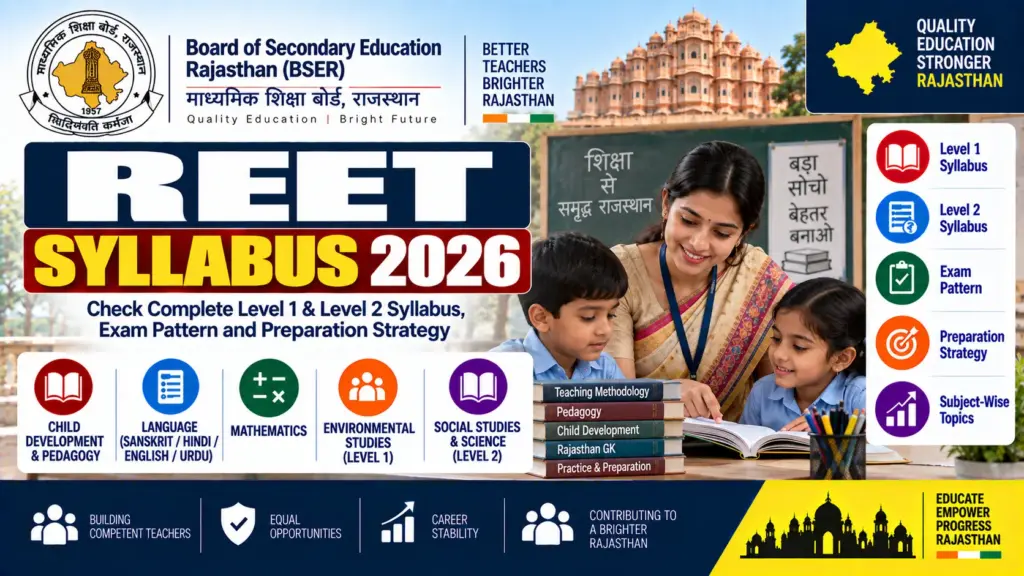
REET Syllabus 2026: Check Complete Level 1 & Level 2 Syllabus, Exam Pattern and Preparation Strategy.The REET Syllabus 2026 is the starting point for anyone preparing for the Rajasthan Eligibility Examination for Teachers. Before picking up books or joining a test series, candidates should first understand what the exam actually covers.
REET is conducted at two levels. Level 1 is for candidates who want to teach Classes 1 to 5, while Level 2 is for those aiming to teach Classes 6 to 8. Although both levels have some common sections, the subject-specific syllabus is different.
A smart preparation strategy begins with knowing the syllabus, understanding the weightage and then dividing the topics into daily targets. This makes preparation much more organised and also reduces the chances of leaving important topics for the last minute.
Overview of REET Syllabus 2026
| Particulars | Details |
|---|---|
| Exam Name | Rajasthan Eligibility Examination for Teachers |
| Exam Levels | Level 1 and Level 2 |
| Level 1 | Classes 1 to 5 |
| Level 2 | Classes 6 to 8 |
| Exam Mode | Offline / OMR |
| Question Type | Objective Type |
| Total Questions | 150 |
| Total Marks | 150 |
| Exam Duration | 2 Hours 30 Minutes |
| Level 1 Subjects | 5 |
| Level 2 Subjects | 4 |
| Level 1 Syllabus | REET Level 2 Syllabus PDF |
| Level 2 Syllabus | REET Level 1 Syllabus PDF |
REET Level 1 Exam Pattern 2026
REET Level 1 is designed for candidates preparing to teach students from Classes 1 to 5. The paper has five sections, and each section carries 30 questions.
| Subject | Questions | Marks |
|---|---|---|
| Child Development and Pedagogy | 30 | 30 |
| Language I | 30 | 30 |
| Language II | 30 | 30 |
| Mathematics | 30 | 30 |
| Environmental Studies | 30 | 30 |
| Total | 150 | 150 |
The total duration of the paper is 150 minutes.
Important
Candidates should not treat all five sections as separate subjects that can be prepared independently. Child Development and Pedagogy, for example, requires an understanding of classroom situations, while the language sections include both language knowledge and teaching-related concepts.
REET Level 1 Syllabus 2026
Child Development and Pedagogy
This section deals with how children grow, learn and respond to different classroom situations. It is more about understanding concepts than simply memorising facts.
Important Topics
- Growth and development
- Principles and dimensions of development
- Factors affecting development
- Heredity and environment
- Concept and process of learning
- Learning theories
- Behaviourism
- Gestalt theory
- Cognitivism
- Constructivism
- Experiential learning
- Motivation and learning
- Individual differences
- Personality
- Intelligence
- Diverse learners
- Children with special needs
- Learning disabilities
- Learning difficulties
- Adjustment
- Teaching-learning process
- Teaching strategies and methods
- Assessment and evaluation
- Continuous and Comprehensive Evaluation
- Learning outcomes
- Achievement tests
- Action research
- Right to Education Act
- Role and responsibilities of teachers
How to Prepare
Don’t just mug up the names of learning theories. Try to understand what each theory means and how it can be applied in a classroom. This approach makes pedagogy questions much easier to handle.
Language I Syllabus
Language I checks a candidate’s understanding of the language as well as basic teaching skills.
The preparation should cover:
- Reading comprehension
- Grammar
- Vocabulary
- Language acquisition
- Language development
- Principles of language teaching
- Language skills
- Listening
- Speaking
- Reading
- Writing
- Teaching-learning materials
- Evaluation
- Remedial teaching
- Language-learning difficulties
Candidates should make a habit of reading comprehension passages regularly. Apart from improving accuracy, this can also help improve speed during the examination.
Language II Syllabus
Language II is different from Language I and focuses on language understanding and pedagogy.
Key Areas
- Comprehension
- Grammar
- Vocabulary
- Language acquisition
- Language learning
- Teaching methods
- Principles of language teaching
- Development of language skills
- Classroom communication
- Teaching-learning materials
- Evaluation
- Learning difficulties
- Remedial strategies
Exam Tip: A common mistake is to prepare only grammar and ignore pedagogy. Give proper attention to both.
Mathematics Syllabus for REET Level 1
Mathematics at Level 1 focuses on basic concepts and their application at the primary level.
Important topics include:
- Number system
- Basic mathematical operations
- Fractions
- Geometry
- Shapes
- Length
- Weight
- Capacity
- Time
- Measurement
- Area and perimeter
- Data handling
- Logical thinking
- Problem-solving
- Mathematics in the curriculum
- Community mathematics
- Evaluation
- Error analysis
- Diagnostic teaching
- Remedial teaching
- Problems of teaching mathematics
Preparation Tip
Mathematics improves with regular practice. Instead of solving hundreds of questions once a week, try solving a smaller set every day. Keep track of the questions you get wrong and revise them regularly.
Environmental Studies Syllabus for REET Level 1
EVS is closely connected with everyday life, society, environment and Rajasthan’s culture.
Family and Society
- Personal relationships
- Nuclear and joint families
- Social problems
- Child marriage
- Dowry system
- Child labour
- Addiction and its effects
Clothes and Habitats
- Clothes according to seasons
- Maintenance of clothes
- Handloom and power loom
- Different types of houses
- Habitats of living beings
- Cleanliness of homes and surroundings
Occupations and Industries
- Farming
- Gardening
- Animal rearing
- Vegetable vendors
- Small industries
- Cottage industries
- Major industries of Rajasthan
- Consumer protection
- Cooperative societies
Rajasthan Culture and Heritage
- National symbols
- National festivals
- Fairs and festivals of Rajasthan
- Traditional dresses
- Jewellery
- Food habits
- Architecture
- Tourist places
- Forts
- Palaces
- Monuments
- Paintings
- Folk deities
- Important personalities
Environment and General Awareness
- Transport and communication
- Traffic rules
- Traffic symbols
- Personal hygiene
- Balanced diet
- Common diseases
- Plants and animals
- Forests and wildlife
- Water resources
- Pollution
- Pollution control
- Solar system
- Indian astronauts
- Environmental Studies pedagogy
REET Level 2 Exam Pattern 2026
REET Level 2 is for candidates preparing to teach Classes 6 to 8.
| Subject | Questions | Marks |
|---|---|---|
| Child Development and Pedagogy | 30 | 30 |
| Language I | 30 | 30 |
| Language II | 30 | 30 |
| Mathematics & Science OR Social Science | 60 | 60 |
| Total | 150 | 150 |
The 60-question section depends on the subject selected by the candidate.
REET Level 2 Syllabus 2026
Child Development and Pedagogy
The major topics include:
- Child development
- Growth and development
- Heredity and environment
- Learning process
- Learning theories
- Constructivism
- Motivation
- Individual differences
- Personality
- Intelligence
- Diverse learners
- Special needs
- Learning disabilities
- Learning difficulties
- Adjustment
- Teaching-learning strategies
- Assessment
- Evaluation
- Learning outcomes
- Action research
- Right to Education Act
- Responsibilities of teachers
Candidates preparing for Level 2 should focus on applying these concepts to upper-primary classroom situations.
Mathematics and Science Syllabus for Level 2
Candidates choosing Mathematics and Science have to prepare both subjects for the 60-mark section.
Mathematics
Important topics include:
- Indices
- Algebraic expressions
- Factors
- Equations
- Square and square root
- Cube and cube root
- Interest
- Ratio and proportion
- Percentage
- Lines and angles
- Plane figures
- Area and perimeter
- Surface area and volume
- Statistics
- Graphs
- Probability
- Logical thinking
- Language of mathematics
- Mathematics curriculum
- Evaluation
- Remedial teaching
- Problems of teaching mathematics
Science
The Science syllabus includes:
- Living and non-living things
- Microorganisms
- Living beings
- Human body and health
- Animal reproduction
- Adolescence
- Mechanics
- Heat and temperature
- Light
- Sound
- Electricity
- Magnetism
- Science and technology
- Solar system
- Structure of matter
- Chemical substances
- Agriculture management
- Nature and structure of science
- Innovation
- Practical and inquiry-based learning
Social Science Syllabus for Level 2
Social Science candidates need to prepare History, Geography, Civics and Rajasthan-specific topics.
History
- Indian civilization
- Indian culture and society
- Mauryan Empire
- Gupta Empire
- Post-Gupta period
- Medieval period
- Modern period
- Freedom movement
Geography
- Earth and environment
- Geography of India
- Natural resources
- Climate
- Agriculture
- Geography of Rajasthan
- Resources of Rajasthan
Civics
- Indian Constitution
- Democracy
- Government
- Composition and functions of government
- Governance
Rajasthan
- History of Rajasthan
- Art and culture
- Geography of Rajasthan
- Resources of Rajasthan
- Important historical developments
- Rajasthan’s cultural heritage
Social Science Pedagogy
- Use of maps
- Charts and teaching aids
- Activity-based learning
- Group discussions
- Classroom activities
- Teaching students with different learning abilities
How to Prepare for REET 2026?
Preparing for REET doesn’t mean sitting with books all day. What matters is having a clear plan and following it consistently.
1. Understand the Syllabus First
Before starting preparation, divide every subject into smaller topics. This will give you a clear idea of how much you have completed and what is still pending.
2. Build Strong Basics
Don’t rush through topics just to finish the syllabus. A strong understanding of basic concepts will help you solve questions more confidently.
3. Give Pedagogy Enough Time
Child Development and Pedagogy can become a scoring section if the concepts are clear. Read each topic carefully and practise application-based questions.
4. Practise Mathematics Daily
Regular practice is the best way to improve calculation speed and accuracy.
5. Strengthen Language Skills
Read passages, revise grammar and practise language pedagogy questions regularly.
6. Focus on Rajasthan Topics
Candidates should not leave Rajasthan-related topics until the end. Make short notes and revise them frequently.
7. Solve Previous-Year Papers
Previous-year papers give you an idea about question patterns and help identify your weak areas.
8. Take Mock Tests
Start with topic-wise tests and gradually move towards full-length mock tests.
Remember: Taking a mock test is only half the job. Analysing your mistakes is equally important.
90-Day REET Preparation Plan
| Period | Preparation Target |
|---|---|
| Days 1–30 | Cover basic concepts and important topics |
| Days 31–60 | Complete the remaining syllabus and practise questions |
| Days 61–75 | Revision and previous-year papers |
| Days 76–90 | Full-length mocks and final revision |
A Simple Daily Timetable
- 2 hours: Main subject
- 1 hour: Child Development and Pedagogy
- 1 hour: Language
- 1 hour: Mathematics/Science/Social Science
- 30 minutes: Revision
- 30 minutes: Practice questions
If you are preparing for both levels, divide your time according to the subjects common to both papers and the additional Level 2 subject.
Common Mistakes to Avoid in REET Preparation
Studying Without a Syllabus
Without a syllabus, it’s easy to spend too much time on topics that may not be important.
Ignoring Pedagogy
REET isn’t simply a test of academic knowledge. Teaching-related concepts are an important part of both levels.
Avoiding Revision
Reading a topic once doesn’t mean you remember it permanently. Keep revising at regular intervals.
Taking Too Many Mock Tests Too Early
First build your concepts. Once you have covered a reasonable portion of the syllabus, increase mock-test practice.
Not Reviewing Mistakes
Maintain a small mistake notebook. Whenever you get a question wrong, write down the reason and revisit it during revision.