
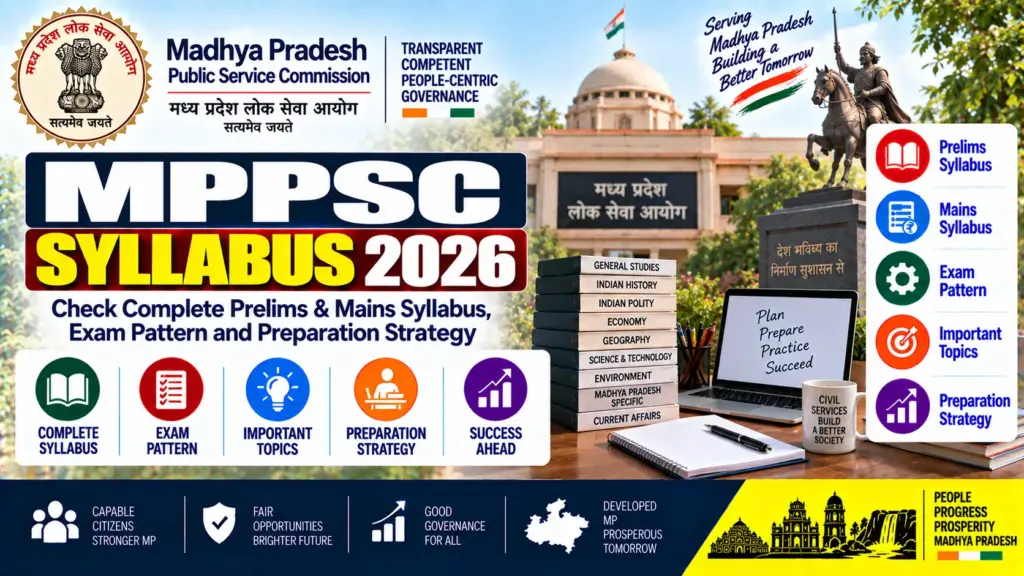
MPPSC Syllabus 2026: Check Complete Prelims & Mains Syllabus, Exam Pattern and Preparation Strategy.Preparing for the MPPSC State Service Examination is not just about studying for long hours. The real challenge is knowing what to study, how much to study and when to revise it. This is where the MPPSC Syllabus 2026 becomes important.
The syllabus covers a wide range of subjects, from Indian History and Polity to Science, Environment, Economy and Current Affairs. At the same time, candidates have to give special attention to Madhya Pradesh-specific topics, which are spread across different sections of the examination.
The MPPSC State Service Examination is conducted in three stages: Prelims, Mains and Interview. Prelims is objective in nature, whereas the Mains examination requires descriptive answers and tests a candidate’s understanding, analytical ability and writing skills.
If you are preparing for MPPSC 2026, understanding the syllabus before starting serious preparation can save you a lot of time. Here is a detailed look at the MPPSC Prelims and Mains syllabus, exam pattern and preparation strategy.
Overview of MPPSC Syllabus 2026
| Particulars | Details |
|---|---|
| Exam Name | MPPSC State Service Examination 2026 |
| Conducting Body | Madhya Pradesh Public Service Commission |
| Exam Level | State Level |
| Selection Process | Prelims, Mains and Interview |
| Prelims Papers | General Studies and General Aptitude Test |
| Mains Papers | General Studies I, II, III, IV, Hindi and Hindi Essay |
| Prelims Type | Objective |
| Mains Type | Descriptive |
| Interview | Personality Test |
MPPSC Exam Pattern 2026
Before going through the detailed syllabus, candidates should understand the structure of the examination.
The MPPSC selection process has three stages:
- Preliminary Examination
- Main Examination
- Interview/Personality Test
Each stage has a different purpose. Prelims mainly tests broad awareness and aptitude, while Mains requires deeper understanding and answer-writing ability.
MPPSC Prelims Exam Pattern
The Preliminary Examination consists of two papers:
| Paper | Subject | Questions | Marks | Duration |
|---|---|---|---|---|
| Paper I | General Studies | 150 | 300 | 2 Hours |
| Paper II | General Aptitude Test | 150 | 300 | 2 Hours |
Paper II is qualifying in nature as per the revised syllabus material.
Important: Different reference versions of the MPPSC syllabus contain differences in the Prelims marking details. Candidates should follow the marking scheme mentioned in the notification applicable to their examination.
MPPSC Prelims Syllabus 2026
The Prelims syllabus is quite broad. It covers national subjects as well as topics related specifically to Madhya Pradesh.
The major areas are:
- General Science and Environment
- Current Affairs
- History of India and Independent India
- Indian Polity and Economy
- Sports
- Geography, History and Culture of Madhya Pradesh
- Polity and Economy of Madhya Pradesh
- Information and Communication Technology
- General Aptitude
Let’s understand these sections one by one.
1. General Science and Environment
The Science and Environment section focuses mainly on basic concepts and their practical applications.
Candidates should prepare topics such as:
- Basic Principles of Science
- Indian Scientific Research Institutions
- Scientific achievements
- Satellite and Space Technology
- Environment and Biodiversity
- Ecosystem
- Nutrition and Food
- Human Body
- Health Policies and Programmes
- Pollution
- Natural Disasters
- Disaster Management
- Agricultural Product Technology
- Food Processing
How to Prepare
Don’t make Science unnecessarily complicated. Start with basic concepts and gradually connect them with current developments.
For example, while studying space technology, also keep track of important developments in India’s space programme. Similarly, while studying the environment, connect static concepts with current environmental issues.
2. Current Affairs
Current Affairs is an important part of MPPSC preparation because questions can come from developments at the national, international and Madhya Pradesh levels.
Focus on:
- National Current Affairs
- International Events
- Madhya Pradesh Current Affairs
- Government Schemes
- Important Reports
- Awards and Honours
- Sports
- Science and Technology
- Environment
- Economy
- Important Government Initiatives
Preparation Tip
Don’t spend hours making huge current-affairs notes.
A better approach is to maintain short and revision-friendly notes. Revise them regularly instead of collecting information from multiple sources.
3. History of India and Independent India
The History section covers ancient, medieval and modern India.
Important topics include:
- Ancient Indian History
- Medieval Indian History
- Modern Indian History
- Major Dynasties
- Indian Culture
- Social and Religious Reform Movements
- Indian National Movement
- Freedom Struggle
- Independence
- Integration of India after Independence
- Reorganisation of India
Madhya Pradesh History
This is particularly important for MPPSC candidates.
Prepare:
- Major events in Madhya Pradesh history
- Major dynasties
- Art and sculpture
- Contribution of Madhya Pradesh to the freedom movement
- Major tribes and dialects
- Festivals
- Folk music
- Folk arts
- Folk literature
- Important writers and their works
- Religious places
- Tourist places
- Important tribal personalities
Remember: Don’t study MP History as an isolated subject. Connect it with culture, tribes, geography and current affairs wherever possible.
4. Indian Polity and Constitution
The Polity section includes both constitutional basics and important institutions.
Major topics include:
- Government of India Act, 1919
- Government of India Act, 1935
- Constituent Assembly
- Indian Constitution
- Fundamental Rights
- Fundamental Duties
- Directive Principles of State Policy
- Constitutional Amendments
- President
- Parliament
- Union Executive
- Supreme Court
- Judicial System
- Financial Institutions
- RBI
- Banking System
- SEBI
- Non-Banking Financial Institutions
- Stock Market
Exam Tip
Instead of memorising constitutional articles randomly, understand the relationship between different constitutional institutions. This makes revision easier and helps in solving conceptual questions.
5. Geography of India
The Indian Geography section includes both physical and economic aspects.
Prepare:
- Mountains
- Plateaus
- Plains
- Rivers
- Lakes
- Climate
- Soils
- Natural Resources
- Agriculture
- Energy Resources
- Population
- Disaster Management
Maps can be very useful while preparing Geography. Try to locate important rivers, mountains, states, resources and geographical regions rather than studying everything only through text.
6. Geography of Madhya Pradesh
Madhya Pradesh Geography deserves separate attention.
Important topics include:
- Rivers
- Forests
- Climate
- Soil
- Minerals
- Irrigation Projects
- Agriculture
- Industries
- Population
- Urbanisation
Preparation Tip
Make a separate notebook for MP Geography. Use maps wherever possible and connect geographical features with agriculture, industries, minerals and development.
7. Economy of India and Madhya Pradesh
The Economy section covers both India and Madhya Pradesh.
Important topics include:
- Economic Development
- Agriculture
- Industry
- Infrastructure
- MSMEs
- Sustainable Development Goals
- Banking System
- RBI
- SEBI
- Foreign Trade
- Economy of Madhya Pradesh
- Development-related issues
Economy can initially feel difficult, especially if you are not from a commerce or economics background. Start with basic concepts and then move towards current economic developments.
8. Information and Communication Technology
ICT has become an increasingly relevant area of competitive examinations.
Important topics include:
- Computer Basics
- Internet
- Digital Communication
- Robotics
- Artificial Intelligence
- Cyber Security
- E-Governance
- Social Media
Candidates should focus on basic understanding rather than going too deeply into technical details.
9. Tribes of Madhya Pradesh
Tribal topics are an important part of the Madhya Pradesh-specific syllabus.
Prepare:
- Major Tribal Communities
- Particularly Vulnerable Tribal Groups
- Nomadic Tribes
- Constitutional Provisions
- Tribal Welfare Schemes
- Tribal Traditions
- Tribal Arts
- Tribal Festivals
- Languages and Dialects
- Tribal Literature
- Tribal Movements
- Tribal Personalities
- Museums and Institutions
- Folk Culture
This section can be prepared effectively by making short tables comparing tribes, their regions, culture, festivals and important personalities.
MPPSC Prelims Paper II: General Aptitude Test
The General Aptitude Test focuses on reasoning and problem-solving skills.
Important topics include:
- Reading Comprehension
- Interpersonal Skills
- Communication Skills
- Logical Reasoning
- Analytical Ability
- Decision Making
- Problem Solving
- General Mental Ability
- Basic Numeracy
- Data Interpretation
- Hindi Language Comprehension
Basic numeracy and data interpretation are covered at approximately the Class 10 level.
How to Prepare for CSAT
Even though the paper is qualifying, don’t leave it completely for the last moment.
Practise:
- Comprehension passages
- Logical reasoning
- Percentages
- Ratios
- Averages
- Basic arithmetic
- Data interpretation
- Decision-making questions
A little practice every day is better than trying to complete the entire aptitude syllabus in a few weeks.
MPPSC Mains Syllabus 2026
The Mains examination is descriptive in nature. Here, simply knowing the answer is not enough. Candidates also need to explain their thoughts clearly within the given word and time limits.
The Mains papers are:
| Paper | Subject | Marks | Duration |
|---|---|---|---|
| Paper I | General Studies I | 300 | 3 Hours |
| Paper II | General Studies II | 300 | 3 Hours |
| Paper III | General Studies III | 300 | 3 Hours |
| Paper IV | General Studies IV | 200 | 3 Hours |
| Paper V | Hindi | 200 | 3 Hours |
| Paper VI | Hindi Essay | 100 | 2 Hours |
General Studies Paper I
GS Paper I mainly focuses on History and Geography.
History
The major areas include:
Ancient and Medieval India
- Political history
- Economic history
- Social history
- Cultural history
- Harappan Civilisation
- Ancient Indian traditions
- Medieval India
- Mughal rulers
- Mughal administration
- Composite culture
Modern India
- British Colonial Rule
- Impact of British Rule on Indian Economy and Society
- Peasant Revolts
- Tribal Revolts
- First Struggle of Independence
- Indian Renaissance
- National Freedom Movement
- Important leaders
- Emergence of India as a Republic
- Reorganisation of States
- Formation of Madhya Pradesh
Madhya Pradesh History and Culture
Prepare:
- Freedom Movement in Madhya Pradesh
- Cultural Heritage
- Art Forms
- Literature
- Festivals
- Architecture
- World Heritage Sites
- Tourism
- Gondwana
- Bundeli region
- Bagheli region
- Holkar
- Scindia
- Bhopal State
Geography
Important topics include:
- Physical Features of India
- Mountains
- Plateaus
- Plains
- Rivers
- Lakes
- Glaciers
- Earthquakes
- Tsunami
- Volcanicity
- Cyclones
- Climate
- Rainfall
- Climatic Regions
- Climate Change
- Water Resources
- Disaster Management
Madhya Pradesh-related geographical topics should also be revised thoroughly.
General Studies Paper II
The Mains syllabus includes Political Science and Sociology under this paper.
Political Science
Candidates should focus on:
- Indian Political System
- Constitution
- Political Institutions
- Governance
- Administrative Structure
- Political Developments
- Contemporary Issues
Sociology
Important areas include:
- Indian Society
- Social Structure
- Social Change
- Social Issues
- Rural Society
- Urban Society
- Tribal Society
- Communities
- Social Development
For Mains, don’t just prepare definitions. Try to understand social issues through examples and current developments.
General Studies Paper III
GS Paper III covers Economics, Science, Technology and Public Health.
Economics
Important topics include:
- Indian Economy
- Economic Development
- Agriculture
- Industry
- Infrastructure
- Employment
- Banking
- Financial Sector
- State Economy
- Development Issues
Science, Technology and Public Health
Prepare:
- Science and Technology
- Emerging Technologies
- Information Technology
- Space Technology
- Biotechnology
- Public Health
- Health Programmes
- Scientific Developments
- Technology and Society
General Studies Paper IV
GS Paper IV focuses on Ethics and its application in administration.
Important areas include:
- Human Needs and Motivation
- Philosophers and Thinkers
- Social Reformers
- Aptitude
- Attitude
- Emotional Intelligence
- Ethics and Values
- Integrity
- Accountability
- Transparency
- Impartiality
- Non-Partisanship
- Public Service Values
- Ethical Reasoning
- Moral Dilemmas
- Code of Conduct
- Corruption
- Case Studies
Important Thinkers and Reformers
The syllabus includes personalities such as:
- Socrates
- Plato
- Aristotle
- Mahavir
- Buddha
- Acharya Shankar
- Charwak
- Guru Nanak
- Kabir
- Tulsidas
- Rabindranath Tagore
- Raja Ram Mohan Roy
- Savitribai Phule
- Swami Dayanand Saraswati
- Swami Vivekananda
- Maharshi Arvind
- Sarvepalli Radhakrishnan
Ethics Preparation Tip
Ethics becomes much easier when you connect theories with real-life situations.
While preparing, ask yourself:
“If I were an administrator facing this situation, what would I do and why?”
This approach is particularly useful for case studies.
Hindi and Hindi Essay
Hindi is also included in the Mains examination.
The syllabus covers:
- General Hindi
- Hindi Grammar
- Hindi Essay
- Format/Praroop Writing
The Hindi paper carries 200 marks, while the Hindi Essay paper carries 100 marks.
For essay preparation, candidates can practise topics related to:
- Education
- Environment
- Women Empowerment
- Agriculture
- Technology
- Rural Development
- Youth
- Governance
- Social Issues
- Madhya Pradesh
The focus should be on clear language, proper structure, relevant examples and a balanced conclusion.
MPPSC Interview 2026
Candidates who qualify for the Mains examination are called for the Personality Test/Interview.
The supplied exam pattern mentions 175 marks for the Interview.
Candidates should be prepared to discuss:
- Madhya Pradesh
- Current Affairs
- Educational background
- Government schemes
- Social issues
- Economic issues
- Administrative issues
- Personal interests
- Hobbies
- Important national developments
- Important international developments
The interview preparation should start well before the interview stage rather than being treated as a last-minute activity.
How to Prepare for MPPSC 2026?
A large syllabus can look intimidating at first. The easiest way to handle it is to divide it into smaller sections and create a realistic study plan.
Step 1: Understand the Syllabus
Before starting any book, read the syllabus carefully.
Mark the topics you already know and identify areas where you need more work.
Step 2: Complete the Basic Subjects
Start with:
- History
- Geography
- Polity
- Economy
- Science
- Environment
Once your basics are strong, move towards current affairs and advanced preparation.
Step 3: Give Special Attention to Madhya Pradesh
Keep dedicated notes for:
- MP History
- MP Geography
- MP Economy
- MP Culture
- MP Tribes
- MP Polity
- MP Current Affairs
- State Government Schemes
Step 4: Practise MCQs
After completing a topic, solve questions from that topic.
This will help you identify whether you have actually understood the subject or have only read it.
Step 5: Start Answer Writing
Don’t wait for the Prelims result.
Start writing short Mains answers during your preparation. Gradually improve your speed, structure and presentation.
A simple answer format is:
Introduction → Main Points → Examples → Analysis → Conclusion
Step 6: Revise Again and Again
Revision should be part of your weekly routine.
A useful cycle is:
Study → Revise → Practise Questions → Analyse Mistakes → Revise Again
90-Day MPPSC Preparation Plan
First 30 Days
Focus on building your foundation.
- Indian History
- MP History
- Geography
- Polity
- Economy
- Science
- Environment
Days 31 to 60
Move towards broader coverage.
- MP Economy
- MP Geography
- MP Culture
- Tribes
- Current Affairs
- ICT
- CSAT
- Previous-Year Questions
Days 61 to 90
Focus primarily on revision and testing.
- Full syllabus revision
- Mock Tests
- Previous-Year Questions
- Weak Topics
- CSAT Practice
- Mains Answer Writing
Avoid spending most of this phase collecting new study material.
Daily Study Timetable for MPPSC
| Time | Activity |
|---|---|
| 2 Hours | Static Subject |
| 1.5 Hours | Madhya Pradesh-Specific Topics |
| 1 Hour | Current Affairs |
| 1.5 Hours | Second Subject |
| 1 Hour | MCQs/Previous-Year Questions |
| 1 Hour | Revision |
| 30 Minutes | CSAT Practice |
This is only a sample timetable. Candidates can adjust it according to their daily schedule and preparation level.
Important MPPSC Preparation Tips
Keep the syllabus in front of you
It is easy to get distracted by the huge amount of study material available. The syllabus will keep you focused.
Don’t ignore Madhya Pradesh
State-specific topics should be part of your preparation from the beginning.
Make short notes
Short notes become extremely useful during revision.
Practise previous-year questions
They help you understand the type and level of questions asked in the examination.
Don’t postpone Mains preparation
Develop answer-writing skills gradually instead of waiting until after Prelims.
Give CSAT regular practice
Even a qualifying paper requires proper preparation.
Analyse your mock tests
A mock test is useful only when you understand why you got a question wrong.
Revision is more important than collecting material
The goal is not to read ten books. The goal is to remember and apply what you have studied.
Common Mistakes Candidates Should Avoid
- Starting preparation without understanding the syllabus
- Ignoring Madhya Pradesh-specific topics
- Leaving Current Affairs for the last few weeks
- Reading without revision
- Avoiding CSAT preparation
- Starting answer writing too late
- Taking mock tests without analysing them
- Collecting too many study materials
- Changing books repeatedly
- Focusing only on Prelims and ignoring Mains