
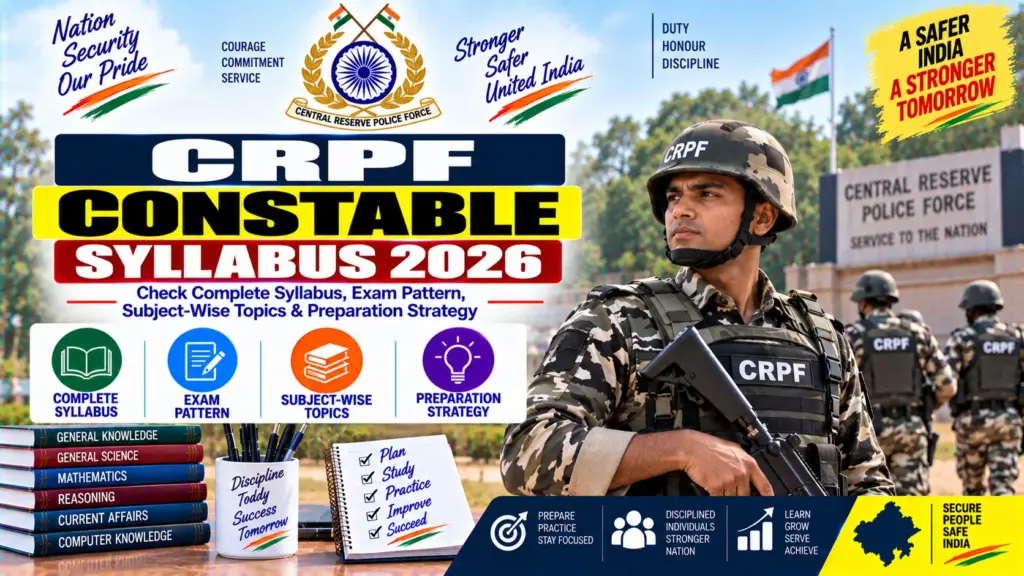
CRPF Constable Syllabus 2026: Check Complete Syllabus, Exam Pattern, Subject-Wise Topics & Preparation Strategy.The CRPF Constable Recruitment 2026 is a major opportunity for candidates who want to join the Central Reserve Police Force as a Constable. But before jumping into preparation, it is important to understand exactly what the written examination covers, how marks are distributed and what comes after the CBT.
The CRPF Constable Syllabus 2026 is divided into four sections: General Intelligence and Reasoning, General Knowledge and General Awareness, Elementary Mathematics, and English/Hindi. The Computer-Based Test consists of 100 questions for 100 marks and is conducted for two hours.
For candidates applying for Technical, Tradesmen or Pioneer Wing posts, preparation does not end with the written examination. Physical tests, trade/skill assessment, document verification and medical examination are also part of the recruitment process.
Here is a complete and easy-to-follow guide to the CRPF Constable syllabus, exam pattern and preparation strategy.
Overview of CRPF Constable Syllabus 2026
| Particulars | Details |
|---|---|
| Organisation | Central Reserve Police Force |
| Post | Constable (Technical & Tradesmen/Pioneer) |
| Exam Mode | Computer-Based Test |
| Question Type | Objective Multiple Choice Questions |
| Total Questions | 100 |
| Maximum Marks | 100 |
| Exam Duration | 2 Hours |
| Subjects | General Intelligence & Reasoning, General Knowledge & General Awareness, Elementary Mathematics, English/Hindi |
| Negative Marking | 0.25 marks for each wrong answer |
| Question Level | Matriculation Level |
Important: Candidates should prepare for the complete recruitment process, not just the CBT. Physical fitness and trade-related preparation are also important for applicable posts.
CRPF Constable Exam Pattern 2026
The CBT contains four equally weighted sections. Each section has 25 questions carrying one mark each.
| Subject | Questions | Marks |
|---|---|---|
| General Intelligence & Reasoning | 25 | 25 |
| General Knowledge & General Awareness | 25 | 25 |
| Elementary Mathematics | 25 | 25 |
| English/Hindi | 25 | 25 |
| Total | 100 | 100 |
The total time allowed is 2 hours. The examination consists of objective-type questions, and 0.25 marks are deducted for every incorrect answer.
Minimum Qualifying Marks
The material provided for the 2026 recruitment mentions the following qualifying percentages:
| Category | CT Technical/Tradesmen | CT Pioneer Wing |
|---|---|---|
| UR | 30% | 35% |
| EWS/OBC | 25% | 33% |
| SC/ST/Other Categories | 20% | 33% |
Candidates should check the applicable recruitment instructions for their particular post and category.
CRPF Constable Selection Process 2026
The recruitment process includes several stages. Candidates have to qualify at the relevant stages before moving forward.
The major stages are:
- Physical Efficiency Test (PET)
- Physical Standard Test (PST)
- Computer-Based Test (CBT)
- Trade/Skill Test
- Document Verification
- Detailed Medical Examination/Review Medical Examination
For Tradesman posts, the Trade Test is a practical assessment connected with the trade selected by the candidate.
CRPF Constable Syllabus 2026 Subject-Wise
Let’s now look at the syllabus section by section.
1. General Intelligence and Reasoning
The Reasoning section is mainly designed to test a candidate’s ability to understand patterns, relationships and logical situations. Many questions are based on basic reasoning concepts, so regular practice can make a noticeable difference.
Important Topics
- Analogies
- Similarities and Differences
- Spatial Visualization
- Spatial Orientation
- Visual Memory
- Discrimination
- Observation
- Relationship Concepts
- Arithmetical Reasoning
- Figural Classification
- Arithmetic Number Series
- Non-Verbal Series
- Coding-Decoding
- Blood Relations
- Directions
- Number Series
- Alphabet Series
- Number Ranking
- Clocks and Calendars
- Cubes and Dice
- Embedded Figures
- Mirror Images
- Decision Making
How to Prepare Reasoning
Start with the basic topics and understand the method used to solve each question type. After that, move towards timed practice.
Reasoning is one of those subjects where solving 20–30 questions regularly is generally more useful than simply reading theory for hours.
Preparation Tip: Keep a small notebook for the question types in which you repeatedly make mistakes and revise them every few days.
2. General Knowledge and General Awareness
The General Knowledge section covers India’s history, geography, culture, constitution, economy, science and current events.
The questions are intended to test general awareness rather than highly specialised knowledge.
Important Topics
- Current Affairs
- Sports
- History
- Indian Culture
- Geography
- Economic Science
- General Policy
- Indian Constitution
- Scientific Research
- India and Neighbouring Countries
- Important National Events
- General Awareness
- Everyday Developments and Observations
Preparation Strategy
GK becomes easier when studied consistently. Instead of trying to remember a huge amount of information in the final weeks, divide the syllabus into smaller areas.
For current affairs, make short notes covering important events, sports, awards, appointments, science and technology and major national developments.
Remember: Revision is extremely important in GK. Reading something once does not mean you will remember it during the examination
3. Elementary Mathematics
The Mathematics section focuses on basic arithmetic and numerical concepts. The questions are based on matriculation-level mathematics.
Important Topics
- Number System
- Whole Numbers
- Decimals
- Fractions
- Relationship Between Numbers
- Fundamental Arithmetical Operations
- Simplification
- Percentage
- Ratio and Proportion
- Average
- Interest
- Profit and Loss
- Discount
- Mensuration
- Time and Distance
- Ratio and Time
- Time and Work
- Problems Based on Ages
- Data Interpretation
- Mixture and Alligation
How to Prepare Mathematics
The key to mathematics is practice. First understand the formula or concept and then solve different varieties of questions based on it.
You can divide your preparation into small targets such as:
- Number System and Simplification
- Percentage and Ratio
- Average
- Profit and Loss
- Interest
- Time and Work
- Time and Distance
- Mensuration
Try to solve questions without depending too heavily on shortcuts in the beginning. Once your basic method becomes clear, you can gradually improve your calculation speed.
Exam Tip: Because there is negative marking, blindly guessing answers can affect your score. Focus on accuracy along with speed.
4. English/Hindi
The language section checks basic comprehension, grammar and vocabulary.
Candidates preparing for English should focus on grammar and understanding simple passages, while Hindi preparation should cover important grammar and vocabulary concepts.
CRPF Constable English Syllabus
Important topics include:
- Basic English Understanding
- Grammar
- Error Spotting
- Fill in the Blanks
- Vocabulary
- Spellings
- Sentence Structure
- Sentence Completion
- Synonyms
- Antonyms
- Idioms and Phrases
- Subject-Verb Agreement
- Tenses
- Articles
- Adverbs
- Comprehension
- Unseen Passages
- Sentence Rearrangement
Regular reading can help improve vocabulary and comprehension. Grammar rules should be followed by question practice rather than studied only theoretically.
CRPF Constable Hindi Syllabus
The Hindi section includes basic language and grammar topics such as:
- व्याकरण
- शब्दों का प्रयोग
- तत्सम एवं तद्भव
- कारक
- लिंग
- अनेकार्थी शब्द
- संधि
- समास
- शब्दावली
- पर्यायवाची/समानार्थी शब्द
- विलोम शब्द
- वाक्य शुद्धि
- शब्द निर्माण
- मुहावरे और लोकोक्तियाँ
- भाषा संबंधी सामान्य प्रश्न
- अपठित गद्यांश
Candidates should revise grammar rules regularly and solve objective questions to improve accuracy.
CRPF Constable Tradesman Trade Test 2026
Candidates applying for Tradesman posts should not overlook the Trade Test. It is a practical and qualifying stage, where candidates are assessed according to the trade for which they have applied.
The supplied recruitment material mentions a practical test of 50 marks, with 20 marks required to qualify.
Some examples of trade-related assessment are:
| Trade | Major Practical Areas |
|---|---|
| Driver | Driving, parking, handling and basic vehicle maintenance |
| Motor Mechanic | Automobile-related work and handling tools |
| Bugler | Playing and handling the bugle |
| Tailor | Measurement, cutting and stitching |
| Cobbler | Leather work, shoe repair and stitching |
| Carpenter | Cutting, fitting, polishing and tool handling |
| Painter | Paints, shades, colour mixing and painting |
| Gardener | Plantation, seeds, fertilizers and plant maintenance |
| Brass Band | Playing and handling band instruments |
| Pipe Band | Playing and handling pipe band instruments |
| Cook | Preparation of different food items |
| Water Carrier | Trade-related practical duties |
Important
The Trade Test is different from the CBT. It is practical in nature, so candidates should continue developing their trade-specific skills during written-exam preparation.
CRPF Constable PET 2026
Physical preparation is another important part of the recruitment process.
The physical efficiency requirements vary depending on the post and trade. The supplied material mentions different race requirements for different groups of posts. For example, certain trades require male candidates to complete 5 km in 24 minutes, while other posts have different running requirements.
Female candidates also have separate standards for applicable posts.
Pioneer Wing posts may have different physical requirements as well.
Preparation Tip: Do not wait for the CBT result before starting physical preparation. Regular running and fitness training should be part of your routine from the beginning.
CRPF Constable Preparation Strategy 2026
A good preparation plan is less about studying for long hours and more about studying consistently.
Understand the Syllabus First
Before opening your books, make a checklist of the complete syllabus. This prevents you from spending too much time on topics that are not important for the examination.
Strengthen Mathematics and Reasoning
Both subjects require regular question practice. Start with basic concepts and gradually increase your speed.
Keep GK and Current Affairs Running
Spend some time every day on General Knowledge and current affairs. Make short revision notes rather than collecting large amounts of study material.
Give Time to Hindi/English
Language preparation is often underestimated. Grammar, vocabulary and comprehension should be practised regularly.
Use Mock Tests Properly
Taking a mock test is only half the work. The real benefit comes from analysing it afterwards.
Check:
- Which questions were wrong?
- Which questions took too much time?
- Which topics caused repeated mistakes?
- Were mistakes caused by lack of knowledge or calculation?
- Did you leave easy questions because of poor time management?
Use the answers to improve your next test.
90-Day CRPF Constable Study Plan
Days 1–30: Build Your Basics
Focus on fundamental concepts in Mathematics, Reasoning, Hindi/English and General Knowledge.
Start regular current affairs revision and basic physical training.
Days 31–60: Complete the Syllabus
Cover the remaining topics and increase daily question practice.
Begin sectional tests and revise previously completed chapters.
Days 61–75: Practice Phase
Focus on:
- Previous questions
- Sectional tests
- Full-length mocks
- Current affairs
- Weak topics
- Grammar revision
- Calculation speed
Tradesman candidates should also continue practical trade preparation.
Days 76–90: Final Revision
The final weeks should be used mainly for revision and mock tests.
Avoid continuously adding new books or study materials. Instead, revise your notes and work on the areas where you are losing marks.
Suggested Daily Timetable
| Study Activity | Suggested Time |
|---|---|
| Mathematics | 1 Hour |
| Reasoning | 1 Hour |
| Hindi/English | 1 Hour |
| GK & Current Affairs | 1 Hour |
| MCQs/Mock Test | 1 Hour |
| Revision | 30 Minutes |
| Physical Training | As per individual requirement |
This timetable is only a framework. If Mathematics is your weak area, you can give it additional time and reduce time from subjects you are already comfortable with.
Common Mistakes Candidates Should Avoid
- Starting preparation without checking the syllabus
- Ignoring negative marking
- Focusing on only one or two subjects
- Leaving current affairs until the last few weeks
- Ignoring Hindi/English preparation
- Taking mock tests without analysing mistakes
- Starting physical preparation too late
- Ignoring the Trade Test for Tradesman posts
- Changing study materials repeatedly
- Not revising completed topics