
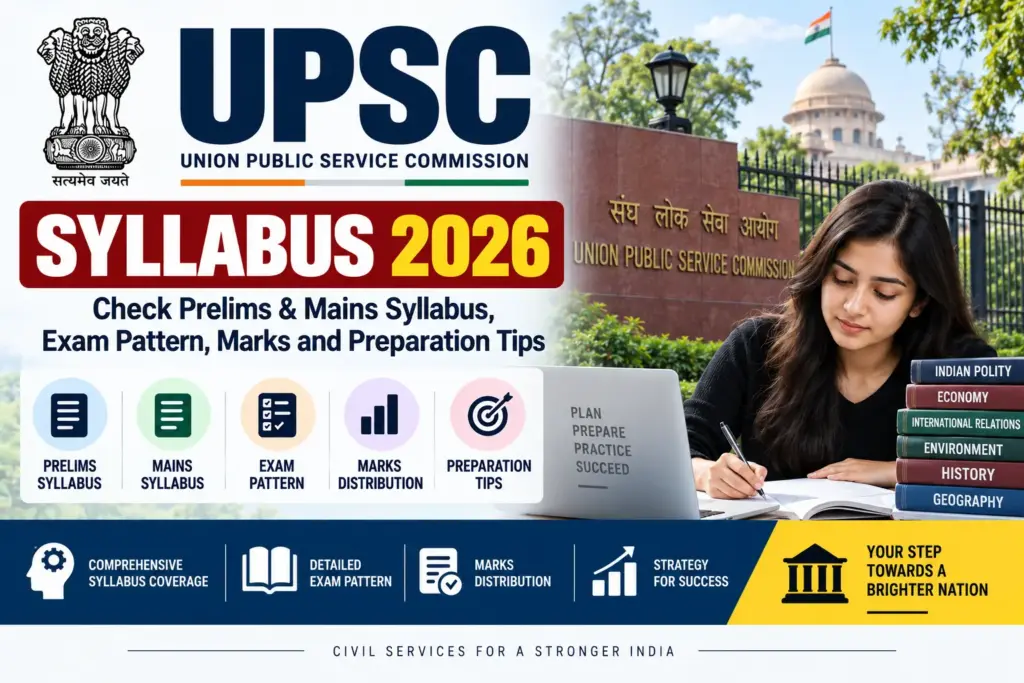
UPSC Syllabus 2026: Check Prelims & Mains Syllabus, Exam Pattern, Marks and Preparation Tips.The UPSC Civil Services Examination (CSE) is one of the most competitive government examinations in India. Every year, lakhs of aspirants prepare for the exam with the goal of securing prestigious services such as IAS, IPS, IFS and other Central Services.
Before starting preparation, understanding the UPSC Syllabus 2026 and Exam Pattern is extremely important. The syllabus may look lengthy in the beginning, but once it is divided into different stages and subjects, it becomes much easier to plan your preparation.
The UPSC CSE is conducted in three stages — Preliminary Examination, Main Examination and Personality Test (Interview).
In this article, we have explained the complete UPSC Syllabus 2026, exam pattern, subject-wise topics, marking scheme, selection process and preparation strategy in simple language.
Overview of UPSC Exam Pattern 2026
Candidates should first understand the overall structure of the examination.
| Stage | Papers | Exam Type | Marks |
|---|---|---|---|
| Prelims | 2 | Objective | 400 |
| Mains | 9 | Descriptive | 1750 |
| Personality Test | — | Interview | 275 |
| Final Merit | — | Mains + Interview | 2025 |
Important: Prelims is only a screening stage. Its marks are not added to the final merit list. The final merit is prepared on the basis of Mains and Personality Test marks.
UPSC Prelims Syllabus 2026
The Preliminary Examination is the first stage of the UPSC Civil Services Examination.
It consists of two compulsory papers:
- General Studies Paper I
- General Studies Paper II (CSAT)
Both papers carry 200 marks.
UPSC Prelims Exam Pattern
| Paper | Subject | Questions | Marks | Duration |
|---|---|---|---|---|
| Paper I | General Studies | 100 | 200 | 2 Hours |
| Paper II | CSAT | 80 | 200 | 2 Hours |
| Total | — | 180 | 400 | 4 Hours |
Important Points
- Both papers are objective-type.
- CSAT is qualifying in nature.
- Candidates need to secure 33% marks in CSAT.
- GS Paper I is used for determining the Prelims cutoff.
- Prelims marks are not counted towards the final merit.
- There is negative marking for incorrect answers.
UPSC Prelims Negative Marking 2026
Candidates need to be careful while attempting questions because UPSC follows a negative marking system in the Preliminary Examination.
For every incorrect answer, one-third of the marks assigned to that question is deducted.
For example:
- GS Paper I question: 2 marks
- Negative marking: approximately 0.66 marks
- CSAT question: 2.5 marks
- Negative marking: approximately 0.83 marks
There is no penalty for questions that are left unanswered.
Exam Tip: Avoid blind guessing. Try to attempt questions where you have a reasonable level of confidence.
UPSC Prelims GS Paper I Syllabus
General Studies Paper I covers several important areas. The syllabus includes both static subjects and current affairs.
1. Current Affairs
Candidates should regularly follow important developments related to:
- National events
- International events
- Government initiatives
- Important policies
- Major economic and social developments
2. History
Important areas include:
- History of India
- Indian National Movement
- Important historical events
- Major personalities and developments
3. Geography
The syllabus covers:
- Indian Geography
- World Geography
- Physical Geography
- Social Geography
- Economic Geography
4. Indian Polity and Governance
Candidates should prepare:
- Constitution
- Political system
- Panchayati Raj
- Public policy
- Rights issues
- Governance
5. Economic and Social Development
Important topics include:
- Sustainable development
- Poverty
- Inclusion
- Demographics
- Social sector initiatives
- Economic development
6. Environment and Ecology
This section covers:
- Environmental ecology
- Biodiversity
- Climate change
- Environmental issues
7. General Science
Questions can be asked from basic science as well as developments related to science and technology.
Important: Current affairs should not be prepared separately from static subjects. Try to connect current events with the relevant UPSC syllabus topics.
UPSC CSAT Syllabus 2026
The Civil Services Aptitude Test (CSAT) is the second paper of Prelims and is qualifying in nature.
Its major areas include:
- Reading comprehension
- Communication and interpersonal skills
- Logical reasoning
- Analytical ability
- Decision-making
- Problem-solving
- General mental ability
- Basic numeracy
- Data interpretation
- Charts and graphs
- Tables
- Data sufficiency
Basic numeracy and data interpretation are broadly based on Class 10 level concepts.
Important: CSAT is qualifying, but it should not be ignored. A candidate who fails to qualify CSAT cannot move ahead, even with a good GS Paper I score.
UPSC Mains Syllabus 2026
Candidates who qualify the Preliminary Examination are called for the Mains Examination.
Unlike Prelims, the Mains examination is descriptive. Candidates have to write detailed answers rather than selecting options.
The Mains examination consists of nine papers.
UPSC Mains Exam Pattern
| Paper | Subject | Marks | Nature |
|---|---|---|---|
| Paper A | Indian Language | 300 | Qualifying |
| Paper B | English | 300 | Qualifying |
| Paper I | Essay | 250 | Merit |
| Paper II | General Studies I | 250 | Merit |
| Paper III | General Studies II | 250 | Merit |
| Paper IV | General Studies III | 250 | Merit |
| Paper V | General Studies IV | 250 | Merit |
| Paper VI | Optional Subject Paper I | 250 | Merit |
| Paper VII | Optional Subject Paper II | 250 | Merit |
| Total | — | 1750 | — |
Each Mains paper is conducted for 3 hours.
UPSC Mains Essay Syllabus
The Essay paper carries 250 marks and is counted towards the final merit.
Essay preparation is different from preparing a conventional subject. Candidates should develop the ability to understand a topic, think from different perspectives and present their arguments in a logical manner.
A good essay should have:
- A clear introduction
- Logical arguments
- Multiple perspectives
- Relevant examples
- Proper paragraph flow
- A balanced conclusion
Preparation Tip: Don’t prepare only a handful of expected essay topics. Instead, practise writing on different themes so that you can handle an unfamiliar topic confidently in the actual examination.
UPSC Mains GS Paper I Syllabus
General Studies Paper I focuses mainly on Indian Heritage and Culture, History, Geography and Society.
Important Topics
Indian Heritage and Culture
- Indian art forms
- Literature
- Architecture
- Cultural heritage
Indian History
- Modern Indian history
- Indian freedom struggle
- Important personalities and events
- Post-independence developments
World History
- Industrial Revolution
- World Wars
- Colonization
- Decolonization
- Major political ideologies
Indian Society
- Diversity of India
- Women-related issues
- Population
- Poverty
- Urbanization
- Globalization
- Social empowerment
- Communalism
- Regionalism
- Secularism
Geography
- Physical geography
- Indian geography
- World geography
- Natural resources
- Industrial location
- Important geographical phenomena
UPSC Mains GS Paper II Syllabus
GS Paper II mainly covers Polity, Constitution, Governance, Social Justice and International Relations.
Important areas include:
- Indian Constitution
- Political system
- Parliament and State Legislatures
- Constitutional bodies
- Statutory bodies
- Governance
- Government policies
- Welfare schemes
- Social justice
- Issues related to vulnerable sections
- Transparency and accountability
- International relations
- India’s relations with other countries
- International organizations
Exam Tip: Don’t focus only on memorising constitutional provisions. Try to understand how constitutional provisions, governance issues and current affairs are connected.
UPSC Mains GS Paper III Syllabus
GS Paper III covers Economy, Agriculture, Science & Technology, Environment, Disaster Management and Internal Security.
Economy
- Indian economy
- Economic development
- Government budgeting
- Inclusive growth
- Liberalization
- Infrastructure
- Investment models
Agriculture
- Cropping patterns
- Irrigation
- Agricultural marketing
- Storage
- Transportation
- Farm subsidies
- Minimum Support Price
- Public Distribution System
- Food security
- Land reforms
- Food processing
Science and Technology
- Recent technological developments
- Space technology
- Information technology
- Robotics
- Biotechnology
- Nanotechnology
- Indigenous technologies
- Intellectual Property Rights
Environment
- Biodiversity
- Conservation
- Pollution
- Environmental degradation
- Environmental Impact Assessment
Disaster Management
- Disaster management
- Disaster-related laws
- Institutional mechanisms
Internal Security
- Cybersecurity
- Border security
- Terrorism
- Extremism
- Organized crime
- Money laundering
- Security agencies
UPSC Mains GS Paper IV Syllabus
GS Paper IV focuses on Ethics, Integrity and Aptitude.
The paper tests how candidates approach ethical situations, decision-making and public service responsibilities. Case studies are also an important component.
Major Topics
- Ethics and human values
- Attitude
- Emotional intelligence
- Integrity
- Probity
- Accountability
- Public service values
- Ethical dilemmas
- Moral thinkers and philosophers
- Decision-making
- Case studies
Preparation Tip: Practise case studies regularly. Instead of simply writing definitions, explain your reasoning and show how you would handle a difficult situation.
UPSC Optional Subject
Candidates have to choose one optional subject for the Mains examination.
The optional subject consists of two papers:
| Paper | Marks |
|---|---|
| Optional Paper I | 250 |
| Optional Paper II | 250 |
| Total | 500 |
The optional subject can make a significant difference to the Mains score, so candidates should select it carefully.
How to Choose the Optional Subject?
Consider the following before making your choice:
- Your interest in the subject
- Academic background
- Availability of study material
- Syllabus size
- Previous-year questions
- Availability of guidance
- Your comfort with answer writing
Remember: There is no single “best” optional subject for everyone. Choose the subject that you can understand, revise and write confidently.
UPSC Interview 2026
The Personality Test is the final stage of the Civil Services Examination.
It carries 275 marks and is designed to assess the candidate’s overall personality rather than simply testing factual knowledge.
Candidates may face questions related to:
- Educational background
- Optional subject
- Current affairs
- Home state and district
- Hobbies
- Interests
- National issues
- International developments
- Situational questions
- General awareness
Important: Be honest and composed during the Interview. If you don’t know the answer to something, it is generally better to acknowledge it rather than trying to bluff.
UPSC Prelims vs Mains
| Feature | Prelims | Mains |
|---|---|---|
| Purpose | Screening | Merit |
| Question Type | Objective | Descriptive |
| Papers | 2 | 9 |
| Marks | 400 | 1750 |
| Qualifying Paper | CSAT | Indian Language & English |
| Negative Marking | Yes | No objective-type negative marking |
| Marks Counted for Final Merit | No | Yes |
The biggest difference is that Prelims tests accuracy and elimination skills, while Mains tests knowledge, analysis and answer-writing ability.
UPSC Selection Process 2026
The UPSC selection process can be remembered in three simple stages.
Stage 1: Preliminary Examination
Candidates appear for GS Paper I and CSAT. They must clear the required GS cutoff and qualify CSAT.
Stage 2: Main Examination
Candidates who qualify Prelims appear for the nine-paper Mains examination.
The merit papers contribute 1750 marks.
Stage 3: Personality Test
Candidates shortlisted after Mains appear for the Personality Test, which carries 275 marks.
Final Merit
Mains: 1750 Marks + Interview: 275 Marks = 2025 Marks
The final merit list is prepared using these marks.
How to Prepare for UPSC Syllabus 2026?
The UPSC syllabus is undoubtedly extensive, but preparation becomes easier when you follow a structured approach.
1. Read the Syllabus First
Don’t start collecting books immediately. First understand what UPSC actually expects from you.
2. Build Your Basics
Focus on developing strong fundamentals in:
- History
- Geography
- Polity
- Economy
- Environment
- Science
3. Follow Current Affairs Smartly
You don’t need to remember every news story. Focus on issues that have a connection with the syllabus.
4. Solve Previous-Year Questions
PYQs can help you understand the actual difficulty level and the way UPSC frames questions.
5. Practise Answer Writing
For Mains, knowledge alone is not enough. You also need to communicate your thoughts clearly within the available time.
6. Take Mock Tests
Mock tests are particularly useful for improving:
- Speed
- Accuracy
- Time management
- Question selection
7. Revise Regularly
Repeated revision is one of the most important parts of UPSC preparation. Reading something once does not mean you have mastered it.
Important Points for UPSC Aspirants
Key Highlights
- UPSC CSE is conducted in three stages.
- Prelims has two objective papers.
- Each Prelims paper carries 200 marks.
- CSAT is qualifying with a 33% requirement.
- Prelims marks are not included in final merit.
- Mains consists of nine papers.
- Two Mains language papers are qualifying.
- Seven Mains papers contribute to merit.
- Mains carries 1750 marks.
- Personality Test carries 275 marks.
- Final merit is based on Mains + Interview = 2025 marks.