
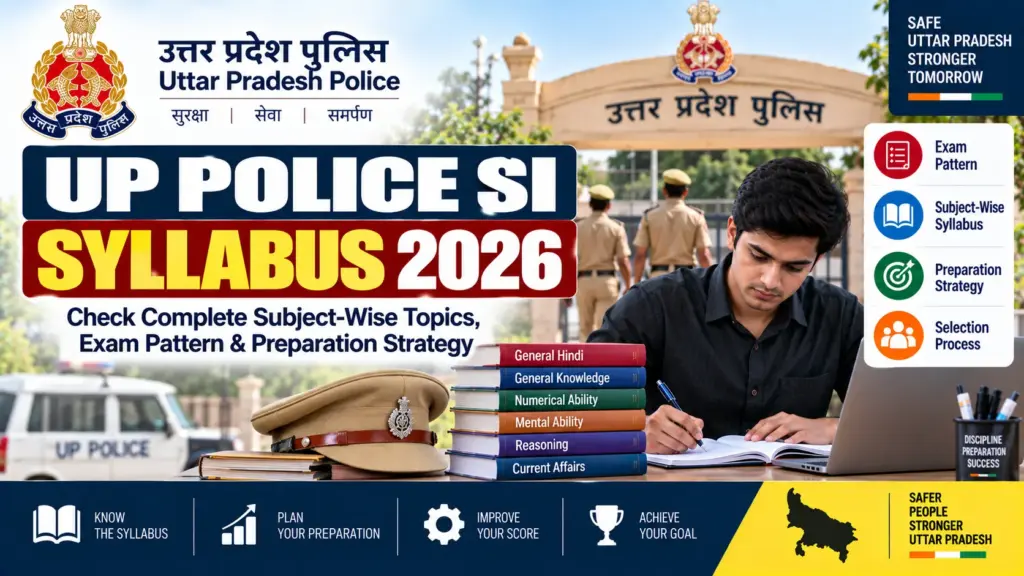
UP Police SI Syllabus 2026: Check Complete Subject-Wise Topics, Exam Pattern & Preparation Strategy.The UP Police Sub Inspector (SI) Exam 2026 is a competitive exam where preparation needs to be focused from the very beginning. Before starting with books, mock tests or current affairs, candidates should first understand the syllabus and exam pattern.
The UP Police SI written exam covers four sections — General Hindi, Fundamental Law/Constitution/General Knowledge, Numerical & Mental Ability, and Mental Aptitude/Intelligence/Reasoning Ability. The paper has 160 questions for 400 marks, with a total exam duration of 2 hours.
A clear understanding of the syllabus will help candidates decide what to study first, how much time to give to each subject and where more practice is required.
Overview of UP Police SI Syllabus 2026
| Particular | Details |
|---|---|
| Exam | UP Police Sub Inspector |
| Total Questions | 160 |
| Total Marks | 400 |
| Number of Sections | 4 |
| Questions in Each Section | 40 |
| Marks in Each Section | 100 |
| Marks for Each Question | 2.5 |
| Exam Duration | 2 Hours |
| Question Type | Objective |
| Negative Marking | No |
| Minimum Qualifying Marks per Section | 35% |
| Minimum Overall Marks | 50% |
Important: Candidates should prepare all four sections seriously. Scoring well in three subjects while ignoring one can create problems because the minimum qualifying requirement applies to individual sections as well.
UP Police SI Exam Pattern 2026
The written examination is divided equally among four sections. Each section contains 40 questions and carries 100 marks.
| Section | Subject | Questions | Marks |
|---|---|---|---|
| 1 | General Hindi | 40 | 100 |
| 2 | Fundamental Law / Constitution / General Knowledge | 40 | 100 |
| 3 | Numerical & Mental Ability | 40 | 100 |
| 4 | Mental Aptitude / Intelligence Quotient / Reasoning Ability | 40 | 100 |
| Total | 160 | 400 |
Each correct answer carries 2.5 marks. The written exam duration is 120 minutes.
The qualifying requirement mentioned for the examination is 35% marks in each section and 50% marks overall.
UP Police SI Syllabus 2026: Subject-Wise Topics
1. General Hindi Syllabus
General Hindi can be a scoring section if you have a strong command of grammar and vocabulary. Regular practice is more useful here than simply reading the rules again and again.
Important Topics
- Hindi and other Indian languages
- Hindi alphabet
- Hindi grammar
- Tatsam and Tadbhav
- Synonyms
- Antonyms
- One-word substitution
- Multiple-meaning words
- Sentence correction
- Gender
- Number
- Case
- Pronouns
- Adjectives
- Verbs
- Tenses
- Voice
- Prefix and suffix
- Sandhi
- Samas
- Punctuation
- Idioms and proverbs
- Rasa
- Chhand
- Alankar
- Unseen passages
- Famous poets and writers
- Famous literary works
- Hindi language awards
How to Prepare General Hindi
Start with basic grammar and gradually move towards vocabulary and comprehension.
A simple daily routine can include:
- 20–30 grammar questions
- Vocabulary revision
- Idioms and proverbs
- One unseen passage
- Revision of previous mistakes
Maintain a separate notebook for confusing words and grammar rules. This will be particularly useful during the final revision.
2. Fundamental Law, Constitution & General Knowledge
This is one of the widest sections in the UP Police SI syllabus. It combines law, Constitution, general studies, Uttar Pradesh-related topics and current affairs.
Fundamental Law
Candidates should prepare topics related to:
- Bharatiya Nyaya Sanhita (BNS)
- Bharatiya Nagarik Suraksha Sanhita (BNSS)
- Legal provisions for women and children
- Protection of Scheduled Caste members
- Traffic rules
- Environmental protection
- Wildlife protection
- Human rights
- Right to Information
- Income Tax
- Prevention of Corruption
- National Security
- Information Technology
- Cyber crime
- Public Interest Litigation
- Important judicial decisions
- Land reforms
- Land acquisition
- Land revenue-related laws
Don’t try to memorise everything in one sitting. Break the law syllabus into smaller topics and revise them regularly.
Indian Constitution
Important areas include:
- Objectives of the Constitution
- Fundamental Rights
- Directive Principles of State Policy
- Fundamental Duties
- Parliamentary system
- Central Government
- State Government
- Powers of Central and State Governments
- Law-making powers
- Local government
- Centre-State relations
- Elections
- Constitutional schedules
- All India Services
- Selection procedures
Preparation Tip
Constitutional topics become easier when you make short notes. Instead of repeatedly reading long chapters, prepare concise points that can be revised quickly.
General Knowledge
The General Knowledge portion covers several areas, including:
- General Science
- Health and health science
- Indian History
- Indian Freedom Movement
- Indian Economy
- Indian Culture
- Indian Agriculture
- Commerce and Trade
- Population
- Environment
- Urbanisation
- Foreign Direct Investment
- World Geography
- Indian Geography
- Natural resources
- National current affairs
- International current affairs
- Uttar Pradesh education and culture
- Social practices of Uttar Pradesh
- Uttar Pradesh revenue administration
- Police and general administration
- India and neighbouring countries
- Basic computer knowledge
- Information and Communication Technology
- Social media communication
Exam Tip
Don’t prepare GK only by reading random facts. Divide it into static GK, Uttar Pradesh-specific topics and current affairs. Revise each category separately.
3. Numerical & Mental Ability Syllabus
Mathematics is another section where regular practice can significantly improve performance.
Important Topics
- Number System
- Simplification
- Decimals
- Fractions
- HCF
- LCM
- Ratio and Proportion
- Percentage
- Profit and Loss
- Discount
- Simple Interest
- Compound Interest
- Partnership
- Average
- Time and Work
- Time and Distance
- Tables and Graphs
- Mensuration
- Arithmetical Computation
- Analytical Functions
- Miscellaneous problems
How to Prepare Maths
Don’t jump directly into difficult questions.
Begin with basic topics such as:
Number System → Simplification → Percentage → Ratio → Average
Then move towards:
Profit & Loss → Interest → Time & Work → Time & Distance → Mensuration
Once you understand a topic, solve questions under a time limit. This will gradually improve your calculation speed.
Preparation Tip: Keep a formula sheet and revise it regularly. A few minutes of formula revision every day can save a lot of time later.
4. Mental Aptitude, Intelligence & Reasoning Ability
This section tests your logical thinking, observation, problem-solving and decision-making ability.
Important Topics
- Relationship and Analogy
- Similarities and Differences
- Classification
- Series Completion
- Coding and Decoding
- Direction Sense
- Blood Relations
- Alphabet-based Questions
- Time Sequence
- Venn Diagrams
- Chart-based Questions
- Mathematical Ability
- Arranging in Order
- Logical Diagrams
- Symbol-Relationship Interpretation
- Perception Test
- Word Formation
- Letter and Number Series
- Common Sense Test
- Logical Interpretation of Data
- Forcefulness of Arguments
- Implied Meanings
- Problem Solving
- Analysis and Judgement
- Decision Making
- Visual Memory
- Observation
- Abstract Ideas and Symbols
How to Prepare Reasoning
Reasoning improves with practice. Once you understand the basic method for a particular topic, spend more time solving questions rather than repeatedly reading the theory.
Start slowly and focus on accuracy. After your accuracy improves, start working on speed.
UP Police SI Selection Process 2026
The recruitment process involves multiple stages:
- Written Examination
- Physical Standard Test (PST)
- Physical Efficiency Test (PET)
- Document Verification
- Medical Examination
The written examination is the main scoring stage, while the physical and subsequent stages are qualifying in nature.
Physical Preparation
Candidates should not wait for the written examination result before starting physical preparation.
Running, basic fitness and stamina building should be included in the routine from the beginning. This gives you enough time to improve gradually rather than rushing your preparation later.
How to Prepare for UP Police SI Exam 2026?
A good preparation strategy doesn’t mean sitting with books all day. What matters is having a realistic schedule that you can actually follow.
1. Understand the Syllabus First
Before starting your preparation, divide every subject into smaller topics.
For example:
Hindi: Grammar, Vocabulary, Comprehension
Law/GK: Law, Constitution, History, Geography, Current Affairs
Maths: Arithmetic, Percentage, Ratio, Profit & Loss, Time & Work
Reasoning: Series, Coding, Analogy, Blood Relations, Direction
This makes the syllabus much less intimidating.
2. Focus on Your Weak Areas
Most candidates naturally spend more time on their favourite subjects.
Try doing the opposite.
If Maths is difficult, give it regular daily practice. If Hindi grammar is weak, spend some time on it every day.
Your preparation should gradually turn weak subjects into manageable ones.
3. Practise Questions Every Day
Reading theory is important, but it is not enough.
After completing a topic, solve questions based on that topic. This will tell you whether you have actually understood the concept.
For Maths and Reasoning especially, daily practice is essential.
4. Make Short Notes
Your notes should help you revise, not become another textbook.
Make short notes for:
- Important legal provisions
- Constitution facts
- Maths formulas
- Hindi vocabulary
- Reasoning tricks
- Current affairs
- Important GK facts
Keep them organised subject-wise.
5. Take Mock Tests
Once you have completed the basic concepts, start taking mock tests.
Initially, take sectional tests. Later, move towards full-length papers.
After every mock, analyse your performance carefully.
Ask yourself:
- Which questions did I get wrong?
- Which topics are still weak?
- Where did I waste time?
- Did I make avoidable mistakes?
- Which section needs more practice?
The analysis is often more valuable than the score itself.
60-Day Preparation Plan for UP Police SI
Days 1–20: Build the Basics
Focus on:
- Hindi grammar
- Basic Maths
- Basic Reasoning
- Constitution
- Fundamental Law
- Indian History
- Geography
- Uttar Pradesh-related topics
- Current Affairs
The goal should be to understand the concepts properly.
Days 21–40: Increase Practice
Now start increasing your question-solving practice.
Focus on:
- Previous questions
- Sectional tests
- Maths practice
- Reasoning practice
- Law revision
- Constitution revision
- Current affairs
- Weak topics
Try to improve accuracy first and speed gradually.
Days 41–60: Full-Length Practice
The final stage should focus mainly on revision and mock tests.
Take full-length tests regularly and analyse them properly.
Your focus should now be:
Revision + Accuracy + Speed
Avoid starting multiple new books during the final days.
Daily Study Timetable
A simple timetable could look like this:
| Subject/Activity | Suggested Time |
|---|---|
| General Hindi | 1 Hour |
| Law & Constitution | 1.5 Hours |
| GK & Current Affairs | 1 Hour |
| Mathematics | 1 Hour |
| Reasoning | 1 Hour |
| Revision/Practice Test | 1 Hour |
| Physical Exercise | 30–45 Minutes |
You can increase or decrease these timings depending on your daily routine.
The important thing is to study consistently rather than following an unrealistic timetable for two or three days and then giving up.
Common Mistakes to Avoid
Don’t Ignore Any Section
All four sections are important. Give additional time to weak subjects instead of avoiding them.
Don’t Leave Law for the End
Law is a broad area, so it should be studied from the beginning.
Don’t Depend Only on Reading
Solve questions after studying every major topic.
Don’t Take Mock Tests Casually
Always analyse your mistakes after a test.
Don’t Collect Too Much Study Material
Too many books can create confusion. Choose suitable material and revise it multiple times.
Don’t Forget Physical Preparation
Written preparation and physical preparation should go together.