
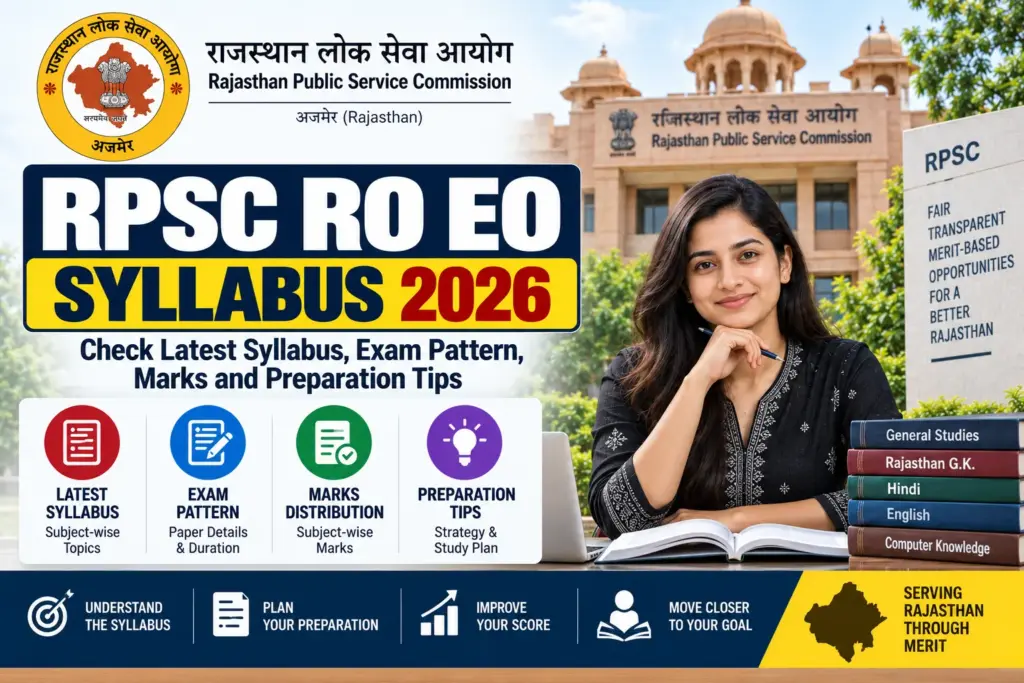
RPSC RO EO Syllabus 2026: Check Latest Syllabus, Exam Pattern, Marks and Preparation Tips.Preparing for the RPSC Revenue Officer (RO) and Executive Officer (EO) Exam 2026 becomes much easier when you know exactly what to study and how the question paper is structured. The syllabus covers a mix of Rajasthan General Knowledge, History, Art and Culture, Geography, Indian Constitution, Governance, Current Affairs, Municipal Laws and Urban Development Schemes.
The written examination consists of 120 objective questions for 120 marks, and candidates get 2 hours to complete the paper. There is also negative marking, so preparation should focus not only on knowledge but also on accuracy.
Important: The RPSC RO EO syllabus has two clearly defined parts. Part A is mainly General Knowledge, while Part B focuses on Rajasthan municipal administration and urban schemes.
RPSC RO EO Exam Pattern 2026
The exam pattern is simple, but candidates should understand the distribution of questions before starting preparation.
| Part | Subject | Questions | Marks |
|---|---|---|---|
| Part A | General Knowledge | 80 | 80 |
| Part B | Rajasthan Municipalities Act, Rules & Urban Schemes | 40 | 40 |
| Total | — | 120 | 120 |
Key Details
- Total Questions: 120
- Total Marks: 120
- Exam Duration: 2 Hours
- Question Type: Objective/MCQ
- Part A: 80 questions
- Part B: 40 questions
- Negative Marking: 1/3 mark for each incorrect answer
- Exam Level: Graduation level
Exam Tip: Since one-third mark is deducted for every wrong answer, don’t make random guesses. Practice enough mock questions to improve both speed and accuracy.
RPSC RO EO Syllabus 2026
The syllabus is divided into two sections:
Part A – General Knowledge
This section covers:
- Rajasthan History
- Rajasthan Art and Culture
- Rajasthan Literature and Heritage
- Rajasthan Geography
- Indian Constitution
- Indian Political System
- Governance
- Rajasthan Political and Administrative System
- Public Policy and Rights
- Current Affairs
Part B – Municipal Administration
This section includes:
- Rajasthan Municipalities Act, 2009
- Municipal Rules
- Municipal Finance and Revenue
- Urban Planning
- Municipal Powers and Functions
- Important Urban Schemes
Part A: General Knowledge Syllabus
1. Rajasthan History, Art, Culture, Literature and Heritage
Rajasthan’s history and culture form a major part of the syllabus. Candidates should study this section carefully because it covers a wide range of topics.
History of Rajasthan
Important topics include:
- Prehistoric sites of Rajasthan
- Paleolithic, Chalcolithic and Bronze Age
- Important historical centres
- Society, religion and culture of ancient Rajasthan
- Major dynasties and rulers
- Guhil/Guhila
- Pratihara
- Chauhan
- Parmar
- Rathore
- Sisodia
- Kachhawa
- Medieval administrative and revenue systems
- Rise of modern Rajasthan
- Social awakening during the 19th and 20th centuries
- Political awakening
- Role of newspapers and political organisations
- Tribal movements
- Peasant movements
- Prajamandal movements
- Integration and unification of Rajasthan
Preparation Tip: Don’t try to memorize Rajasthan history in one go. Divide it into ancient, medieval and modern Rajasthan and prepare short notes for each period.
Art and Architecture
Prepare topics related to:
- Temples
- Forts
- Palaces
- Traditional water structures
- Painting styles
- Handicrafts
- Architectural traditions
Performing Arts
The syllabus includes:
- Classical music
- Classical dance
- Folk music
- Musical instruments
- Folk dances
- Folk drama and theatre
Language and Literature
Candidates should study:
- Rajasthani language and its dialects
- Rajasthani literature
- Folk literature
Religious and Social Life
Important areas include:
- Religious communities
- Saints and sects
- Folk deities
- Fairs and festivals
- Social customs
- Traditional practices
- Costumes
- Jewellery and ornaments
- Important personalities
Heritage and Tourism
Also revise:
- Historical tourist places
- Heritage sites
- Important tourist circuits
2. Geography of Rajasthan
Rajasthan Geography is another important section and should be prepared with maps wherever possible.
Topics include:
- Major physiographic regions
- Physical features
- Climate
- Major rivers
- Lakes
- Natural vegetation
- Soil
- Major crops
- Irrigation projects
- Water conservation
- Population growth
- Population density
- Literacy
- Sex ratio
- Major tribes
- Metallic and non-metallic minerals
- Conventional energy resources
- Non-conventional energy resources
- Biodiversity
- Conservation
- Major industries
- Tourist places and circuits
- Mineral resources
Major Crops to Study
The syllabus specifically mentions:
- Wheat
- Maize
- Barley
- Cotton
- Sugarcane
- Millet/Bajra
Exam Tip: Make a separate Rajasthan map and mark important rivers, lakes, irrigation projects, mineral areas, industries, wildlife areas and tourist destinations.
3. Indian Constitution, Political System and Governance
This section tests your understanding of India’s constitutional and political system.
Indian Constitution
Study:
- Constituent Assembly
- Features of the Constitution
- Constitutional amendments
- Preamble
- Fundamental Rights
- Directive Principles of State Policy
- Fundamental Duties
Indian Political System
Important topics include:
- President
- Prime Minister
- Council of Ministers
- Parliament
- Supreme Court
- Judicial Review
- Election Commission
- Comptroller and Auditor General
- NITI Aayog
- Central Vigilance Commission
- Lokpal
- Central Information Commission
- National Human Rights Commission
- Federalism
- Democratic politics
- Coalition governments
- National integration
4. Rajasthan Political and Administrative System
Candidates should also understand the functioning of the Rajasthan government and administration.
Political System
Prepare:
- Governor
- Chief Minister
- Council of Ministers
- Rajasthan Legislative Assembly
- High Court
Administrative System
Important topics include:
- District administration
- Local self-government
- Panchayati Raj institutions
State Institutions
Study the role and functions of:
- Rajasthan Public Service Commission
- State Human Rights Commission
- Lokayukta
- State Election Commission
- State Information Commission
5. Public Policy and Rights
This part includes:
- Public policy
- Legal rights
- Citizen’s Charter
- Transparency and accountability
- Rajasthan Public Services Guarantee Act, 2011
Candidates should understand these topics conceptually instead of simply memorizing definitions.
6. Current Affairs
Current Affairs covers developments related to:
- Rajasthan
- India
- International events
- Important people in the news
- Important places
- Organisations and institutions
- Sports
- Major sports activities and achievements
Preparation Tip: Give special attention to Rajasthan current affairs. Read monthly current-affairs notes and revise them regularly instead of waiting until the last month.
Part B: Rajasthan Municipalities Act, 2009
Part B is especially important for RO and EO aspirants because it is directly related to municipal administration.
The major areas include:
Rajasthan Municipalities Act, 2009
Prepare:
- Constitution and governance of municipalities
- Formation of municipal bodies
- Conduct of municipal business
- Ward committees
- Municipal property
- Municipal finance
- Municipal funds
- Municipal revenue
- Municipal development
- Urban planning
- Powers of municipalities
- Offences
- Prosecution
- Suits
- Control
Important: This section should not be treated like ordinary GK. Read the municipal law topic-wise and make short revision notes.
Rajasthan Municipal Rules
Candidates should also prepare the important rules associated with municipal administration.
Rajasthan Municipalities (General Purchase and Contract) Rules, 1974
Focus on:
- Purchase procedures
- Contracts
- Procurement-related provisions
Rajasthan Municipalities (Conduct of Business) Rules, 2009
Focus on:
- Conduct of meetings
- Municipal business
- Decision-making
Rajasthan Municipalities (Powers, Duties and Functions of Committees) Rules, 2009
Prepare:
- Committee structure
- Powers
- Duties
- Functions
- Working of committees
Important Urban Schemes for RPSC RO EO
The syllabus includes several important schemes related to urban areas.
Candidates should prepare:
- Swachh Bharat Mission (Urban)
- Indira Rasoi Yojana
- Pradhan Mantri Awas Yojana (Urban)
- Indira Gandhi Urban Employment Guarantee Scheme
- AMRUT – Atal Mission for Rejuvenation and Urban Transformation
- National Urban Livelihood Mission (NULM)
- Indira Gandhi Credit Card Yojana
For each scheme, try to remember its objective, beneficiaries, major features and implementation-related details.
RPSC RO EO Subject-Wise Preparation Strategy
A smart preparation strategy is more useful than simply studying for long hours.
Start With Rajasthan GK
Begin with:
History → Culture → Geography → Polity → Current Affairs
Once your basics are clear, move towards municipal law.
Give Separate Time to Part B
Don’t leave the Rajasthan Municipalities Act for the final days. Read it regularly and revise important provisions multiple times.
Practice Questions Every Day
Try solving MCQs after completing each topic. This will help you understand the type of questions you can expect and will also improve your speed.
Revise More Than You Read
Government exam preparation often becomes difficult because candidates keep collecting new material but don’t revise what they have already studied.
A better cycle is:
Study → Make Notes → Practice MCQs → Revise → Take Mock Test
RPSC RO EO Daily Study Plan
A simple daily routine could look like this:
| Subject | Suggested Time |
|---|---|
| Rajasthan History & Culture | 2 Hours |
| Rajasthan Geography | 1–1.5 Hours |
| Constitution & Governance | 1 Hour |
| Municipal Act & Rules | 1.5–2 Hours |
| Current Affairs | 45 Minutes |
| MCQ Practice | 1 Hour |
| Revision | 30 Minutes |
You don’t have to follow these timings exactly. The important thing is to maintain consistency.
How to Improve Your Score in RPSC RO EO Exam
1. Complete the syllabus before chasing extra material
First finish the prescribed topics. Additional books and study material should come later.
2. Make Rajasthan-specific short notes
Prepare separate notes for:
- Dynasties
- Historical movements
- Folk dances
- Festivals
- Literature
- Rivers
- Lakes
- Minerals
- Tribes
- Industries
- Irrigation projects
3. Learn municipal law through headings
Instead of reading the entire Act repeatedly, divide it into:
Municipalities → Committees → Property → Finance → Revenue → Planning → Powers → Offences → Prosecution
This makes revision much faster.
4. Take regular mock tests
Mock tests help you identify whether your problem is:
- Lack of knowledge
- Slow solving speed
- Careless mistakes
- Guessing
- Poor time management
5. Maintain an error notebook
Whenever you answer a question incorrectly, write down the correct information. Revise this notebook every few days.
Remember: Your mistakes in mock tests are useful if you learn from them. Repeating the same mistake in the actual examination is what you need to avoid.
RPSC RO EO Syllabus 2026: Important Points at a Glance
Key Highlights
- The written exam has 120 questions.
- The paper carries 120 marks.
- Exam duration is 2 hours.
- Part A contains 80 questions.
- Part B contains 40 questions.
- Each question carries 1 mark.
- There is 1/3 negative marking for incorrect answers.
- Rajasthan History, Art, Culture and Geography are major areas.
- Indian Constitution and Governance are included in Part A.
- Current Affairs covers Rajasthan, national and international developments.
- Part B focuses on the Rajasthan Municipalities Act, 2009, municipal rules and urban schemes.