
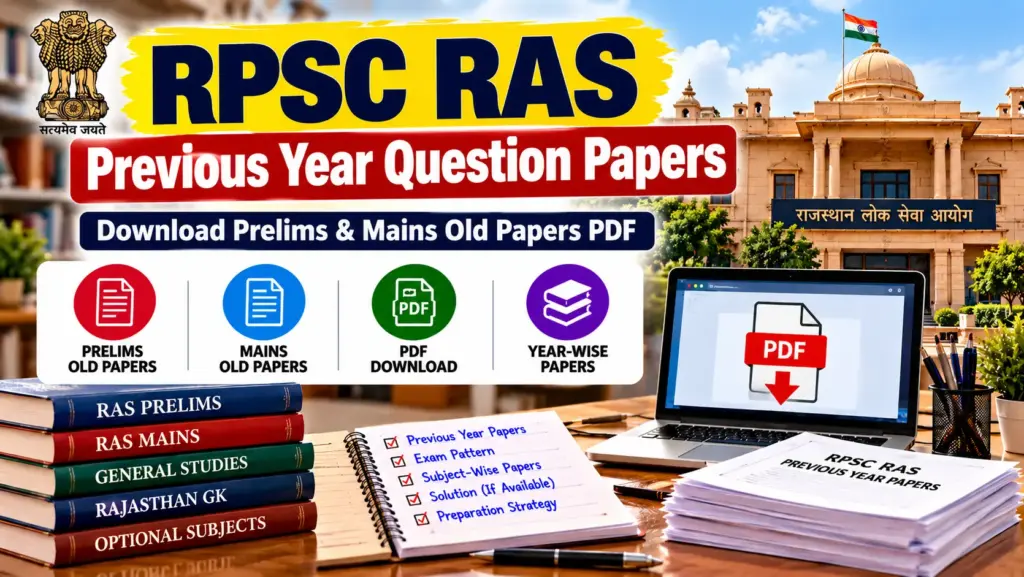
RPSC RAS Previous Year Question Papers 2026: Download Prelims & Mains Old Papers PDF.The RPSC RAS Previous Year Question Papers are among the most useful resources for candidates preparing for the Rajasthan Administrative Service examination. While completing the syllabus is important, it is equally necessary to understand how questions are framed in the actual examination.
Old question papers give candidates a chance to practise with real exam-style questions, understand the level of preparation required and identify the areas where they need more work. Instead of waiting until the final stage of preparation, aspirants can start using previous year papers alongside their regular studies.
This article covers RPSC RAS Prelims and Mains Previous Year Question Papers, available year-wise papers, their benefits and the right way to use them during preparation.
RPSC RAS Previous Year Question Papers
Previous year question papers provide a practical picture of the examination. A candidate may complete a chapter from a book and feel confident about the topic, but attempting questions from an actual RAS paper can give a much clearer idea of whether that preparation is sufficient.
The available previous year paper collections include papers from different RAS examination years for both Prelims and Mains. Candidates can use them for practice, revision and self-assessment.
The most important thing is not simply to collect PDFs. Candidates should actually solve the papers, check their performance and analyse their mistakes.
RPSC RAS Prelims Previous Year Question Papers
The RAS Prelims examination consists of objective-type questions. Because candidates have to deal with a large number of questions within a fixed period, regular practice is important.
Previous year Prelims papers can help aspirants become comfortable with the question format and improve their speed and accuracy.
The available collections include RAS Prelims papers from several years, including:
| Year | Previous Year Paper |
|---|---|
| 2024 | RPSC RAS Prelims Question Paper |
| 2023 | RPSC RAS Prelims Question Paper |
| 2021 | RPSC RAS Prelims Question Paper |
| 2018 | RPSC RAS Prelims Question Paper |
| 2016 | RPSC RAS Prelims Question Paper |
| 2013 | RPSC RAS Prelims Question Paper |
Some collections also contain a separate 2018 TSP paper and multiple versions of the 2013 paper. Candidates should select the paper applicable to their preparation.
RPSC RAS Mains Previous Year Question Papers
RAS Mains preparation requires a different approach because the examination includes descriptive papers. Candidates have to do more than remember information; they need to present relevant points clearly within the given time.
Previous year Mains papers are therefore useful for practising answer writing and understanding the way questions are structured.
The available material includes four Mains papers for several examination years:
| Year | Papers Available |
|---|---|
| 2024 | Paper 1, Paper 2, Paper 3, Paper 4 |
| 2023 | Paper 1, Paper 2, Paper 3, Paper 4 |
| 2021 | Paper 1, Paper 2, Paper 3, Paper 4 |
| 2018 | Paper 1, Paper 2, Paper 3, Paper 4 |
| 2016 | Paper 1, Paper 2, Paper 3, Paper 4 |
| 2013 | Paper 1, Paper 2, Paper 3, Paper 4 |
A separate TSP set is also available in the provided paper collection for 2018.
Why Should You Solve RPSC RAS Previous Year Papers?
There is a big difference between reading about an examination and actually attempting its questions. Previous year papers help bridge that gap.
Understand the Exam Pattern
Old papers allow candidates to become familiar with the structure of questions and the overall nature of the examination.
After solving several papers, aspirants can better understand how questions are presented and what is expected from them.
Identify Important Topics
Going through papers from different years can help candidates identify subjects and areas that have been tested previously.
This does not mean that the same questions will be repeated. Instead, the analysis can help candidates understand the broader areas that deserve attention during revision.
Improve Speed and Accuracy
For Prelims, time management can make a significant difference. Candidates should practise solving complete papers within the prescribed time.
With regular practice, they can identify questions that take too much time and learn when it is better to move on rather than remain stuck on a single question.
Improve Answer Writing
For Mains candidates, previous year questions can be converted into an answer-writing practice set.
Pick a question, set the appropriate time limit and write the answer as you would in the examination hall. Afterwards, check whether the answer is relevant, properly structured and covers the important points.
Find Weak Areas
One of the biggest advantages of PYQs is that they expose gaps in preparation.
A candidate may discover that a particular topic looks easy while reading but becomes difficult when questions are asked from it. Such observations can help in planning another round of revision.
RPSC RAS Exam Pattern
The RAS examination is conducted through Prelims, Mains and Interview stages.
The provided exam-pattern material describes the Prelims as an objective examination and the Mains as a descriptive examination.
The listed Prelims pattern includes:
- 150 questions
- 200 marks
- 3 hours duration
The listed Mains pattern consists of four papers:
- General Studies-I – 200 marks
- General Studies-II – 200 marks
- General Studies-III – 200 marks
- General Hindi & General English – 200 marks
Each Mains paper is listed with a duration of three hours.
Candidates should always check the latest RPSC notification before relying on the examination pattern for an upcoming recruitment cycle.
How to Use RPSC RAS Previous Year Papers Effectively?
Simply downloading previous year papers will not improve your preparation. The real benefit comes from analysing them properly.
Step 1: Study the Topic First
Before attempting a large number of questions, develop a basic understanding of the relevant topic from your study material.
Step 2: Solve Questions Without Help
Keep your books and notes aside while attempting the paper. This gives you a realistic idea of your preparation level.
Step 3: Set a Timer
Try to solve the paper within the prescribed examination time. Avoid unnecessary breaks during the test.
Step 4: Check Your Answers
Once the paper is completed, check the answers and calculate your score where applicable.
Step 5: Analyse Your Mistakes
Do not simply mark a question as wrong and move on.
Try to understand why the mistake happened:
- Was the concept unclear?
- Did you forget an important fact?
- Did you misunderstand the question?
- Did you make a careless mistake?
- Did you spend too much time on it?
Step 6: Revise the Weak Area
Once the reason for the mistake is clear, return to that topic and revise it.
Step 7: Reattempt the Question
After revision, attempt the difficult questions again. This helps you check whether the problem has actually been resolved.
RPSC RAS Previous Year Papers for Mains Answer Writing
Mains preparation deserves special attention because simply reading previous papers does not develop answer-writing skills.
Candidates can select questions from old papers and practise writing answers regularly.
While writing, focus on:
- Understanding exactly what the question is asking
- Staying relevant to the topic
- Organising the answer properly
- Using suitable examples and facts
- Maintaining clarity
- Completing the answer within the available time
The objective should not be to make every answer unnecessarily lengthy. Instead, the answer should contain relevant information presented in a clear and organised manner.
Previous Year Papers vs Mock Tests
Previous year papers and mock tests are useful for different purposes.
Previous Year Papers help candidates understand questions from earlier examinations and analyse the nature of the paper.
Mock Tests provide additional practice and can be used to simulate examination conditions.
A practical preparation routine can therefore include:
Syllabus → Concept Preparation → Previous Year Papers → Revision → Mock Tests → Performance Analysis
Common Mistakes While Solving RAS PYQs
Many candidates make the mistake of solving a paper, checking the score and immediately moving to the next one.
Avoid this approach.
Some common mistakes include:
- Solving papers without a timer
- Looking at answers before completing the paper
- Memorising answers instead of understanding concepts
- Ignoring incorrect answers
- Not revising weak topics
- Focusing only on the final score
- Reading Mains papers without actually writing answers
- Depending completely on old papers while ignoring the latest syllabus
How Many RAS Previous Year Papers Should You Solve?
There is no fixed number that works for every candidate.
The focus should be on quality of practice rather than simply counting papers. It is better to thoroughly analyse a paper and learn from mistakes than to solve several papers without reviewing them.
Candidates should also give greater importance to papers that are closer to the current syllabus and examination pattern.
Older papers can still be useful for additional practice and understanding the nature of the examination, but they should not replace the latest official syllabus and notification.
Simple RAS PYQ Preparation Strategy
A straightforward approach can make previous year papers much more effective:
Study → Solve → Check → Analyse → Revise → Reattempt
For Prelims, gradually move from topic-wise practice to full-length papers.
For Mains, start with individual answer-writing practice and eventually attempt complete papers within the prescribed time.
This approach allows candidates to identify problems early instead of discovering them shortly before the examination.