
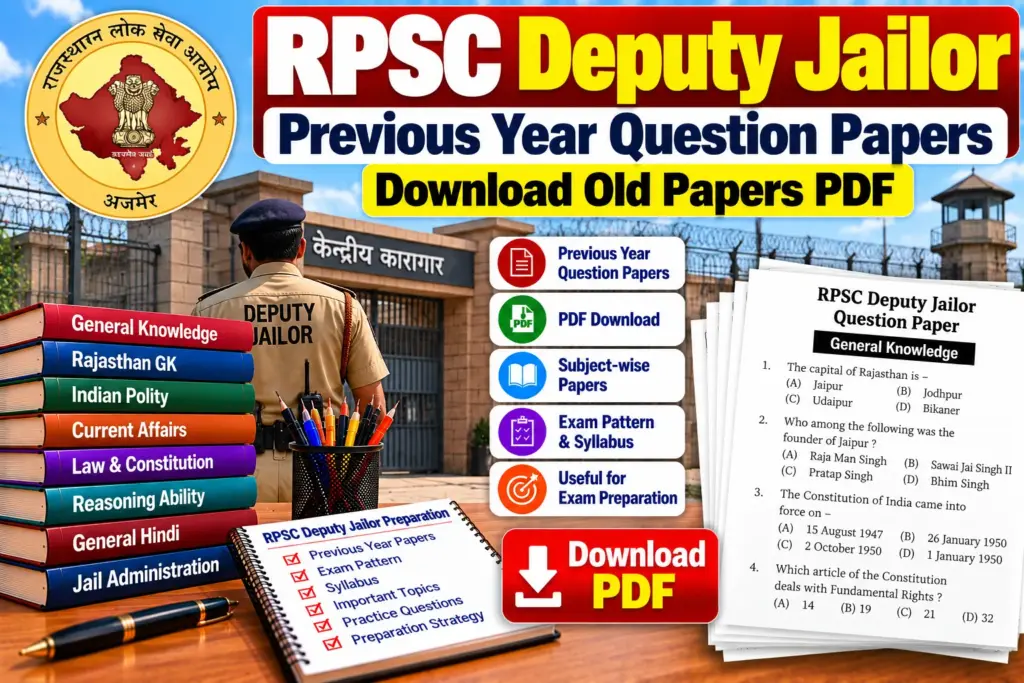
RPSC Deputy Jailor Previous Year Question Papers: Download Old Papers PDF.Preparing for the RPSC Deputy Jailor exam becomes much easier when you know what the actual examination paper looks like. The syllabus tells you what to study, but previous year papers show you how those topics are actually asked in the exam.
Solving RPSC Deputy Jailor Previous Year Question Papers can help candidates understand the question pattern, difficulty level, time management and areas that need more revision. The available collection includes papers for both Paper 1 and Paper 2, along with the latest 2025 question papers.
RPSC Deputy Jailor Previous Year Question Papers
The RPSC Deputy Jailor written examination includes two papers:
- Paper 1 – General Hindi
- Paper 2 – General Knowledge & General Science
Candidates should practise both papers rather than concentrating on only one. Regular practice also helps in becoming comfortable with the different types of questions asked in the examination.
RPSC Deputy Jailor 2025 Question Papers
The latest available question papers are from the 2025 examination, which was held on 13 July 2025.
| Paper | Subject | Exam Date |
|---|---|---|
| Paper 1 | General Hindi | 13 July 2025 |
| Paper 2 | General Knowledge & General Science | 13 July 2025 |
These papers can be particularly useful for candidates preparing for future RPSC Deputy Jailor recruitment because they provide a recent example of the examination.
RPSC Deputy Jailor Exam Pattern
The available exam-pattern material describes the written examination as follows:
| Paper | Subject | Questions | Marks | Duration |
|---|---|---|---|---|
| Paper 1 | General Hindi | 150 | 200 | 3 Hours |
| Paper 2 | General Knowledge & General Science | 150 | 200 | 3 Hours |
The provided material mentions 1/3 negative marking for each incorrect answer.
Because negative marking is involved, candidates should focus on both speed and accuracy instead of attempting questions randomly.
RPSC Deputy Jailor 2025 Question Paper
The RPSC Deputy Jailor 2025 Question Paper is one of the most useful papers for current preparation.
Candidates who appeared in the examination can use it to analyse their performance. Those preparing for future recruitment can treat it as a full-length practice paper and understand the level of questions asked.
The 2025 collection contains:
- General Hindi Paper 1
- General Knowledge & General Science Paper 2
Both papers were conducted on 13 July 2025.
Why Should You Solve RPSC Deputy Jailor Previous Year Papers?
Previous year papers are useful for much more than simply practising questions.
Understand the Actual Question Pattern
The syllabus tells you what subjects to cover, but previous papers show you how questions are framed from those subjects.
After solving a few papers, you begin to recognise the style and structure of the examination.
Identify Your Weak Areas
Sometimes a topic feels easy while reading notes but becomes difficult when you face an actual question.
Previous papers help you find these gaps in your preparation.
Improve Time Management
A candidate can know the correct answer and still lose marks by spending too much time on one question.
Practising complete papers under timed conditions helps you learn when to continue with a question and when to move ahead.
Improve Accuracy
Negative marking makes careless attempts costly. Regular PYQ practice helps you become more selective and accurate.
Build Confidence
The first full-length paper may feel difficult. After several attempts, the same examination format starts feeling familiar.
That familiarity can reduce pressure on the actual exam day.
How to Use RPSC Deputy Jailor Previous Year Papers
Don’t simply download several PDFs and leave them aside. The real benefit comes from solving and analysing them properly.
Step 1: Start With the Latest Paper
Begin with the 2025 General Hindi paper and General Knowledge & General Science paper.
Step 2: Solve Without Looking at the Answers
Keep your books and notes aside while attempting the paper.
Step 3: Use a Timer
Try to create an examination-like environment and complete the paper within the prescribed time.
Step 4: Check Your Answers
Once you finish, check your answers and calculate your score.
Step 5: Analyse Every Mistake
Don’t stop after seeing the score. Go through every wrong answer and understand why you made the mistake.
Step 6: Revise the Weak Topic
Return to the relevant chapter or topic and revise it properly.
Step 7: Attempt Another Paper
After revision, solve another paper and check whether your accuracy has improved.
This simple cycle works well:
Solve → Analyse → Revise → Solve Again
Important Topics to Focus On
While analysing previous papers, candidates should pay attention to areas such as:
- Rajasthan General Knowledge
- Indian History
- Indian Polity
- Geography
- General Science
- Current Affairs
- Logical Reasoning and Mental Ability
- Constitution
- Law
- Administrative Structure
- General Hindi
The purpose of previous papers is not to memorise every question. Instead, use them to understand which topics require more attention.
Don’t Just Memorise Previous Questions
This is an important point.
If you find a question in a previous paper, don’t simply remember its answer and move on. Try to understand the concept behind it.
A similar concept can appear in a completely different form in the actual examination.
For example, if a question helps you identify an important topic in Indian Polity, revise that entire topic rather than memorising only that one question.
Make a Separate Mistake Notebook
A mistake notebook can make your revision much easier.
Whenever you get a question wrong, write down:
- Topic
- Question
- Your answer
- Correct answer
- Reason for the mistake
- Important concept
Keep separate sections for General Hindi, General Knowledge and General Science if that makes revision easier.
Before the examination, this notebook can become a quick revision resource containing exactly the areas where you have struggled.
Don’t Focus Only on Your Score
Your score is important, but it isn’t the only thing you should look at.
After every paper, ask yourself:
- How many questions did I get wrong?
- How many questions did I guess?
- Which topics caused the most mistakes?
- Did I waste time on difficult questions?
- Was my problem knowledge, speed or accuracy?
- Did I make avoidable mistakes?
These answers will tell you much more about your preparation than the score alone.
Practice Both Papers
Candidates should give proper attention to both sections of the written examination.
It is easy to spend more time on the subject you enjoy and postpone the other one. That approach can create an unnecessary weakness.
Make General Hindi and General Knowledge & General Science part of your regular practice schedule.
How Many Previous Year Papers Should You Solve?
There is no fixed number that guarantees success.
If your preparation time is limited, start with the latest 2025 papers and analyse them thoroughly. After that, move towards the older papers available to you.
If you have more time, solve additional previous papers and use them as full-length tests.
Remember:
Five papers solved carefully are more useful than ten papers solved casually.
Common Mistakes Candidates Should Avoid
While practising previous year papers, avoid these mistakes:
- Checking answers while solving
- Solving without a timer
- Focusing only on the final score
- Guessing too many questions
- Ignoring negative marking
- Not analysing wrong answers
- Preparing only one paper
- Repeating the same mistakes
- Spending too much time on one difficult question