
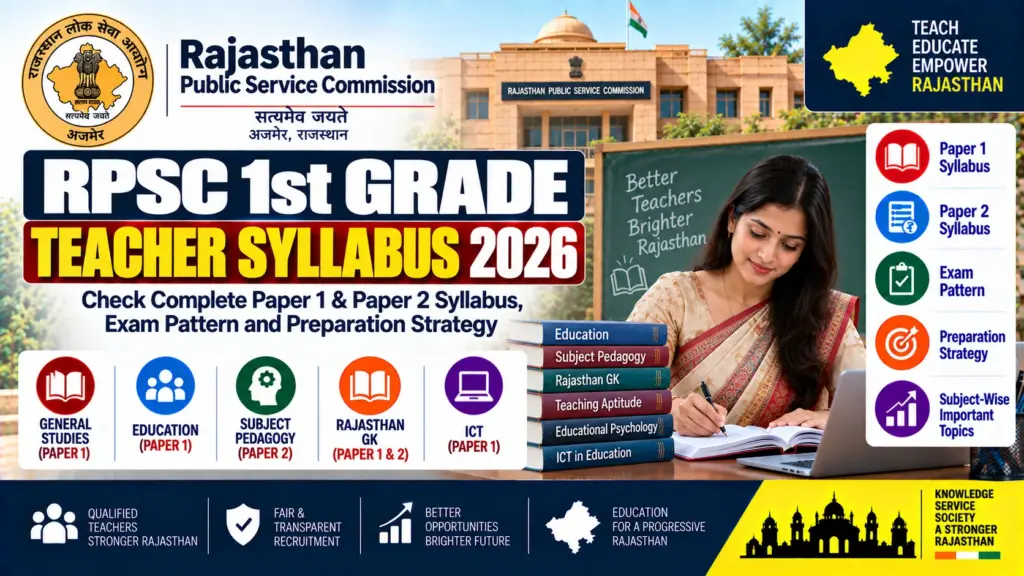
RPSC 1st Grade Teacher Syllabus 2026: Check Complete Paper 1 & Paper 2 Syllabus, Exam Pattern and Preparation Strategy.Preparing for the RPSC 1st Grade Teacher Exam 2026 becomes much easier when you know exactly what you need to study. The syllabus is fairly detailed, and trying to cover everything without a proper plan can quickly become overwhelming. That is why candidates should first understand the exam pattern and then divide the syllabus into smaller, manageable sections.
The RPSC 1st Grade Teacher examination consists of two papers. Paper 1 covers General Awareness and General Studies, while Paper 2 focuses on the subject chosen by the candidate. Paper 2 carries twice the marks of Paper 1, so it deserves special attention during preparation.
In this article, you will find the complete RPSC 1st Grade Teacher Syllabus 2026, exam pattern, important topics and a practical preparation strategy.
Overview of RPSC 1st Grade Teacher Syllabus 2026
| Particulars | Details |
|---|---|
| Exam Name | RPSC 1st Grade Teacher / School Lecturer |
| Conducting Body | Rajasthan Public Service Commission |
| Total Vacancies | 3,225 |
| Number of Papers | 2 |
| Paper 1 | General Awareness & General Studies |
| Paper 2 | Subject Specific |
| Paper 1 Questions | 75 |
| Paper 1 Marks | 150 |
| Paper 2 Questions | 150 |
| Paper 2 Marks | 300 |
| Total Marks | 450 |
| Paper 1 Duration | 1.5 Hours |
| Paper 2 Duration | 3 Hours |
| Question Type | Objective Type |
| Negative Marking | Yes |
| Selection Process | Written Examination and Document Verification |
RPSC 1st Grade Teacher Exam Pattern 2026
Before jumping into the syllabus, it is important to understand how the exam is structured.
Paper 1
| Particulars | Details |
|---|---|
| Total Questions | 75 |
| Total Marks | 150 |
| Duration | 1.5 Hours |
| Type of Questions | Multiple Choice Questions |
| Negative Marking | Applicable |
Paper 2
| Particulars | Details |
|---|---|
| Total Questions | 150 |
| Total Marks | 300 |
| Duration | 3 Hours |
| Type of Questions | Multiple Choice Questions |
| Negative Marking | Applicable |
Each correct answer carries 2 marks, while negative marking is applicable for incorrect answers.
Important: Since there is negative marking, candidates should focus on accuracy instead of attempting questions blindly.
RPSC 1st Grade Teacher Paper 1 Syllabus 2026
Paper 1 is designed to test a candidate’s general knowledge, awareness and understanding of Rajasthan, India and education-related topics.
The major areas covered in Paper 1 are:
- History of Rajasthan
- Indian History
- Indian National Movement
- Mental Ability
- Statistics
- Mathematics
- Hindi Language Ability
- English Language Ability
- Current Affairs
- General Science
- Indian Polity
- Geography of Rajasthan
- Educational Management
- Educational Scenario in Rajasthan
- Right to Education Act, 2009
Let’s look at these sections one by one.
History of Rajasthan and Indian History
History is one of the major areas of Paper 1. Candidates need to prepare both Rajasthan History and important developments in Indian History.
Important Indian History Topics
- Ancient Indian History
- Medieval Indian History
- Modern Indian History
- Indian National Movement
- Revolt of 1857
- Growth of nationalism
- Important freedom fighters
- Revolutionary movements
- Social and religious reform movements
- Major events of the freedom struggle
Rajasthan History
Rajasthan-specific history should be prepared carefully.
Important areas include:
- Ancient culture and civilisation of Rajasthan
- Kalibangan
- Ahar
- Ganeshwar
- Bairath
- History of Rajasthan from the 8th to 18th century
- Gurjara-Pratiharas
- Chauhans of Ajmer
- Relations with the Delhi Sultanate
- Mewar
- Ranthambore
- Jalore
- Rajasthan and the Mughals
- Rana Sanga
- Maharana Pratap
- Mansingh of Amer
- Chandrasen
- Rai Singh of Bikaner
- Raj Singh of Mewar
- Freedom struggle in Rajasthan
- Peasant movements
- Tribal movements
- Prajamandal Movement
- Integration of Rajasthan
- Role of women in medieval and modern Rajasthan
Preparation Tip: Don’t try to memorise Rajasthan History in one go. Create small timelines for dynasties, rulers, movements and important events and revise them regularly.
Rajasthan Art and Culture
Rajasthan’s rich culture makes this section particularly important for candidates preparing for the exam.
You should cover:
- Society and religion
- Folk traditions
- Lok Devata and Devian
- Saints of Rajasthan
- Temples
- Forts
- Palaces
- Architecture
- Painting schools
- Fairs and festivals
- Customs and traditions
- Traditional dresses
- Ornaments
- Folk music
- Folk dances
- Language and literature
Remember: Prepare separate short notes for folk dances, fairs, festivals, folk deities, saints, forts and painting styles. These are much easier to revise from short notes before the exam.
Rajasthan Geography
Rajasthan Geography is another important part of Paper 1.
Candidates should focus on:
- Location and extent of Rajasthan
- Physical features
- Relief features
- Climate
- Drainage system
- Natural vegetation
- Agriculture
- Livestock
- Dairy development
- Population distribution
- Population growth
- Literacy
- Sex ratio
- Religious composition
- Industries
- Economic activities
- Planning
- Budgetary trends
- Major tourist centres
Exam Tip: Make sure you can connect geography with Rajasthan’s economy, agriculture, industries and population. This makes revision easier and improves conceptual understanding.
Current Affairs of Rajasthan
Current affairs should not be left until the final few days. Candidates should keep themselves updated with important developments throughout their preparation.
Focus on:
- Major Rajasthan government schemes
- New policies and initiatives
- Important appointments
- Awards
- Sports
- Important personalities
- Economic developments
- Social developments
- Political developments
- Major state-level events
- Important issues concerning Rajasthan
A simple way to prepare current affairs is to revise them weekly and then conduct a monthly revision.
General Knowledge of India and the World
This section covers broader national and international knowledge.
Important areas include:
World Geography
- Continents
- Oceans
- Global wind systems
- Environmental issues
- Environmental protection strategies
- Globalisation
- Population-related topics
India
- Monsoon
- Drainage system
- Agriculture
- Industries
- National income
- Poverty
- Poverty reduction programmes
- India’s foreign policy
- India’s relations with international organisations
Indian Constitution and Polity
- Constitutional history
- Government of India Acts
- Indian Constitution
- Fundamental Rights
- Fundamental Duties
- Directive Principles of State Policy
- President
- Prime Minister
- Parliament
- Federal system
- Major political parties
- Constitution-making
- Role of Mahatma Gandhi
- Role of Dr. B.R. Ambedkar
Preparation Tip: For polity, focus on understanding how the system works rather than simply memorising articles and facts.
General Science
General Science is also part of Paper 1.
Candidates should revise basic concepts from:
- Physics
- Chemistry
- Biology
- Everyday science
- Scientific developments
The best way to prepare this section is to focus on basic concepts and practise objective questions regularly.
Mental Ability, Statistics and Mathematics
Paper 1 also tests basic mental ability along with statistics and mathematics.
Mental Ability
Prepare topics such as:
- Analogy
- Classification
- Number series
- Letter series
- Coding-decoding
- Logical reasoning
- Problem-solving
- Basic analytical ability
Statistics
Focus on fundamental concepts and numerical interpretation at the prescribed level.
Mathematics
Mathematics is included at the secondary level. Candidates should concentrate on basic concepts, calculations and commonly tested question types.
Hindi and English Language Ability
Language ability is another component of Paper 1.
Hindi
Important areas include:
- Hindi grammar
- Vocabulary
- Sentence structure
- Correct usage
- Comprehension
- Common grammatical errors
English
Focus on:
- Grammar
- Vocabulary
- Sentence correction
- Correct usage
- Comprehension
- Common errors
Simple Strategy: Spend a little time on language practice every day instead of trying to complete the entire section at the end.
Educational Management and Educational Scenario in Rajasthan
Since this is a teacher recruitment examination, education-related topics have an important place in Paper 1.
Candidates should prepare:
- Educational management
- Educational scenario in Rajasthan
- School education
- Education-related developments
- Right to Education
- RTE Act, 2009
These topics can become scoring areas if prepared systematically.
RPSC 1st Grade Teacher Paper 2 Syllabus 2026
Paper 2 carries 300 marks, making it the largest component of the examination.
The paper mainly tests the candidate’s knowledge of the selected subject at different academic levels.
The broad syllabus includes:
- Subject knowledge at Senior Secondary level
- Subject knowledge at Graduation level
- Subject knowledge at Post-Graduation level
- Educational Psychology
- Pedagogy
- Teaching-Learning Material
- Computers and Information Technology in Teaching
The exact topics in Paper 2 depend on the subject chosen by the candidate.
RPSC 1st Grade Subject-Wise Syllabus 2026
The examination covers several subjects.
Major subjects include:
- Hindi
- English
- Sanskrit
- Rajasthani
- Punjabi
- Urdu
- History
- Political Science
- Geography
- Economics
- Sociology
- Home Science
- Chemistry
- Physics
- Mathematics
- Biology
- Commerce
- Drawing
- Music
- Coach
- Physical Education
The Sanskrit Department also includes specialised subjects such as:
- Political Science
- Mathematics
- Economics
- Dharm Shastra
- Jyotish
- Yajurved
- Samanya Darsan
- Jain Darsan
- Nayay Darsan
- History
- Hindi
- English
- General Grammar
- Literature
- Grammar
Paper 2 Subject Preparation
Senior Secondary Level
Start with the basics of your selected subject.
Focus on:
- Fundamental concepts
- Definitions
- Important theories
- Principles
- Formulas
- Core topics
- Textbook-level concepts
Graduation Level
The graduation-level portion requires a deeper understanding of the subject.
Don’t simply read the material. Try to understand the concept and then solve related questions.
Post-Graduation Level
Candidates also need to prepare subject knowledge at the postgraduate level.
This portion can take considerable time, so it is better to start early rather than leaving it for the final month.
Important: Paper 2 carries 300 marks. Candidates should therefore give it a major share of their preparation time.
Educational Psychology and Pedagogy
The teaching-related part of Paper 2 includes areas such as:
- Educational Psychology
- Pedagogy
- Teaching-learning material
- Teaching methods
- Classroom teaching
- Use of computers in teaching
- Information Technology in education
- Subject-specific teaching methods
The key is to understand how educational concepts can be applied in a real classroom.
RPSC 1st Grade Coach and Physical Education Syllabus
Candidates applying for specialised posts should follow the syllabus applicable to their particular post.
Coach
Important areas include:
- History of Rajasthan and India
- Indian National Movement
- Mental Ability
- Statistics
- Mathematics
- Hindi and English
- Current Affairs
- General Science
- Indian Polity
- Geography of Rajasthan
- Physical Education and Sports
- Sports Sciences
- Training Methods
- Games and Sports
- Sports-related Current Affairs
Physical Education
Important topics include:
- Physical Education
- Sports
- History of Physical Education
- Theories and definitions
- Education and Games Psychology
- Methods and supervision
- Organisation of Physical Education
- Training theories
- Decision-making
- Physical anatomy
- Health Education
- Camp
- Yoga
How to Prepare for RPSC 1st Grade Teacher Exam 2026
A good preparation strategy does not mean studying for the entire day. What matters more is studying the right topics consistently.
1. Start With the Syllabus
First, understand exactly what is included in Paper 1 and your selected Paper 2 subject.
Divide the syllabus into small weekly targets.
2. Prioritise Paper 2
Since Paper 2 carries 300 marks, it should receive more study time.
Complete your basic subject concepts first and then move toward graduation and postgraduate-level topics.
3. Study Rajasthan GK Every Day
Give at least some time each day to:
- Rajasthan History
- Rajasthan Geography
- Rajasthan Culture
- Rajasthan Current Affairs
This prevents the entire Rajasthan portion from piling up at the end.
4. Make Short Notes
Don’t make huge notebooks that become difficult to revise.
Prepare concise notes containing:
- Important facts
- Dates
- Names
- Formulas
- Difficult concepts
- Frequently confused topics
5. Practise Previous-Year Questions
Previous-year questions are useful for understanding what type of questions you can expect.
They also show which areas need more attention.
6. Take Mock Tests
Once you have completed a reasonable portion of the syllabus, start taking mock tests.
But don’t stop after checking your marks.
Analyse every test and identify your mistakes.
7. Revise Regularly
A simple rule works well:
Study → Practise → Revise → Test → Analyse → Revise again
This cycle is much more effective than repeatedly reading new material.
RPSC 1st Grade Teacher 90-Day Study Plan
| Period | Main Focus |
|---|---|
| Days 1–30 | Paper 1 basics + important Paper 2 topics |
| Days 31–60 | Major Paper 2 topics + remaining Paper 1 |
| Days 61–75 | Graduation/Post-Graduation + pedagogy |
| Days 76–90 | Mock tests + previous-year questions + revision |
Suggested Daily Routine
| Study Area | Time |
|---|---|
| Paper 2 Subject | 2.5–3 Hours |
| Rajasthan GK | 1 Hour |
| Educational Topics | 1 Hour |
| Current Affairs | 45 Minutes |
| Practice Questions | 1 Hour |
| Revision | 30 Minutes |
You don’t have to follow these timings exactly. Adjust them according to your strengths, weaknesses and daily schedule.
Common Mistakes to Avoid
Ignoring the Syllabus
Starting preparation without understanding the syllabus can result in spending too much time on less important topics.
Giving All Your Time to Paper 2
Paper 2 is important, but Paper 1 still carries 150 marks. Keep it in your daily routine.
Leaving Higher-Level Topics for the End
Graduation and postgraduate-level topics should be completed well before the final revision phase.
Ignoring Current Affairs
Current affairs can become difficult to manage if you try to cover everything in the last few weeks.
Skipping Mock-Test Analysis
Your score tells you how you performed, but your mistakes tell you how to improve.
Not Revising
Completing the syllabus once is not enough. Regular revision is essential.