
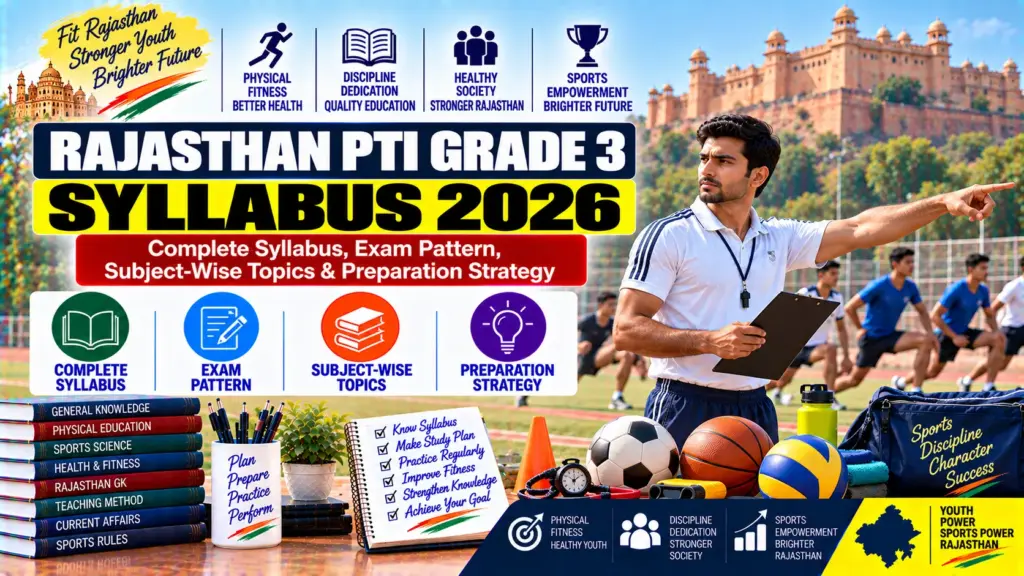
Rajasthan PTI Grade 3 Syllabus 2026: Complete Syllabus, Exam Pattern, Subject-Wise Topics & Preparation Strategy.Preparing for the Rajasthan PTI Grade 3 exam becomes much easier when you know exactly what is going to be asked. Many candidates start with sports and Physical Education, but the syllabus is actually much wider. Rajasthan GK, current affairs, India and World GK, Educational Psychology, sports, training, anatomy, health education and yoga all have an important place in the examination.
The Rajasthan PTI Grade 3 syllabus covers two papers. Paper I focuses mainly on general knowledge and Educational Psychology, while Paper II tests the candidate’s knowledge of Physical Education and sports.
For candidates preparing for the exam, the important thing is to understand the syllabus first and then build a study plan around it. This article explains the complete Rajasthan PTI Grade 3 Syllabus 2026 in a simple, easy-to-follow format.
Overview of Rajasthan PTI Grade 3 Syllabus 2026
| Particulars | Details |
|---|---|
| Exam Name | Rajasthan PTI Grade 3 |
| Department | Secondary Education Department |
| Papers | Paper I & Paper II |
| Paper I Marks | 200 |
| Paper II Marks | 260 |
| Paper I Questions | 100 |
| Paper II Questions | 130 |
| Duration | 2 Hours Each |
| Question Type | Multiple Choice Questions |
| Negative Marking | Yes |
The prescribed syllabus for P.T.I. Grade II & III provides separate syllabi for Paper I and Paper II. Paper I carries 200 marks, while Paper II carries 260 marks.
Rajasthan PTI Grade 3 Exam Pattern 2026
Before moving to the detailed syllabus, candidates should understand the paper pattern.
Paper I
| Subject | Marks |
|---|---|
| Rajasthan Geography, History, Culture & General Knowledge | 80 |
| Rajasthan Current Affairs | 20 |
| General Knowledge of India & World | 60 |
| Educational Psychology | 40 |
| Total | 200 |
Paper I consists of 100 questions, with a total of 200 marks and a duration of two hours.
Paper II
| Subject | Marks |
|---|---|
| General Knowledge of Physical Education | 60 |
| General Knowledge of Sports, Physical Education & Current Affairs | 40 |
| Theories, Definitions & History of Physical Education | 20 |
| Education & Games Psychology | 20 |
| Methods, Supervision & Organisation of Physical Education | 20 |
| Theories of Training & Decisions | 20 |
| Basic Physical Anatomy, Functions & Health Education | 40 |
| Recreation, Camp & Yoga | 40 |
| Total | 260 |
Paper II has 130 questions for 260 marks and is also conducted for two hours. Negative marking is applicable.
Rajasthan PTI Grade 3 Paper I Syllabus 2026
Paper I is where candidates need to combine their preparation for Rajasthan-specific subjects with general studies and Educational Psychology.
1. Rajasthan Geography, History, Culture & General Knowledge
This section carries 80 marks, making it the biggest section of Paper I.
Rajasthan Geography
Candidates should prepare:
- Location and extent of Rajasthan
- Relief features
- Climate
- Drainage system
- Vegetation
- Agriculture
- Livestock
- Dairy development
- Population distribution
- Population growth
- Literacy
- Sex ratio
- Religious composition
- Industries
- Planning
- Budgetary trends
- Major tourist centres
Ancient Culture and Civilisation
Important areas include:
- Kalibangan
- Ahar
- Ganeshwar
- Bairath
History of Rajasthan
The syllabus covers the history of Rajasthan from the 8th to the 18th century.
Topics include:
- Gurjar Pratiharas
- Chauhans of Ajmer
- Relations with the Delhi Sultanate
- Mewar
- Ranthambore
- Jalore
- Rajasthan and the Mughals
- Maharana Sanga
- Maharana Pratap
- Man Singh of Amer
- Chandrasen
- Rai Singh of Bikaner
- Raj Singh of Mewar
Freedom Struggle and Modern Rajasthan
Candidates should also cover:
- Freedom struggle in Rajasthan
- Peasant movements
- Tribal movements
- Prajamandal Movement
- Integration of Rajasthan
- Role of women during the medieval and modern periods
Rajasthan Art and Culture
Important topics include:
- Lok Devatas and Devian
- Saints of Rajasthan
- Temples
- Forts and palaces
- Different schools of painting
- Fairs and festivals
- Customs
- Traditional dresses
- Ornaments
- Folk music
- Folk dances
- Language and literature
Rajasthan Polity
The syllabus includes:
- Governor
- Chief Minister
- Council of Ministers
- State Secretariat
- Chief Secretary
- Rajasthan Public Service Commission
- State Human Rights Commission
- Panchayati Raj in Rajasthan
2. Rajasthan Current Affairs
This section carries 20 marks.
Candidates should keep themselves updated about major developments in Rajasthan related to:
- Socio-economic issues
- Political developments
- Games and sports
- Important state-level events
Preparation Tip
Current affairs can become difficult if you leave everything for the final month. Spend a little time every day and prepare short monthly notes. During revision, focus on important events rather than trying to remember every news item.
3. General Knowledge of India and World
This section carries 60 marks, so it should be given regular attention.
World Geography and International Affairs
Prepare topics such as:
- Continents
- Oceans and their characteristics
- Global wind systems
- Environmental problems
- Global strategies
- Globalisation
- Impact of globalisation
- Population trends
- Population distribution
- India and the United Nations
- Major international policy trends
- Nuclear non-proliferation
Indian Geography and Economy
Important areas include:
- Location of India
- Advantages of India’s location
- Monsoon system
- Drainage
- Changing agricultural patterns
- Industries
- National income
- Poverty
- Poverty reduction schemes
- India’s foreign policy
- Nehru’s contribution to foreign policy
Indian History and Constitution
Candidates should prepare:
- Government of India Acts of 1919 and 1935
- Gandhi’s contribution to the National Movement
- Ambedkar and Constitution-making
- Salient features of the Indian Constitution
- Fundamental Rights
- Fundamental Duties
- Directive Principles of State Policy
- President of India
- Prime Minister
- Federal system
- Major political parties
4. Educational Psychology
Educational Psychology carries 40 marks in Paper I.
This section is particularly relevant for teaching aspirants because many of the topics deal with learning, child development and classroom behaviour.
Important Topics
- Meaning and scope of Educational Psychology
- Role of psychology in classroom situations
- Contributions of psychologists
- Meaning and types of learning
- Theories of learning
- Transfer of learning
- Factors affecting learning
- Constructivist learning
- Physical development
- Emotional development
- Social development
- Development of the child as an individual
- Personality
- Personality theories
- Personality assessment
- Adjustment
- Mechanisms of adjustment
- Maladjustment
- Intelligence
- Intelligence theories
- Measurement of intelligence
- Creativity
- Emotional intelligence
- Human cognition
- Motivation
- Achievement motivation
- Individual differences
- Gifted and talented students
- Slow learners
- Delinquency
- Self-concept
- Attitude
- Interest
- Habits
- Aptitude
- Social skills
Exam Tip: Try to understand Psychology with examples. For instance, while studying motivation, think about how a teacher or coach can motivate students. This makes theoretical topics easier to remember.
Rajasthan PTI Grade 3 Paper II Syllabus 2026
Paper II is the main Physical Education paper and carries 260 marks. It covers everything from basic Physical Education concepts to sports, training, anatomy, health, recreation and yoga.
1. General Knowledge of Physical Education – 60 Marks
Basic Physical Education
Prepare:
- Meaning of Physical Education
- Aims
- Objectives
- Scope
- Need
- Importance
- Misconceptions about Physical Education
Biological Foundation
Topics include:
- Heredity and environment
- Chronological age
- Anatomical age
- Physiological age
- Mental age
- Body types
- Body classification
- Second wind
- Oxygen debt
- Kinesthetic sense
Psychological Foundation
- Learning
- Personality
- Instinct
- Emotions
- Motives
- Motivation
Sociological Foundation
- Traditions
- Leadership
- Group dynamics
- Socialisation
- Social interaction
Philosophical Foundation
- Idealism
- Pragmatism
- Naturalism
- Realism
Physical Fitness
Candidates should prepare:
- Warm-up
- Limbering down
- Aerobic activities
- Anaerobic activities
- Calisthenics
- Rhythmic exercises
- Physical fitness tests
- Health-related fitness tests
The syllabus also covers exercise programmes for different body parts such as the chest, abdomen, back, neck, arms, shoulders, thighs and calves.
Kinesiology and Sports Science
Important topics are:
- History of kinesiology
- Aims and objectives
- Role in Physical Education and sports
- Laws of motion
- Levers
- Force
- Centre of gravity
- Equilibrium
- Application of these principles in sports
- Postural deviations
- Deformities
- Therapeutic modalities
- Sports massage
- Prevention of sports injuries
- First aid
2. General Knowledge of Sports, Physical Education & Current Affairs – 40 Marks
This section covers several major sports.
Sports in the Syllabus
- Athletics
- Basketball
- Badminton
- Chess
- Cricket
- Football
- Gymnastics
- Handball
- Hockey
- Judo
- Kabaddi
- Kho-Kho
- Lawn Tennis
- Swimming/Diving
- Table Tennis
- Volleyball
- Wrestling
For each sport, candidates should study:
- History
- Rules
- Playing field measurements
- Equipment specifications
- Fundamental skills
- Sports terminology
- Sports gear
- Important tournaments
- Important venues
- Sports personalities
- Sports awards
- Sports associations and federations
Olympic Games
The syllabus also includes:
- International Olympic Committee
- Origin of the Olympics
- Olympiad
- Objectives
- Olympic motto
- Olympic Charter
- Olympic venues
- Olympic flag and rings
- Olympic mascot
- Olympic oath
- Olympic flame and torch
- Olympic medals
- Opening ceremony
- Closing ceremony
Preparation Tip: Make separate one-page notes for every major sport. Write down its important rules, dimensions, equipment, terminology, tournaments and notable personalities. This will save a lot of time during revision.
3. Theories, Definitions & History of Physical Education – 20 Marks
This section deals with the historical development of Physical Education.
Topics to Cover
- Definitions of Physical Education
- Principles of Physical Education
- Physical Education in Greece
- Physical Education in other countries
- Physical Education in ancient India
- Vedic period
- Epic period
- Medieval period
- Modern Physical Education in India
- Pre-independence Physical Education
- Post-independence Physical Education
Important Leaders
The syllabus includes the contribution of:
- B.P. de Coubertin
- Johan Basedow
- Guts Muths
- H.C. Buck
- G.D. Sondhi
- Dr. P.M. Joseph
- Prof. D.G. Wakharkar
- Prof. Karan Singh
- Prof. Ajmer Singh
Important Movements
- Turnverein Movement
- Philanthropium Movement
- Spartakiad
- YMCA
- Akharas
4. Education & Games Psychology – 20 Marks
This section focuses on the relationship between psychology, education and sports.
Important Topics
- Meaning of Psychology
- Definitions
- Nature
- Branches
- Scope
- Importance of Psychology in education
- Psychology in Physical Education
- Growth and development
- Sports Psychology
- Psycho-physical unity
- Individual differences
- Transfer of training
5. Methods, Supervision & Organisation of Physical Education – 20 Marks
A PTI needs practical knowledge of teaching and organising physical activities, and this section covers those areas.
Topics
- Types of teaching methods
- Principles of teaching
- Presentation techniques
- Class management
- Lesson planning
- Types of lessons
- Objectives of lessons
- Parts of lessons
- Teaching aids
- Principles of supervision
- Features of supervision
- Supervision techniques
- Qualities of a supervisor
- Organisation of competitions
- Knock-out tournaments
- League tournaments
- Combination tournaments
- Challenge or perennial tournaments
- Public relations in Physical Education and sports
6. Theories of Training & Decisions – 20 Marks
This section covers sports training, coaching and officiating.
Important Topics
- Principles of sports training
- Characteristics of training
- Training methods
- Training load
- Periodisation
- Motor abilities
- Types of motor abilities
- Principles of developing motor abilities
- Methods of developing motor abilities
- Coaching
- Coaching techniques
- Tactics
- Lead-up games
- Officiating
- Importance of officiating
- Principles of officiating
- Qualities of a good official
- Qualifications of an official
- Responsibilities of an official
7. Basic Physical Anatomy, Functions & Health Education – 40 Marks
This section requires a clear understanding of the human body and health.
Anatomy
Prepare:
- Meaning of anatomy
- Concept of anatomy
- Importance of anatomy in Physical Education and sports
- Cell
- Tissue
- Organ
- Organ system
- Bones
- Joints
- Classification of bones and joints
- Movements around joints
- Muscles
- Structure of muscles
- Functional classification of muscles
- Properties of muscles
Exercise Physiology
Important topics include:
- Meaning of exercise physiology
- Need and importance
- Effects of exercise on the muscular system
- Effects of exercise on the circulatory system
- Effects of exercise on the respiratory system
Health Education
Prepare:
- Dimensions of health
- Ecology
- Health spectrum
- Determinants of health
- Positive health
- Hygiene
- Community health
- School health services
- Concept of health education
- Objectives of health education
- Principles of health education
- Food and nutrition
- Balanced diet
- Diet according to sports activities
- Health problems
- Communicable diseases
- Non-communicable diseases
- Hereditary diseases
8. Recreation, Camp & Yoga – 40 Marks
The final section of Paper II covers recreation, camping and yoga.
Recreation
Important topics include:
- Definition
- Types
- Scope
- Significance
- Philosophy
- Objectives
- Theories of play
- Recreational activities
- Recreation agencies
- Facilities
- Equipment
- Maintenance of equipment
Camping
Prepare:
- Scope of camping
- Significance
- Types of camps
- Selection of camp sites
- Layout of camp sites
- Organisation of camps
- Administration of camps
Yoga
Topics include:
- Meaning of Yoga
- Types
- Stages
- Scope
- Objectives
- Significance
- Yogic Kriyas
- Pranayama
- Asanas
- Benefits of Asanas
The syllabus specifically mentions these asanas:
- Ardha Matsyendrasana
- Bhujangasana
- Chakrasana
- Dhanurasana
- Halasana
- Mayurasana
- Paschimottanasana
- Padmasana
- Shalabhasana
- Sarvangasana
- Savasana
- Sukhasana
- Tadasana
- Vajrasana
How to Prepare for Rajasthan PTI Grade 3 Exam 2026
The syllabus may look lengthy when you first see it, but there is no need to study everything at the same time.
Give Paper II Consistent Attention
Paper II carries 260 marks and contains the core Physical Education syllabus. Make it a part of your daily study schedule.
Build Rajasthan GK Slowly
Rajasthan History, Geography and Culture need repeated revision. Make separate notes for each topic and revise them regularly.
Study Sports One at a Time
Instead of jumping between different sports, complete one sport first. Cover its rules, field dimensions, equipment, skills, terminology and important competitions before moving to the next one.
Understand Psychology
Don’t try to memorise every definition word-for-word. Understand the basic idea behind learning, personality, intelligence, motivation and individual differences.
Use Diagrams for Anatomy
Anatomy becomes much easier when you use labelled diagrams for bones, joints, muscles and body systems.
Solve MCQs After Every Topic
Reading alone is not enough for an objective examination. Once you finish a topic, solve questions from it and note down the mistakes you make.
Rajasthan PTI Grade 3 90-Day Study Plan
Days 1–30: Foundation
Focus on:
- Rajasthan Geography
- Rajasthan History
- Rajasthan Culture
- Indian and World GK
- Educational Psychology
- Physical Education basics
- Anatomy basics
Days 31–60: Technical Preparation
Complete:
- Sports and rules
- Olympic Games
- History of Physical Education
- Sports Psychology
- Teaching methods
- Training theories
- Anatomy
- Health Education
- Recreation
- Camping
- Yoga
Days 61–75: Practice
Now increase your focus on:
- Topic-wise MCQs
- Previous questions
- Mock tests
- Rajasthan GK revision
- Sports questions
- Psychology questions
- Anatomy questions
Keep track of your mistakes. A mistake notebook can become extremely useful during the final revision.
Days 76–90: Revision
Use the final phase mainly for revision.
Revise:
- Rajasthan GK
- Current Affairs
- Educational Psychology
- Sports rules
- Sports terminology
- Important tournaments
- Anatomy
- Training
- Health Education
- Yoga
- Important personalities
- Olympic facts
Daily Study Timetable
| Subject | Time |
|---|---|
| Rajasthan GK | 1 Hour |
| Physical Education | 1.5 Hours |
| Sports | 1 Hour |
| Educational Psychology | 45 Minutes |
| Anatomy & Health | 45 Minutes |
| Current Affairs | 30 Minutes |
| MCQ Practice | 1 Hour |
| Revision | 30 Minutes |
You don’t have to follow this timetable exactly. The important thing is to maintain consistency and give adequate time to both papers.
Common Mistakes to Avoid
- Preparing only Physical Education and ignoring Paper I
- Ignoring Rajasthan-specific topics
- Leaving Educational Psychology until the end
- Trying to study all sports together
- Ignoring anatomy and health education
- Reading theory without solving MCQs
- Not revising completed topics
- Changing study material repeatedly
- Taking mock tests without analysing mistakes
- Attempting questions carelessly despite negative marking