
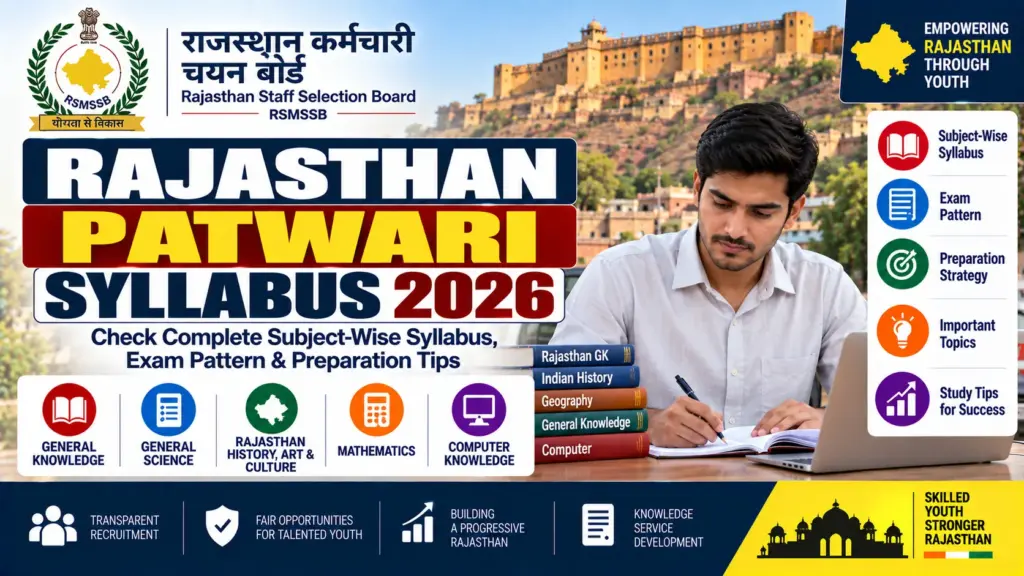
Rajasthan Patwari Syllabus 2026: Check Complete Subject-Wise Syllabus, Exam Pattern & Preparation Tips.The Rajasthan Patwari Syllabus 2026 is the first thing candidates should understand before starting their preparation. The Patwari exam covers a mix of Rajasthan-specific knowledge, Indian General Knowledge, Hindi and English, Reasoning, Mathematics and Computer Awareness. With 150 questions to solve in 3 hours, knowing the syllabus properly can make preparation much more organised.
Candidates often make the mistake of studying only Rajasthan GK and leaving other sections for later. A better approach is to divide the syllabus into small topics, complete the basics and then spend enough time on practice and revision.
Here is a simple and complete guide to the Rajasthan Patwari Syllabus 2026 and Exam Pattern.
Overview of Rajasthan Patwari Exam Pattern 2026
The Rajasthan Patwari written examination consists of 150 objective-type questions carrying 300 marks. Candidates get 3 hours to complete the paper.
| Subject | Questions | Marks |
|---|---|---|
| General Science, Indian History, Polity, Geography, General Knowledge & Current Affairs | 38 | 76 |
| Rajasthan Geography, History, Culture & Polity | 30 | 60 |
| General Hindi & English | 22 | 44 |
| Mental Ability, Reasoning & Basic Numerical Efficiency | 45 | 90 |
| Basic Computer Knowledge | 15 | 30 |
| Total | 150 | 300 |
Important Exam Pattern Details
- Total Questions: 150
- Total Marks: 300
- Time Duration: 3 hours
- Question Type: Multiple Choice Questions
- Marks for Correct Answer: 2 marks
- Negative Marking: 1/3 mark for each wrong answer
- Exam Mode: Offline/OMR-based
Exam Tip: Since there is negative marking, accuracy is just as important as speed. Avoid making random guesses, especially when you are not confident about an answer.
Rajasthan Patwari Syllabus 2026 Subject-Wise
The syllabus can broadly be divided into five major areas. Let’s look at each one in detail.
1. General Science, Indian History, Polity, Geography and Current Affairs
This section combines several important areas, so candidates should prepare it systematically rather than trying to cover everything at once.
General Science
Important topics include:
- Basic concepts of science
- Everyday science
- Human body
- Food and nutrition
- Health and diseases
- Basic scientific facts
- Science-related developments
The questions are primarily focused on general awareness and basic understanding rather than highly advanced scientific concepts.
Indian History
Candidates should cover:
- Ancient Indian history
- Medieval Indian history
- Important historical events
- Major developments from the 18th century onwards
- Freedom movement
- Important personalities and events
Indian Polity
The important areas include:
- Indian Constitution
- Political system
- Governance system
- Constitutional development
- Important constitutional institutions
- Basic political and administrative structure
Indian Geography
Prepare topics such as:
- Physical features of India
- Geographical characteristics
- Environment
- Ecology
- Environmental changes
- Effects of environmental changes
Current Affairs
Current affairs preparation should include:
- National events
- International events
- Government schemes and policies
- Awards and honours
- Sports
- Important appointments
- Economy and financial developments
- Science and technology
- Defence
- Environment
- Important days and events
Preparation Tip: Make short monthly current-affairs notes instead of trying to remember every news story you read.
2. Rajasthan History, Geography, Culture and Polity
This is a particularly important part of the Patwari syllabus because it focuses specifically on Rajasthan.
Rajasthan History
Candidates should study:
- Important historical events of Rajasthan
- Major dynasties
- Important personalities
- Freedom movement in Rajasthan
- Public awakening movements
- Political integration of Rajasthan
- Major historical developments
Rajasthan Administration and Polity
Important topics include:
- Governor
- State Legislative Assembly
- High Court
- District administration
- Rajasthan Public Service Commission
- State Human Rights Commission
- State Election Commission
- Lokayukta
- State Information Commission
- Public policy
- Administrative system of Rajasthan
Rajasthan Geography
Focus on:
- Location and geographical extent of Rajasthan
- Major physical divisions
- Thar Desert
- Aravalli Range
- Plains and plateaus
- Rivers and drainage system
- Lakes
- Climate
- Soil
- Natural vegetation
- Forests
- Wildlife
- Water conservation
- Livestock
- Irrigation projects
- River valley projects
- Population
Rajasthan Art and Culture
This section can become a scoring area if prepared properly.
Important topics include:
- Rajasthani languages and dialects
- Literature
- Folk music
- Folk dances
- Folk theatre
- Religious movements
- Saints and poets
- Folk deities
- Fairs and festivals
- Folk arts
- Paintings
- Handicrafts
- Architecture
- Traditional dress
- Jewellery
- Customs and traditions
- Cultural heritage
- Important tourist places
- Famous personalities
Remember: Rajasthan GK should not be prepared only at the end. Give it some time every day because the syllabus is wide and requires repeated revision.
3. General Hindi
The General Hindi section focuses mainly on grammar, vocabulary and correct usage.
The important topics are:
- संधि एवं संधि-विच्छेद
- उपसर्ग एवं प्रत्यय
- समास एवं समास-विग्रह
- शब्द युग्म
- पर्यायवाची शब्द
- विलोम शब्द
- शब्द शुद्धि
- वाक्य शुद्धि
- वाक्यांश के लिए एक शब्द
- पारिभाषिक शब्दावली
- मुहावरे
- लोकोक्तियाँ
How to Prepare Hindi
Hindi can be improved through regular practice. Keep a small notebook for difficult words, मुहावरे, लोकोक्तियाँ and grammar rules.
Rather than reading the same rules repeatedly, solve questions after completing each topic. This will help you understand how questions are actually framed.
4. General English
The English syllabus is relatively focused and includes:
- Synonyms
- Antonyms
- Phrases and idioms
- Common grammatical errors
- Correct usage
- Unseen passages
- Reading comprehension
Preparation Tip
Spend 20–30 minutes a day on English. Read a short passage, learn a few new words and solve grammar questions. Regular practice is more useful than studying English for several hours once a week.
5. Mental Ability and Reasoning
Reasoning and Mental Ability, along with Basic Numerical Efficiency, form the largest section of the examination with 45 questions for 90 marks.
Important topics include:
- Series
- Analogy
- Figure matrix
- Classification
- Alphabet test
- Routes and conclusions
- Blood relations
- Coding-decoding
- Direction sense test
- Seating arrangement
- Input-output
- Number ranking
- Decision making
- Logical arrangement of words
- Missing character/number
- Mathematical operations
How to Prepare Reasoning
Don’t try to memorise reasoning questions. Instead, understand the method behind each question type.
For example, after learning coding-decoding, solve 20–30 questions of different patterns. The same approach can be used for blood relations, directions, series and seating arrangement.
With practice, the time taken per question will naturally come down.
6. Basic Numerical Ability and Mathematics
Mathematics is included with Mental Ability and Reasoning in the exam pattern.
Important topics include:
- Mathematical operations
- Average
- Ratio
- Percentage
- Area
- Volume
- Simple Interest
- Compound Interest
- Unitary Method
- Profit and Loss
Mathematics Preparation Strategy
Start with basic concepts and formulas. Once the fundamentals are clear, move to mixed practice sets.
Make a separate formula sheet and revise it regularly. Try solving calculations without unnecessarily using lengthy methods.
Exam Tip: Don’t wait until the final month to start Mathematics. Even 30–45 minutes of daily practice can make a significant difference over time.
7. Basic Computer Knowledge
The Computer section carries 15 questions for 30 marks.
The syllabus includes:
- Characteristics of computers
- Computer organisation
- RAM
- ROM
- File system
- Input devices
- Computer software
- Hardware and software
- Operating systems
- MS Word
- MS Excel
- Spreadsheet
- MS PowerPoint
Candidates with basic computer knowledge can score well here, but they should revise important terminology before the exam.
Rajasthan Patwari Selection Process 2026
The available Rajasthan Patwari examination material describes the selection process around the following stages:
- Written Examination
- Document Verification
Candidates who qualify the written examination move ahead according to the applicable recruitment and document-verification requirements.
Important: Candidates should always follow the recruitment notification applicable to their particular recruitment cycle for the final selection rules.
How to Prepare for Rajasthan Patwari Exam 2026?
A smart preparation strategy is more useful than simply increasing study hours.
Step 1: Understand the Complete Syllabus
Before opening your books, make a checklist of every subject and topic. Mark topics as:
- Not Started
- In Progress
- Completed
- Revised
This simple system makes preparation much easier to track.
Step 2: Prioritise High-Weightage Sections
Mental Ability, Reasoning and Basic Numerical Efficiency account for 90 marks, while Rajasthan-specific topics account for 60 marks.
These areas should receive regular attention.
Step 3: Study Rajasthan GK Every Day
Spend some time daily on Rajasthan History, Geography, Culture and Polity.
Don’t try to complete all Rajasthan GK in one sitting. Daily revision works much better.
Step 4: Practise Questions After Every Topic
For example:
Study Percentage → Solve Percentage Questions → Analyse Mistakes → Revise Formula
Follow the same cycle for every subject.
Step 5: Solve Previous-Year Questions
Previous-year questions help you understand the level and style of questions you may face.
Keep track of questions you get wrong and revise those concepts separately.
Step 6: Take Mock Tests
Full-length mock tests are important because the actual paper contains 150 questions and has a fixed time limit.
Initially, focus on accuracy. Once your accuracy improves, start working on speed.
Step 7: Revise Again and Again
Revision is especially important for:
- Rajasthan GK
- Current Affairs
- Hindi vocabulary
- English vocabulary
- Computer facts
- Important formulas
60-Day Preparation Plan for Rajasthan Patwari
| Days | Preparation Focus |
|---|---|
| 1–15 | Build basic concepts across all subjects |
| 16–30 | Rajasthan GK + Hindi/English + Mathematics |
| 31–45 | Reasoning + Computer + Current Affairs |
| 46–55 | Previous-year questions + sectional tests |
| 56–60 | Full-length mocks + complete revision |
If you already have a strong base, you can spend more time on mock tests and weak areas instead of following this plan strictly.
Rajasthan Patwari Daily Study Plan
A practical timetable can look like this:
| Subject | Daily Time |
|---|---|
| Rajasthan GK | 2 Hours |
| Reasoning & Mental Ability | 1.5 Hours |
| Mathematics | 1.5 Hours |
| General Science/GK | 1 Hour |
| Hindi & English | 1 Hour |
| Computer | 30 Minutes |
| Current Affairs | 30 Minutes |
| Revision/Practice | 1 Hour |
The exact number of hours is less important than consistency. Even if you have limited time, make sure you study regularly and revise what you have already covered.
Common Mistakes Candidates Should Avoid
1. Ignoring the Exam Pattern
Knowing the syllabus but not knowing the marks distribution can lead to poor time allocation.
2. Leaving Rajasthan GK for the End
Rajasthan GK has a large syllabus. It should be prepared throughout your study schedule.
3. Avoiding Mathematics
Candidates sometimes focus heavily on GK and neglect numerical questions. This can cost valuable marks.
4. Studying Without Practising
Reading theory alone will not improve your speed. Question practice is essential.
5. Taking Too Many Random Guesses
With negative marking, unnecessary guessing can bring your score down.
6. Not Revising
A topic that feels easy today may be forgotten after a few weeks. Regular revision solves this problem.