
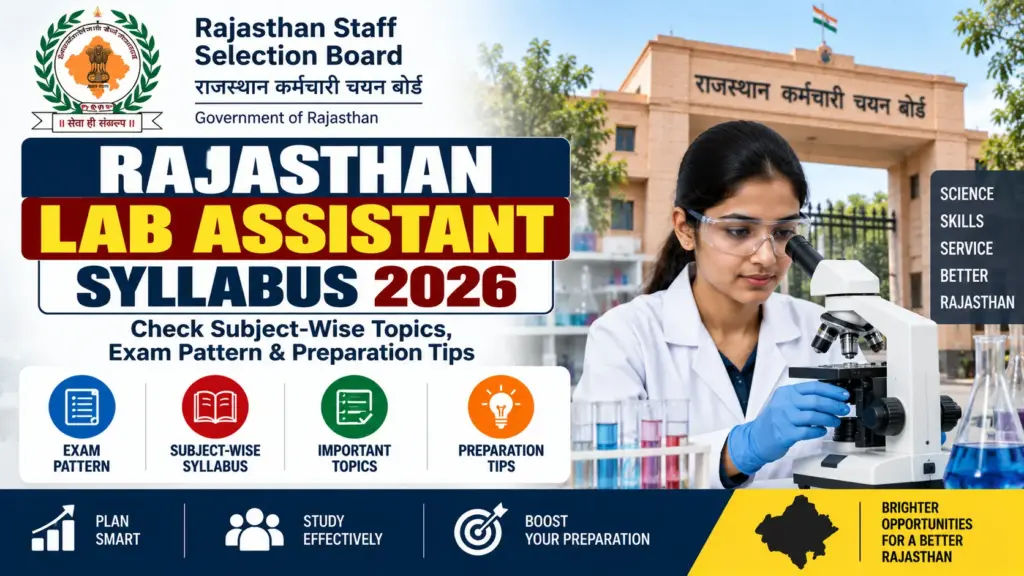
Rajasthan Lab Assistant Syllabus 2026: Check Subject-Wise Topics, Exam Pattern & Preparation Tips.The Rajasthan Lab Assistant Syllabus 2026 is the first thing candidates should understand before starting serious preparation. The examination is conducted for candidates from different streams, mainly Science and Geography, and the syllabus changes according to the stream.
For Science candidates, the exam covers Rajasthan General Knowledge along with Physics, Chemistry and Biology. Geography candidates have to prepare Rajasthan-related General Knowledge as well as a detailed Geography syllabus.
With a large syllabus to cover, preparing randomly can waste a lot of time. A better approach is to divide the subjects into smaller topics, focus on important areas and keep revision and MCQ practice as part of the daily routine.
Here is a complete, easy-to-follow guide to the Rajasthan Lab Assistant Syllabus 2026, exam pattern, important topics and preparation strategy.
Overview of Rajasthan Lab Assistant Syllabus 2026
| Particular | Details |
|---|---|
| Exam Name | Rajasthan Lab Assistant Exam 2026 |
| Conducting Board | Rajasthan Staff Selection Board |
| Posts | Lab Assistant / Junior Lab Assistant |
| Streams | Science and Geography |
| Total Vacancies | 804 |
| Exam Type | Objective Type |
| Selection Process | Written Examination + Document Verification |
| Negative Marking | 1/3 mark for each wrong answer |
| Exam Language | Hindi and English |
Rajasthan Lab Assistant Exam Pattern 2026
The exam pattern is different for Science and Geography candidates. Therefore, candidates should first identify their respective stream and then prepare according to the relevant paper structure.
Science Exam Pattern
For the Science stream, the examination consists of two papers.
| Paper | Subjects | Questions | Marks | Duration |
|---|---|---|---|---|
| Paper 1 | Rajasthan GK, History, Culture, Geography, Current Affairs, India & World GK, Educational Psychology | 100 | 200 | 2 Hours |
| Paper 2 | Physics, Chemistry & Biology | 100 | 200 | 2 Hours |
| Total | — | 200 | 400 | 4 Hours |
Each question carries 2 marks. Negative marking is applicable for incorrect answers.
Geography Exam Pattern
The Geography stream follows a different pattern.
| Part | Subject | Questions | Marks | Duration |
|---|---|---|---|---|
| Part A | Rajasthan History, Art, Culture, Literature, Traditions, Heritage & Geography | 100 | 100 | 3 Hours |
| Part B | Geography | 200 | 200 | 3 Hours |
| Total | — | 300 | 300 | 3 Hours |
Important
The Science and Geography examinations have different structures. Candidates should avoid mixing the two syllabi while preparing.
Rajasthan Lab Assistant Paper 1 Syllabus
Paper 1 for Science candidates mainly focuses on Rajasthan General Knowledge and related subjects.
The major areas include:
- Rajasthan History
- Rajasthan Art and Culture
- Rajasthan Geography
- Rajasthan Current Affairs
- General Knowledge of India and the World
- Educational Psychology
Let’s look at these topics one by one.
1. Rajasthan History
Rajasthan History is an important part of the General Knowledge section.
Important Topics
- Sources of Rajasthan History
- Prehistoric civilizations of Rajasthan
- Major dynasties of Rajasthan
- Achievements of important rulers
- Mughal-Rajput relations
- Architecture
- Forts and monuments
- Religious movements
- Folk deities
- Princely states
- British treaties
- Revolt and movements of 1857
- Peasant movements
- Tribal movements
- Prajamandal Movement
- Important historical personalities
Preparation Tip
Instead of memorising isolated facts, try to study Rajasthan History in chronological order. Creating a simple timeline of important events can make revision much easier.
2. Rajasthan Art and Culture
Rajasthan’s art and culture are important areas that candidates should revise regularly.
Topics to Cover
- Rajasthan’s cultural traditions
- Folk dances
- Folk music
- Musical instruments
- Fairs and festivals
- Jewellery
- Folk deities
- Traditional art
- Architecture
- Historical tourist places
- Important personalities
- Literature
- Heritage
Exam Tip
Prepare separate short notes for folk dances, fairs, festivals and musical instruments. These are easy to revise during the final stage of preparation.
3. Rajasthan Geography
Candidates should have a good understanding of Rajasthan’s physical and economic geography.
Important Topics
- Location of Rajasthan
- Physical divisions
- Desert region
- Aravalli Range
- Plains
- Plateau region
- Drainage system
- Climate
- Soil
- Natural vegetation
- Wildlife
- Environmental issues
- Agro-climatic regions
- Major crops
- Livestock
- Irrigation projects
- Mineral resources
Rajasthan Geography can become a scoring section if the basic facts are revised regularly.
4. Rajasthan Current Affairs
Current Affairs should not be left for the last few weeks.
Focus on:
- Important Rajasthan government initiatives
- Major state-level developments
- Important appointments
- Awards
- Sports
- Science and Technology
- Environment
- Major events
- Important personalities
- Rajasthan-related national developments
Preparation Tip
Give at least 20–30 minutes daily to current affairs and revise monthly notes regularly.
5. General Knowledge of India and World
Candidates should also prepare important general awareness topics related to India and the world.
Important areas include:
- Indian history
- Indian geography
- Important national events
- International developments
- Important organisations
- Awards and honours
- Sports
- Science and Technology
- Major personalities
6. Educational Psychology
Educational Psychology is also included in the syllabus for the Science stream.
Candidates should understand basic concepts related to:
- Learning
- Child development
- Behaviour
- Educational psychology
- Motivation
- Individual differences
- Teaching-learning process
- Classroom behaviour
The focus should be on understanding concepts rather than memorising definitions without context.
Rajasthan Lab Assistant Science Syllabus 2026
The Science paper covers three major subjects:
- Physics
- Chemistry
- Biology
This section carries significant weight in the Science examination, so candidates should give it consistent preparation time.
Biology Syllabus
Biology covers plant biology, animal biology, human physiology, genetics, ecology and biotechnology.
Important Topics
- Classification of plants
- Algae
- Fungi
- Lichens
- Bryophytes
- Pteridophytes
- Gymnosperms
- Angiosperms
- Plant morphology
- Plant anatomy
- Photosynthesis
- Respiration
- Transpiration
- Plant growth and movement
- Ecosystem
- Energy flow
- Biogeochemical cycles
- Environmental pollution
- Population ecology
- Biodiversity
- Biotechnology
- Recombinant DNA technology
- Transgenic plants and animals
- Cell structure
- Cell theory
- Cell division
- Genetics
- Mendel’s laws
- DNA and RNA
- Animal classification
- Digestion
- Respiration
- Excretion
- Circulation
- Endocrine system
- Nervous system
- Human reproductive system
- Human diseases
- Evolution
Important
For Biology, diagrams can make revision much easier. Pay special attention to human body systems, cell structure, plant anatomy and physiological processes.
Physics Syllabus
Physics covers mechanics, thermodynamics, waves, electricity, optics, nuclear physics and electronics.
Important Topics
- Rigid body dynamics
- Moment of inertia
- Conservation of momentum
- Thermodynamics
- Laws of thermodynamics
- Heat engines
- Refrigerators
- Simple Harmonic Motion
- Oscillations
- Resonance
- Waves
- Doppler Effect
- Electrostatics
- Coulomb’s Law
- Electric field
- Gauss’s Law
- Current electricity
- Kirchhoff’s Laws
- Wheatstone Bridge
- Meter Bridge
- Potentiometer
- Optics
- Microscope
- Telescope
- Interference
- Diffraction
- Polarisation
- Bohr’s Model
- Nuclear Physics
- Nuclear fission
- Nuclear fusion
- Semiconductor electronics
- PN Junction
- Transistors
- Logic Gates
- Diodes
Exam Tip
Make a separate formula notebook for Physics. Revise it regularly and solve numerical questions after completing each topic.
Chemistry Syllabus
Chemistry includes fundamental concepts from physical, inorganic and organic chemistry.
Important Topics
- Atomic structure
- Electron, proton and neutron
- Rutherford’s model
- Quantum numbers
- Pauli’s Exclusion Principle
- Aufbau Principle
- Orbitals
- Hund’s Rule
- Periodic Table
- Atomic properties
- Atomic size
- Ionisation potential
- Electron affinity
- Electronegativity
- S-Block elements
- P-Block elements
- Chemical equilibrium
- Ionic equilibrium
- Gaseous state
- Liquid state
- Solid state
- Solutions
- Organic compounds
- Organic nomenclature
- Hydrocarbons
Preparation Tip
Give extra attention to the Periodic Table, Atomic Structure, Chemical Equilibrium and Organic Chemistry. Revise important concepts repeatedly instead of studying them only once.
Rajasthan Lab Assistant Geography Syllabus 2026
The Geography stream has a detailed Geography syllabus covering physical, environmental, Indian and human geography.
Physical Geography
Important topics include:
- Origin and evolution of Earth
- Interior of Earth
- Rocks
- Geomorphic processes
- Landforms
- Atmosphere
- Insolation
- Heat balance
- Pressure belts
- Atmospheric circulation
- Evaporation
- Condensation
- Rainfall
- Climate classification
- Global warming
- Climate change
Oceanography
Candidates should also prepare:
- Hydrological cycle
- Ocean relief
- Ocean temperature
- Ocean salinity
- Waves
- Tides
- Ocean currents
Environment and Biodiversity
Important areas include:
- Biosphere
- Ecosystems
- Biomes
- Biodiversity
- Conservation
- Environmental issues
- Global warming
- Climate change
- Natural hazards
Indian Geography
Focus on:
- Location and size of India
- Physiographic divisions
- Himalayas
- Northern Plains
- Peninsular Plateau
- Indian drainage system
- Himalayan rivers
- Peninsular rivers
- Indian soils
- Climate
- Monsoon
- Natural resources
- Agriculture
Maps and Remote Sensing
This section includes:
- Maps
- Map projections
- Topographical maps
- Remote sensing
- Weather instruments
- Weather charts
Exam Tip
Candidates often ignore mapping and remote sensing while focusing only on theoretical Geography. Don’t make this mistake. Keep these topics in your preparation schedule.
Important Topics for Rajasthan Lab Assistant Exam 2026
If you have limited preparation time, prioritise these areas.
Science Candidates
Rajasthan GK
- History
- Art and Culture
- Geography
- Current Affairs
Biology
- Human Physiology
- Plant Physiology
- Genetics
- Ecology
- Biotechnology
- Cell Biology
Physics
- Thermodynamics
- Electricity
- Optics
- Waves
- Electrostatics
- Semiconductor Electronics
Chemistry
- Atomic Structure
- Periodic Table
- Chemical Equilibrium
- Ionic Equilibrium
- Organic Chemistry
Geography Candidates
- Physical Geography
- Indian Geography
- Rajasthan Geography
- Climate
- Indian Monsoon
- Oceanography
- Environment
- Biodiversity
- Mapping
- Remote Sensing
How to Prepare for Rajasthan Lab Assistant Exam 2026
1. Understand the Syllabus First
Before starting your preparation, divide the complete syllabus into sections. This prevents you from spending too much time on one subject while ignoring another.
2. Focus on Your Main Subject
Science candidates should regularly study Physics, Chemistry and Biology. Geography candidates should dedicate most of their study time to Geography.
3. Keep Rajasthan GK in Your Daily Routine
Rajasthan History, Culture, Geography and Current Affairs should be revised regularly.
4. Practise MCQs Every Day
After completing a topic, solve objective questions. This helps you understand whether you have actually understood the concept.
5. Solve Previous-Year Papers
Previous-year papers are useful for understanding the question style, difficulty level and frequently tested topics.
6. Take Mock Tests
Mock tests help improve both speed and accuracy. Don’t just check your score after a test. Analyse every wrong answer.
7. Make Short Notes
Keep short revision notes for:
- Important facts
- Formulas
- Scientific concepts
- Rajasthan GK
- Geography facts
- Difficult topics
8. Revise Again and Again
Revision is particularly important for a syllabus containing a large number of factual topics. Keep revising older chapters while studying new ones.
Suggested Daily Study Plan
| Study Area | Time |
|---|---|
| Main Subject | 3 Hours |
| Rajasthan GK | 1 Hour |
| Current Affairs | 30 Minutes |
| MCQ Practice | 1 Hour |
| Revision | 30 Minutes |
You can change this timetable according to your daily routine. The main goal should be consistent study every day.
Common Mistakes to Avoid
Ignoring Rajasthan GK
Science and Geography candidates sometimes focus too heavily on their main subject and neglect Rajasthan GK.
Studying Only Theory
Reading books for hours without solving MCQs does not provide enough exam practice.
Leaving Revision Until the End
Revision should begin from the early stages of preparation.
Avoiding Difficult Topics
Don’t keep postponing difficult chapters. Break them into smaller parts and complete them gradually.
Guessing Too Many Questions
Negative marking makes accuracy important. Avoid unnecessary guesses.
Rajasthan Lab Assistant Syllabus 2026: Key Highlights
Remember these important points:
- The recruitment includes Science and Geography streams.
- The provided material mentions 804 vacancies.
- Science candidates have two papers.
- The Science examination carries 400 marks.
- Each Science paper is of 2 hours.
- Geography candidates have a 300-question, 300-mark examination structure.
- The Geography examination duration is 3 hours.
- Negative marking is applicable.
- Rajasthan GK is important for the examination.
- Science candidates need to prepare Physics, Chemistry and Biology.
- Geography candidates need to cover Physical, Indian and Human Geography.
- Regular revision and MCQ practice are essential.