
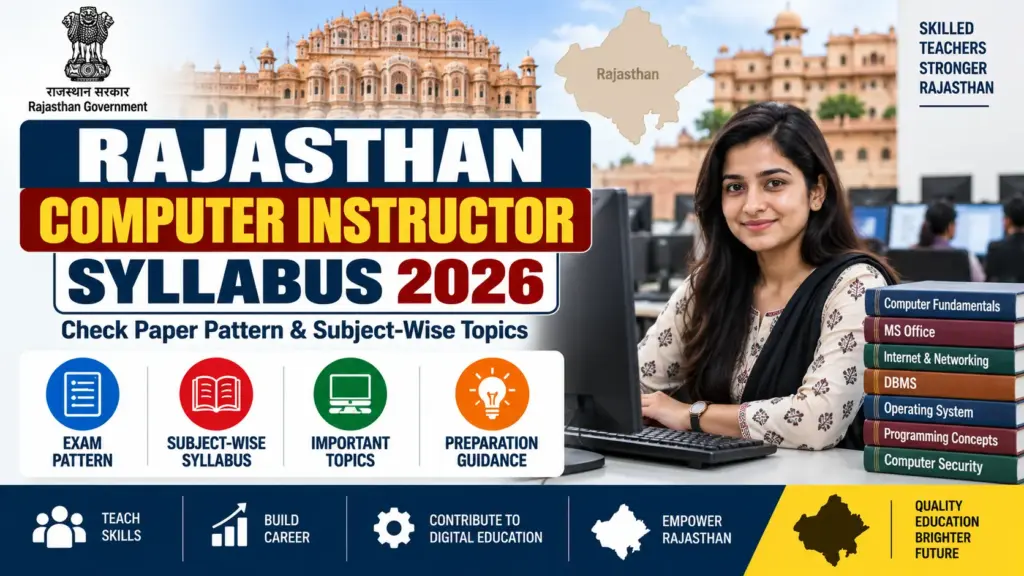
Rajasthan Computer Instructor Syllabus 2026: Check Paper Pattern & Subject-Wise Topics.The Rajasthan Computer Instructor exam is an important opportunity for candidates who want to build a career in the teaching and computer education sector. The recruitment is conducted for two posts — Senior Computer Instructor and Basic Computer Instructor.
Before starting preparation, candidates should understand the syllabus properly because the examination covers much more than basic computer knowledge. Along with Rajasthan-specific General Knowledge, History, Geography, Science, Current Affairs and Reasoning, candidates also have to prepare professional computer subjects.
The good thing is that once the syllabus is divided into smaller sections, preparation becomes much easier. Here is the complete Rajasthan Computer Instructor Syllabus 2026, including the exam pattern, subject-wise topics and useful preparation tips.
Overview of Rajasthan Computer Instructor Syllabus 2026
| Particular | Details |
|---|---|
| Exam Name | Rajasthan Computer Instructor Exam 2026 |
| Conducting Board | Rajasthan Staff Selection Board |
| Posts | Senior Computer Instructor and Basic Computer Instructor |
| Total Papers | 2 |
| Total Questions | 200 |
| Total Marks | 200 |
| Questions in Each Paper | 100 |
| Marks in Each Paper | 100 |
| Duration | 2 Hours for Each Paper |
| Question Type | Objective Type |
| Negative Marking | 1/3 Mark for Each Wrong Answer |
| Selection Process | Written Examination and Document Verification |
Rajasthan Computer Instructor Exam Pattern 2026
The written examination consists of two papers. Paper I is mainly focused on Rajasthan-related General Knowledge and General Ability, while Paper II covers pedagogy, mental ability and professional computer subjects.
Paper I
- 100 questions
- 100 marks
- 2 hours
- Objective-type questions
- Negative marking of 1/3 mark for every wrong answer
Paper II
- 100 questions
- 100 marks
- 2 hours
- Objective-type questions
- Negative marking of 1/3 mark for every wrong answer
Total Examination
| Paper | Questions | Marks | Duration |
|---|---|---|---|
| Paper I | 100 | 100 | 2 Hours |
| Paper II | 100 | 100 | 2 Hours |
| Total | 200 | 200 | 4 Hours |
Important
Since there is negative marking, candidates should focus on accuracy as well as speed. Random guessing can reduce the overall score.
Rajasthan Computer Instructor Paper I Syllabus
Paper I is common for both Senior Computer Instructor and Basic Computer Instructor.
The paper covers the following broad areas:
- Art and Culture
- History
- Geography
- General Science
- Current Affairs of Rajasthan
- Logical Reasoning
- Analytical Ability
- Decision Making
- Problem Solving
- General Mental Ability
- Basic Numeracy
- Data Interpretation
1. Rajasthan and Indian Art & Culture
Art and Culture is an important part of Paper I. Candidates should focus on both Rajasthan and Indian culture.
Important Topics
- Indian Art and Culture
- Culture of Indian States
- Art and Culture of Rajasthan
- Folk dances
- Traditional culture
- Cultural heritage
- Important historical and cultural places
- Major cultural developments
Preparation Tip
Prepare short notes for Rajasthan’s important folk dances, festivals, fairs, traditions and cultural facts. These topics are easier to revise repeatedly.
2. History
The History section includes important topics from Rajasthan as well as Indian history.
Candidates should prepare:
- Ancient Indian History
- Medieval Indian History
- Modern Indian History
- Rajasthan History
- Important historical events
- Famous historical places
- Important rulers and dynasties
- Major developments in Indian history
- Vedic period and related developments
Instead of trying to memorise every date, focus on the sequence of important events and their major facts.
3. Geography
Geography questions can be asked from Rajasthan as well as India.
Important Topics
- Rajasthan Geography
- Indian Geography
- Soil types
- Crops
- Natural resources
- Motions of the Earth
- Interior of the Earth
- Earthquakes
- Physical features
- Geography and environment
Candidates should give special attention to Rajasthan-specific geographical facts.
4. General Science and Environment
This section checks the candidate’s basic understanding of science and environmental issues.
Important areas include:
- General Science
- Environment
- Pollution
- Soil Pollution
- Environmental Protection
- Non-renewable Energy
- Development and Environment
- Science and Technology
- Sports-related awareness
Exam Tip
Don’t spend too much time going into highly advanced science topics. Focus on basic concepts, important facts and objective questions.
5. Current Affairs
Current Affairs covers important developments related to Rajasthan and the country.
Candidates should keep track of:
- Rajasthan government initiatives
- Important Rajasthan developments
- National events
- Awards
- Sports
- Science and Technology
- Environment
- Important appointments
- Major achievements
- Important current events
A regular current affairs routine is much better than trying to cover everything just before the examination.
6. General Ability and Reasoning
General Ability can become a scoring section with regular practice.
Important Topics
- Logical Reasoning
- Analytical Ability
- Decision Making
- Problem Solving
- General Mental Ability
- Number Series
- Coding-Decoding
- Blood Relations
- Direction Sense
- Analogy
- Classification
- Data Interpretation
- Data Sufficiency
- Basic Numeracy
Basic Numeracy and Data Interpretation are based on the Class 10 level.
Preparation Tip
Solve reasoning questions every day. Even 20–30 questions daily can make a noticeable difference over time.
Senior Computer Instructor Paper II Syllabus 2026
Paper II is the most important technical paper for Senior Computer Instructor candidates.
The major sections include:
- Pedagogy
- Mental Ability
- Fundamentals of Computer
- Programming Fundamentals
- Object-Oriented Programming
- Data Structures and Algorithms
- Digital Logic
- Computer Organization and Architecture
- Operating Systems
- DBMS
- Software Engineering
- Computer Networks
- Network Security
- Communication Systems
- Web Development
- Internet of Things and Applications
1. Pedagogy
Since the post is related to computer teaching, pedagogy plays an important role.
Topics to Prepare
- Teaching Methods
- Teaching-Learning Process
- Classroom Management
- Educational Psychology
- Learning Theories
- Student Evaluation
- Communication Skills
- Educational Technology
- Motivation
- Learning Techniques
- ICT in Education
- E-learning Tools
- Teaching Aids
Remember
Don’t study pedagogy only as definitions. Try to understand how different teaching methods can be used in an actual classroom.
2. Mental Ability
Important topics include:
- Logical Reasoning
- Analytical Ability
- Data Interpretation
- Data Sufficiency
- Decision Making
- Problem Solving
- Major Developments in Information Technology
Regular practice is important because many questions require quick thinking.
3. Fundamentals of Computer
This section builds the foundation for the technical paper.
Important Topics
- Number System
- Binary Number System
- Decimal Number System
- Hexadecimal Number System
- Arithmetic Operations
- Computer Generations
- Types of Computers
- Programming Language Categories
- Input Devices
- Output Devices
- Computer Memory
- Storage
- Hardware
- Software
Candidates should make sure their basics are clear before moving to advanced topics.
4. Programming Fundamentals
Programming is one of the major areas of the Senior Computer Instructor syllabus.
Important Topics
- C
- C++
- Java
- DotNet
- Python
- Artificial Intelligence
- Machine Learning
- Blockchain
- Data Types
- Variables and Constants
- Scope of Variables
- Operators
- Operator Precedence
- Conditional Statements
- Loops
- Arrays
- Pointers
- Structures
- Unions
- Enums
- Functions
- Recursion
- File Handling
- Command-Line Arguments
- Algorithms
- Flowcharts
Exam Tip
Don’t rely only on theoretical reading. Practise programming-based MCQs and output questions regularly.
5. Object-Oriented Programming
Important OOP concepts include:
- Classes
- Objects
- Constructors
- Destructors
- Encapsulation
- Inheritance
- Polymorphism
- Function Overloading
- Operator Overloading
- Abstraction
- Exception Handling
- Event Handling
- Files and Streams
- Java Packages
- Interfaces
A clear understanding of the basic OOP principles can help in solving many conceptual questions.
6. Data Structures and Algorithms
Data Structures is another major technical area.
Important Topics
- Abstract Data Types
- Arrays
- Linked Lists
- Stacks
- Queues
- Circular Queues
- Trees
- Binary Trees
- Binary Search Trees
- Graphs
- Searching
- Sorting
- Symbol Tables
- Hashing
- Recursion
- Dynamic Memory Allocation
- Tree Traversal
- Greedy Algorithms
- Branch and Bound
- Divide and Conquer
- Complexity Analysis
- Big O Notation
Preparation Tip
Study each data structure separately and immediately solve practice questions. This will make revision much easier later.
7. Digital Logic
Candidates should prepare:
- Boolean Algebra
- Logic Gates
- Boolean Expressions
- K-Maps
- TTL
- CMOS
- Half Adder
- Full Adder
- Subtractors
- Multiplexers
- Flip-Flops
- Sequential Circuits
- Synchronous Sequential Design
8. Computer Organization and Architecture
Important topics include:
- Von Neumann Architecture
- Registers
- Micro-operations
- Instruction Cycle
- Processor Organization
- Bus Organization
- Addressing Modes
- Control Logic
- DMA
- Processor I/O
- Memory Hierarchy
- Cache Memory
- Main Memory
9. Operating Systems
The Operating System section includes both fundamental and advanced concepts.
Important Topics
- Operating System Concepts
- Processes
- Threads
- CPU Scheduling
- Process Synchronization
- Deadlocks
- Memory Management
- Virtual Memory
- File Systems
- Disk Scheduling
- Distributed Systems
- Client-Server Systems
- RPC
- Real-Time Operating Systems
- Linux
- Booting
- User Account Handling
- Backup and Restore
- Shell
10. DBMS
Database Management System is an important technical subject.
Prepare the following topics:
- Database Concepts
- ER Model
- Relational Model
- Relational Algebra
- Relational Calculus
- Integrity Constraints
- Normalization
- Indexing
- Triggers
- Transactions
- Concurrency Control
- Database Recovery
- SQL
- RDBMS
Important
Give extra attention to SQL, normalization, ER diagrams, transactions and database concepts.
11. Software Engineering
Important topics include:
- Software Development Life Cycle
- Requirement Analysis
- System Modelling
- Data Flow Diagrams
- SRS
- Software Design
- Software Testing
- Debugging
- Software Maintenance
- Project Management
12. Computer Networks
Candidates should prepare:
- Networking Basics
- Data Communication
- Transmission Media
- Network Devices
- TCP/IP
- OSI Model
- Functions of Different Layers
- Multiplexing
- LAN Technologies
- IP Addressing
- Routing
- Congestion Control
- TCP
- UDP
- DNS
Exam Tip
Learn the OSI model properly and understand the purpose of each layer instead of simply memorising the seven names.
13. Network Security
Important areas include:
- Cryptography
- Security Services
- Symmetric Encryption
- Asymmetric Encryption
- DES
- AES
- IDEA
- RSA
- Key Management
- Hashing
- Message Authentication
- Email Security
- Viruses
- Malware
- Trusted Systems
- Ethical Hacking
- LAN Security
- WAN Security
14. Communication Systems
Prepare:
- Communication Systems
- Channel Capacity
- Attenuation
- Communication Impairments
- Electromagnetic Wave Propagation
- PCM
- Delta Modulation
- WDM
- GSM
- CDMA
15. Web Development
The Web Development section includes:
- HTML
- DHTML
- Web Page Authoring
- DOM
- Dynamic HTML
- CSS
- XML
- PHP Basics
- JavaScript
Candidates should understand the basic purpose and application of these technologies.
16. Internet of Things and Applications
Important topics include:
- Internet Technologies
- Internet Protocols
- LAN
- MAN
- WAN
- Search Engines
- Internet Services
- Online and Offline Messaging
- Web Browsers
- Web Publishing
- HTML and XML Basics
- Scripts
- Website Creation
- Multimedia
- Graphics
- Voicemail
- Video Conferencing
- E-commerce
Basic Computer Instructor Paper II Syllabus 2026
The Basic Computer Instructor paper focuses more on fundamental and intermediate-level computer knowledge.
The major areas are:
- Mental Ability
- Fundamentals of Computer
- Programming
- Data Structures
- DBMS
- Computer Networks
- Web Technology
- Cyber Security
- IT Ethics
- Office Automation
- Teaching Methodology
Mental Ability
Important topics include:
- Data Interpretation
- Analytical Ability
- Logical Reasoning
- Data Sufficiency
- Decision Making
- Problem Solving
- Major Developments in Information Technology
Fundamentals of Computer
Prepare:
- Input Devices
- Output Devices
- Pointing Devices
- Scanner
- Digital and Analog Data
- Decimal Number System
- Binary Number System
- Hexadecimal Number System
- Data Processing
- Files
- Types of Files
Programming
The programming section includes:
- C
- C++
- Java
- DotNet
- Python
- Artificial Intelligence
- Machine Learning
- Blockchain
- Programming Principles
- Programming Techniques
- Object-Oriented Programming
Data Structures and DBMS
Candidates should understand the basic concepts of:
- Data Structures
- Arrays
- Linked Lists
- Stacks
- Queues
- Trees
- Searching
- Sorting
- Database Concepts
- SQL
- RDBMS
- Normalization
Computer Networks and Web Technology
Important topics include:
- Networking Basics
- Network Devices
- Internet
- TCP/IP
- OSI Model
- IP Addressing
- Web Technology
- HTML
- CSS
- XML
- JavaScript
- Basic Website Development
Cyber Security and IT Ethics
Candidates should also prepare:
- Cyber Security Basics
- Malware
- Viruses
- Internet Security
- Data Security
- Online Safety
- IT Ethics
- Responsible Use of Technology
Office Automation
Office-related computer knowledge is particularly useful for Basic Computer Instructor preparation.
Focus on:
- MS Word
- MS Excel
- MS PowerPoint
- MS Access
- OpenOffice
- LibreOffice
- Basic Office Automation
Teaching Methodology
Important topics include:
- ICT in Education
- Smart Classes
- E-learning Tools
- Teaching Aids
- Classroom Management
- Student Assessment
- Teaching Methods
- Learning Process
Rajasthan Computer Instructor 2026: Most Important Topics
If you are short on preparation time, prioritise the following topics.
Paper I
- Rajasthan History
- Rajasthan Art & Culture
- Rajasthan Geography
- Current Affairs
- General Science
- Reasoning
- Basic Numeracy
- Data Interpretation
Senior Computer Instructor
- Programming
- Data Structures
- Algorithms
- DBMS
- Operating Systems
- Computer Networks
- Digital Logic
- Computer Architecture
- Cyber Security
- Web Development
- Pedagogy
Basic Computer Instructor
- Computer Fundamentals
- Programming
- Data Structures
- DBMS
- Networks
- Web Technology
- Office Automation
- Cyber Security
- Teaching Methodology
How to Prepare for Rajasthan Computer Instructor Exam 2026
1. Start With the Syllabus
Before picking up study material, divide the syllabus into small sections. This will help you understand exactly what has been covered and what is still pending.
2. Give Daily Time to Technical Subjects
Computer Science has a lengthy syllabus, especially for Senior Computer Instructor. Try to study technical subjects every day instead of completing them in one go.
3. Keep Rajasthan GK in Your Routine
Rajasthan-related topics should be revised regularly. Don’t leave History, Geography and Art & Culture for the last few days.
4. Practise MCQs
After completing a topic, solve questions based on it. This will help you understand the type of questions you may face in the examination.
5. Maintain Short Notes
Short notes are especially useful for:
- Computer terminology
- Programming concepts
- Rajasthan GK
- Important facts
- Formulas
- Networking concepts
- DBMS concepts
6. Take Mock Tests
Mock tests help you improve time management and identify weak areas. After every test, check your incorrect answers carefully.
7. Revise Regularly
Don’t wait until the entire syllabus is completed before starting revision. Keep revising older topics while moving ahead with new ones.
Suggested Daily Study Plan
| Study Session | Time |
|---|---|
| Computer Science | 2 Hours |
| Programming / Data Structures | 1 Hour |
| Rajasthan GK & Current Affairs | 1 Hour |
| Reasoning | 45 Minutes |
| MCQ Practice | 45 Minutes |
| Revision | 30 Minutes |
This is only a sample schedule. Candidates can change the timings according to their own study routine.
Common Mistakes Candidates Should Avoid
Ignoring Paper I
Computer Instructor candidates often focus heavily on technical subjects and neglect Rajasthan GK and reasoning. This can affect the overall score.
Studying Only Theory
Reading computer concepts without solving questions is not enough. Practice should be part of daily preparation.
Avoiding Revision
A large syllabus can be difficult to remember without repeated revision.
Guessing Too Many Questions
Because the exam has negative marking, unnecessary attempts can reduce your score.
Trying to Finish Everything at Once
Divide the syllabus into weekly targets. Small and consistent progress is much easier to maintain.
Rajasthan Computer Instructor Syllabus 2026: Key Highlights
Remember these points before starting your preparation:
- The examination has two papers.
- Each paper contains 100 questions.
- Each paper carries 100 marks.
- The total examination is of 200 marks.
- Each paper is of 2 hours.
- There is 1/3 negative marking for an incorrect answer.
- Paper I covers Rajasthan GK, History, Geography, Science, Current Affairs and General Ability.
- Paper II focuses on pedagogy, mental ability and professional computer subjects.
- Senior Computer Instructor has a more detailed and advanced technical syllabus.
- Basic Computer Instructor focuses more on fundamental and intermediate computer topics.