
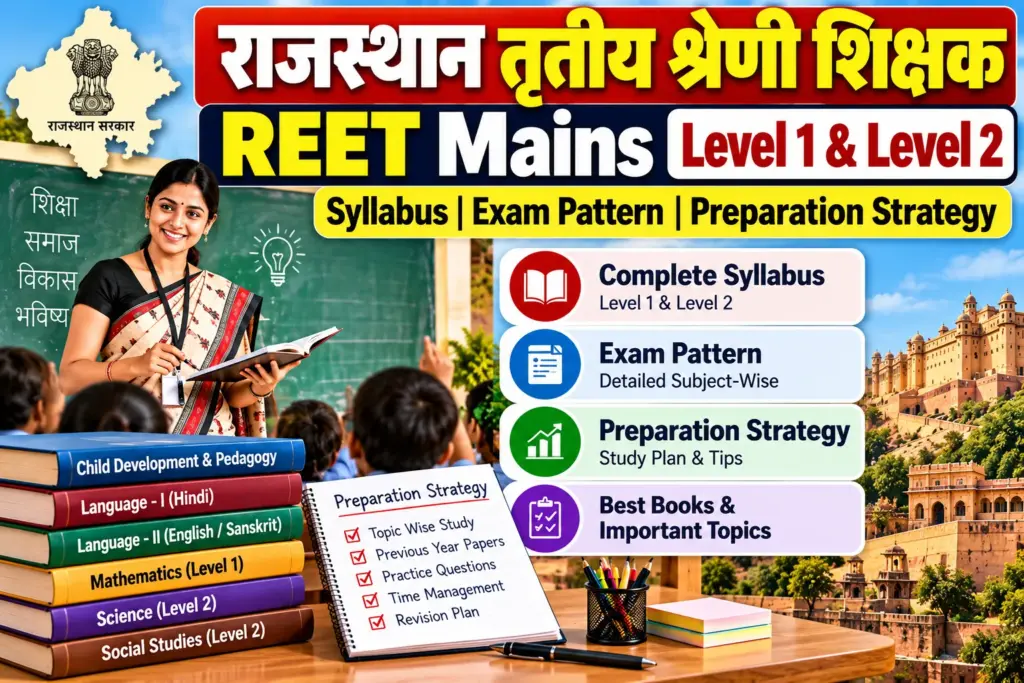
Rajasthan 3rd Grade Teacher Syllabus 2026: REET Mains Level 1 & Level 2 Exam Pattern and Preparation Strategy.If you are preparing for the Rajasthan 3rd Grade Teacher Recruitment 2026, understanding the syllabus should be your first priority. The syllabus gives you a clear idea of what to study, which subjects carry more marks and where you need to spend more time during preparation.
The Rajasthan 3rd Grade Teacher exam is conducted for Primary Teacher (Level 1) and Upper Primary Teacher (Level 2) posts. Both levels have a 300-mark written examination, but the subjects and marks distribution are different.
Here is a complete and easy-to-understand overview of the Rajasthan 3rd Grade Teacher Syllabus 2026, including the exam pattern, subject-wise topics and practical preparation strategy.
Overview of Rajasthan 3rd Grade Teacher Syllabus 2026
| Particular | Details |
|---|---|
| Exam Name | Rajasthan 3rd Grade Teacher / REET Mains |
| Levels | Level 1 & Level 2 |
| Posts | Primary Teacher & Upper Primary Teacher |
| Exam Mode | Offline |
| Questions | 150 |
| Total Marks | 300 |
| Duration | 2 Hours 30 Minutes |
| Question Type | Objective Type |
| Negative Marking | 1/3 mark for each wrong answer |
| Papers | Paper 1 & Paper 2 |
| REET Mains Syllabus PDF [Primary Teacher] | Download PDF |
| REET Mains Syllabus PDF [Upper Primary Teacher] | Download PDF |
Rajasthan 3rd Grade Teacher Exam Pattern 2026
Before getting into the detailed syllabus, it is important to understand the paper pattern.
The written examination consists of 150 objective-type questions for 300 marks. Candidates get 2 hours and 30 minutes to complete the paper.
Each correct answer carries 2 marks, while 1/3 mark is deducted for every incorrect answer.
This makes accuracy just as important as attempting a good number of questions.
Rajasthan 3rd Grade Teacher Level 1 Exam Pattern
Level 1 is for candidates preparing for the Primary Teacher post.
| Subject | Marks |
|---|---|
| Rajasthan Geography, History, Culture & Language | 80 |
| General Knowledge of Rajasthan | 80 |
| Educational Psychology | 20 |
| Teaching Methodology | 40 |
| Hindi Language | 20 |
| English Language | 20 |
| Mathematics | 10 |
| General Science | 10 |
| Social Studies | 10 |
| Educational Technology & ICT | 10 |
| Total | 300 |
Rajasthan-specific sections together form a major portion of the Level 1 paper, so candidates should give them regular attention instead of leaving Rajasthan GK and history for the final stage.
Rajasthan 3rd Grade Teacher Level 1 Syllabus 2026
1. Rajasthan Geography, History, Culture & Language
This is one of the biggest sections of Level 1.
Rajasthan Geography
The syllabus includes:
- Geographical structure of Rajasthan
- Climate and monsoon system
- Drainage system
- Lakes, rivers and dams
- Forest resources
- Wildlife and wildlife conservation
- Soils and soil conservation
- Major crops
- Population
- Population density
- Literacy and sex ratio
- Tribes and tribal areas
- Metallic and non-metallic minerals
- Energy resources
- Traditional and non-traditional energy resources
- Major tourist places
- Transport in Rajasthan
Rajasthan History and Culture
Candidates need to prepare:
- Ancient civilizations of Rajasthan
- Kalibanga
- Ahar
- Ganeshwar
- Balathal
- Bairat
- Important historical events
- Major dynasties
- Administrative and revenue systems
- Forts and monuments
- Architecture
- Fairs and festivals
- Folk art
- Folk music
- Folk drama
- Folk dances
- Cultural traditions and heritage
- Religious movements
- Saints and folk deities
- Important historical sites
- Major personalities
- Traditional clothes and jewellery
- Paintings and handicrafts
- Rajasthan’s contribution to the Revolt of 1857
- Tribal and peasant movements
- Prajamandal movement
- Unification of Rajasthan
Rajasthani Language
The syllabus also covers:
- Regional dialects
- Major Rajasthani literary works
- Important Rajasthani writers
- Saint literature
- Folk literature
2. General Knowledge of Rajasthan
The Rajasthan GK section includes topics related to the state’s administration, culture, schemes and important places.
Important areas are:
- Symbols of Rajasthan
- Flagship schemes of the state government
- Major research centres
- Religious places
- Major players of Rajasthan
- Famous cities and places
- Major industries
- Political and administrative system
- Public welfare schemes
Educational Scenario
Candidates should also study:
- Innovations in teaching-learning
- Student welfare schemes
- Government awards
- School management
- School management committees
- National Education Policy 2020 in the context of Rajasthan
Right to Education
Important topics include:
- Right of Children to Free and Compulsory Education Act, 2009
- Major provisions of the Act
- Implementation
- Rajasthan Right of Children to Free and Compulsory Education Rules, 2011
- Free admission provisions in recognised private schools
Current Affairs
Preparation should include:
- Rajasthan current affairs
- Development plans
- State government initiatives
- Important current events
3. Educational Psychology
Educational Psychology is another important part of the Level 1 paper.
The syllabus covers:
- Meaning, scope and functions of educational psychology
- Child development
- Principles of child development
- Factors affecting development
- Heredity and environment
- Personality
- Types of personality
- Factors affecting personality
- Measurement of personality
- Intelligence
- Theories of intelligence
- Measurement of intelligence
- Meaning of learning
- Factors affecting learning
- Learning theories
- Learning processes
- Diverse learners
- Gifted learners
- Creative learners
- Children with special needs
- Learning difficulties
- Motivation and its impact on learning
- Adjustment
- Methods of adjustment
- Role of teacher in adjustment
Preparation Tip: Don’t simply memorise definitions in Educational Psychology. Try to understand the concept and then solve MCQs. This makes revision much easier.
4. Teaching Methodology
Teaching Methodology focuses on how different subjects are taught and evaluated in the classroom.
Hindi Teaching
- Methods of teaching Hindi
- Listening, speaking, reading and writing skills
- Development of language skills
- Approaches to Hindi teaching
- Problems in Hindi teaching
- Teaching-learning aids
- Evaluation methods
- Diagnostic teaching
- Remedial teaching
English Teaching
- Principles of teaching English
- Communicative English language teaching
- Methods of teaching English
- Difficulties in learning English
- Role of home language
- Multilingualism
- Evaluation methods
- Remedial teaching
Mathematics Teaching
- Methods of teaching mathematics
- Approaches to mathematics teaching
- Problems in mathematics teaching
- Teaching aids
- Evaluation
- Diagnostic teaching
- Remedial teaching
Science Teaching
- Science teaching methods
- Approaches to science teaching
- Science teaching aids
- Evaluation methods
- Diagnostic teaching
- Remedial teaching
Social Studies Teaching
- Concept and nature of social studies
- Teaching-learning aids
- Problems in teaching social studies
- Project work
- Evaluation
- Diagnostic teaching
- Remedial teaching
5. Hindi Language
The Hindi section focuses mainly on grammar and language usage.
Important topics include:
- Noun
- Pronoun
- Adjective
- Verb
- Adverb
- Conjunction
- Compounds
- Word formation
- Word correction
- Idioms
- Proverbs
- Word conversion
Regular practice is useful here because grammar-based questions become easier with repeated revision.
6. English Language
Important topics include:
- Articles
- Tenses
- Voice
- Narration
- Idioms and proverbs
- Phrasal verbs
- One-word substitution
Candidates should also work on comprehension and vocabulary while preparing English.
7. Mathematics
The Level 1 Mathematics syllabus includes:
- Whole numbers
- Prime and composite numbers
- Fractions
- Decimal numbers
- Basic mathematical operations
- Prime factors
- HCF
- LCM
- Percentage
- Profit and Loss
- Simple Interest
- Compound Interest
- Lines and angles
- Perimeter
- Area of plane figures
8. General Science
Important Science topics are:
- Acids, bases and salts
- Elements
- Compounds and mixtures
- Physical and chemical changes
- Motion
- Force
- Laws of motion
- Light
- Cell structure and function
- Respiration
- Transportation in living organisms
- Reproduction in animals
9. Social Studies
The Social Studies syllabus includes:
- Introduction to Rajasthan
- Mughal Empire
- Economy of Rajasthan
- Major landforms of the Earth
- Natural vegetation of India
- Wildlife
- Wildlife conservation
- Agriculture in Rajasthan
- Indian Constitution
- Contribution of Rajasthan in the making of the Constitution
- Public Administration in Rajasthan
- Pedagogical methodology
10. Educational Technology & ICT
This section covers the basics of technology and its use in education.
Important topics include:
- Fundamentals of Information Technology
- IT tools
- Applications of Information Technology
- Social impact of Information Technology
Rajasthan 3rd Grade Teacher Level 2 Exam Pattern 2026
Level 2 is for Upper Primary Teacher preparation.
| Subject | Marks |
|---|---|
| Rajasthan Geography, History & Culture | 80 |
| General Knowledge of Rajasthan | 50 |
| Educational Psychology & Policies | 50 |
| Language / Subject Section | 120 |
| Total | 300 |
The 120-mark section includes the relevant subject/language combination such as:
- Hindi
- English
- Sanskrit
- Sindhi
- Punjabi
- Social Studies
- Mathematics & Science
Rajasthan 3rd Grade Teacher Level 2 Syllabus
Rajasthan Geography, History & Culture
Candidates should cover Rajasthan’s:
- Geography
- History
- Culture
- Important historical events
- Major personalities
- Fairs and festivals
- Folk traditions
- Art and literature
- Cultural heritage
General Knowledge of Rajasthan
Important areas include:
- Rajasthan geography
- History
- Culture
- Political system
- Administrative system
- Economy
- Government schemes
- Important places
- Major personalities
- Current affairs
- Educational developments
Level 2 Hindi Syllabus
The Hindi syllabus includes:
- Hindi alphabet
- Noun
- Pronoun
- Adjective
- Verb
- Adverb
- Gender
- Number
- Tense
- Case
- Word formation
- Synonyms
- Antonyms
- One-word substitution
- Group words
- Sentence construction
- Prefixes
- Suffixes
- Word correction
- Sentence correction
- Sentence types
- Sentence transformation
- Idioms
- Proverbs
- Word power
- Unseen prose passage
- Unseen poetry passage
- Grammar related to passages
Level 2 English Syllabus
Important topics include:
- Parts of speech
- Tenses
- Voice
- Narration
- Transformation
- Conditional sentences
- Idioms and proverbs
- Phrasal verbs
- One-word substitution
- Clauses
- Subject-verb agreement
- Synonyms and antonyms
- Literary terms
- Modal auxiliaries
- Prepositions
- Unseen prose
- Unseen poetry
- English sounds
- Phonetic symbols
Level 2 Mathematics Syllabus
The Mathematics section covers:
Number System
- Natural numbers
- Whole numbers
- Integers
- Rational numbers
- Real numbers
- Number operations
Algebra
- Algebraic expressions
- Identities
- Simplification
- BODMAS
- Linear equations
- Factorisation
- Factors and multiples
- HCF and LCM
Geometry and Mensuration
- Plane geometry
- Solid geometry
- Lines and angles
- Area
- Volume
- Practical applications
Data and Statistics
- Data tabulation
- Pictographs
- Bar graphs
- Pie charts
- Mean
- Median
- Mode
- Graphs and charts
Arithmetic and Other Topics
- Ratio and proportion
- Profit and loss
- Simple interest
- Compound interest
- Time and work
- Time, distance and speed
- Probability
- Symmetry
- Patterns
- Reflection
- Rotation
- Transformation of solid shapes
Level 2 Science Syllabus
Important Science topics include:
- Matter and its states
- Molecules
- Structure of matter
- Properties of substances
- Classification of substances
- Separation of substances
- Scientific processes
- Observation and inference
- Force and motion
- Energy
- Newton’s laws
- Sound
- Light
- Reflection
- Refraction
- Lenses and mirrors
- Magnetism
- Electricity
- Current and resistance
- Electric circuits
- Pollution
- Conservation
- Ecosystem
- Recycling
- Nutrition
- Health and diseases
- Deficiency diseases
- Scientific principles
- Scientific inventions
- Natural resources
- Atomic structure
- Work and energy
- Important scientific laws
- Scientists and their contributions
Level 2 Social Studies Syllabus
History
- Indus Valley Civilization
- Vedic Culture
- Jainism and Buddhism
- Mauryan period
- Gupta period
- Mauryan economy
- Kautilya’s Arthashastra
- Delhi Sultanate
- Mughal period
- Prithviraj Chauhan
- Indian National Movement
Geography
- Major landforms
- Volcanoes
- Earthquakes
- World map
- Continents
- Oceans
- Map reading
- Forest resources
- Agriculture
- Industrial development
- Climate and weather
Indian Constitution and Polity
- Constitutional development
- Preamble
- Fundamental Rights
- Directive Principles
- Fundamental Duties
- Legislature
- Executive
- Judiciary
- Local governance
- 73rd Constitutional Amendment
- 74th Constitutional Amendment
- Democratic process
- Women’s representation
- Federal structure
- Centre-State relations
Economics
- Indian economic system
- Economic sectors
- Post-liberalisation economy
- Privatisation
- Globalisation
- World Trade Organization
- Planning
- Food security
- Consumer rights
- National income
- Human development
- Agriculture and irrigation in Rajasthan
- Public distribution system
How to Prepare for Rajasthan 3rd Grade Teacher Exam 2026?
A long syllabus can look difficult at first, but the preparation becomes manageable once you divide it into smaller parts.
Start With Rajasthan
Rajasthan GK, history, geography and culture are important parts of the examination. Make short notes and revise them regularly.
Give Proper Time to Pedagogy
Educational Psychology and Teaching Methodology should not be treated as secondary subjects. Understand the concepts and practise objective questions.
Improve Language Sections Through Practice
Hindi and English require regular practice. Instead of studying grammar once and leaving it, revise important rules repeatedly and solve MCQs.
Practise Mathematics and Science
Even though some sections carry fewer marks, they should not be ignored. A few marks can become important when the overall competition is close.
Solve Previous-Year Questions
Previous-year questions help you understand how concepts are converted into actual exam questions. They are also useful for identifying your weak areas.
Attempt Mock Tests
Start with sectional tests and then move towards full-length papers. Always analyse your mistakes after completing a test.
90-Day Preparation Strategy
Days 1–30: Build Your Base
Complete the basics of:
- Rajasthan Geography
- Rajasthan History
- Rajasthan Culture
- Rajasthan GK
- Educational Psychology
- Hindi
- English
Days 31–60: Complete the Syllabus
Focus on:
- Teaching Methodology
- Mathematics
- Science
- Social Studies
- ICT
- Language-specific topics
- Current affairs
Along with this, start solving previous-year questions.
Days 61–90: Revision Mode
The final month should be used for:
- Complete syllabus revision
- Short notes
- Previous-year papers
- Mock tests
- Current affairs revision
- Weak-topic improvement
- Time management practice
Rajasthan 3rd Grade Teacher Preparation Tips
Don’t try to finish everything in one go. Complete one topic, revise it and then move ahead.
Keep Rajasthan GK in daily study. Regular revision is much more effective than studying the entire Rajasthan section just before the exam.
Maintain short notes. Especially for history, geography, schemes, important personalities and current affairs.
Practise with a timer. Since the exam has 150 questions to be completed in 150 minutes, speed and accuracy both matter.
Analyse every mock test. The purpose of a mock test is not just to see your score. Find out why you got questions wrong and revise those topics.