
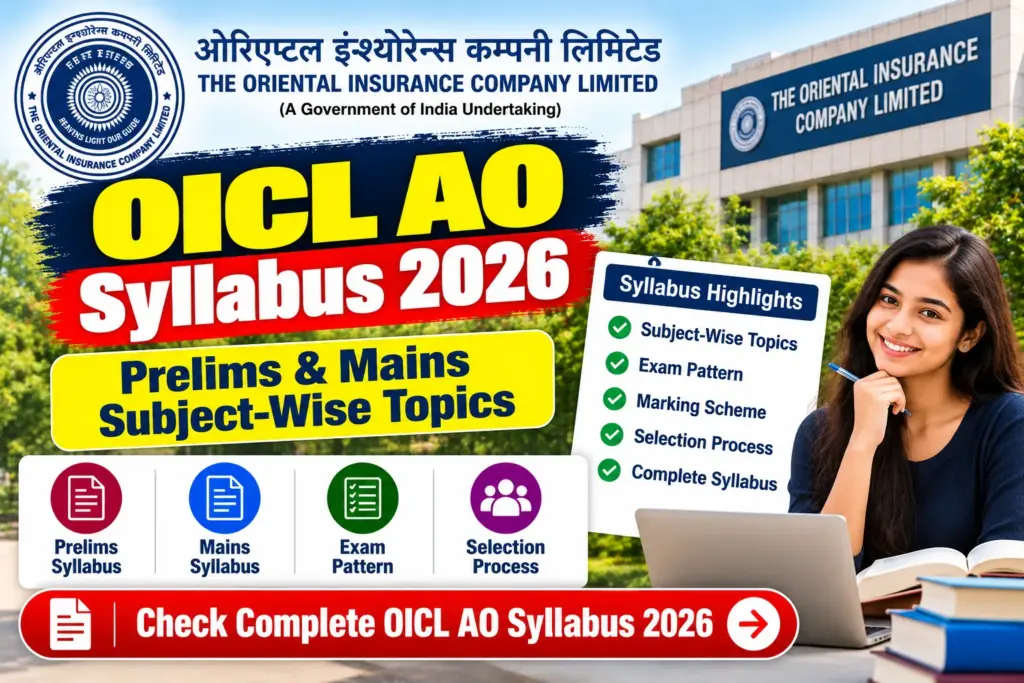
OICL AO Syllabus 2026: Check Prelims & Mains Subject-Wise Topics, Exam Pattern and Selection Process.Candidates preparing for the OICL Administrative Officer (AO) Recruitment 2026 should understand the syllabus before starting their preparation. Knowing which subjects are included in Prelims and Mains makes it easier to plan daily study, select the right books and practise the topics that matter.
The Oriental Insurance Company Limited (OICL) conducts the Administrative Officer examination in multiple stages. The Preliminary examination tests candidates in Reasoning Ability, Quantitative Aptitude and English Language. The Mains examination covers these subjects along with General Awareness and Professional Knowledge. Candidates also need to prepare for the descriptive English paper and interview.
In this article, you will find the OICL AO Syllabus 2026, the exam pattern for both stages, subject-wise topics, selection process and practical preparation tips.
Overview of OICL AO Syllabus 2026
| Particulars | Details |
|---|---|
| Organisation | Oriental Insurance Company Limited |
| Post Name | Administrative Officer |
| Scale | Scale-I |
| Examination | OICL AO 2026 |
| Selection Process | Prelims, Mains and Interview |
| Prelims Subjects | Reasoning, Quantitative Aptitude, English |
| Mains Subjects | Reasoning, English, Quantitative Aptitude, General Awareness, Professional Knowledge |
| Prelims Questions | 100 |
| Prelims Marks | 100 |
| Mains Objective Questions | 200 |
| Mains Objective Marks | 200 |
| Prelims Duration | 60 minutes |
| Mains Objective Duration | 150 minutes |
| Descriptive Test | 30 marks |
| Negative Marking | 0.25 mark for each incorrect answer |
| Website Link | https://orientalinsurance.org.in/careers |
OICL AO Selection Process 2026
The OICL AO selection process has three stages. Candidates must qualify in the required examination stages to progress towards final selection.
- Preliminary Examination: An objective test covering Reasoning Ability, Quantitative Aptitude and English Language.
- Main Examination: An objective examination covering five subjects, followed by a descriptive English test.
- Interview: Candidates shortlisted after Mains are called for the interview stage.
The final merit calculation described in the supplied recruitment material gives 80% weightage to the online examination and 20% to the interview. The descriptive test is qualifying in nature and its marks are not included in the final merit score.
OICL AO Exam Pattern 2026
Understanding the exam pattern is just as important as knowing the syllabus. Both Prelims and Mains have sectional timing, so candidates should practise completing questions within the time available for each section.
OICL AO Prelims Exam Pattern
The Preliminary examination contains 100 objective-type questions for 100 marks. Candidates get 60 minutes to complete the paper, with 20 minutes allotted to each section.
| Subject | Questions | Marks | Duration |
|---|---|---|---|
| Reasoning Ability | 35 | 35 | 20 minutes |
| Quantitative Aptitude | 35 | 35 | 20 minutes |
| English Language | 30 | 30 | 20 minutes |
| Total | 100 | 100 | 60 minutes |
Marking Scheme:
- Each correct answer carries 1 mark.
- A deduction of 0.25 mark applies to each incorrect answer.
- Each section has a separate time limit of 20 minutes.
Exam Tip: Do not spend too much time on a single puzzle or calculation. Since the sections have fixed timings, practise selecting questions that you can solve accurately and quickly.
OICL AO Mains Exam Pattern
The Mains objective examination carries 200 marks and contains 200 questions. It is divided into five sections, each with its own time limit.
| Subject | Questions | Marks | Duration |
|---|---|---|---|
| Reasoning Ability | 40 | 40 | 30 minutes |
| English Language | 40 | 40 | 30 minutes |
| General Awareness | 40 | 40 | 25 minutes |
| Quantitative Aptitude | 40 | 40 | 30 minutes |
| Professional Knowledge | 40 | 40 | 35 minutes |
| Total | 200 | 200 | 150 minutes |
Each correct answer carries 1 mark, while 0.25 mark is deducted for every incorrect answer.
OICL AO Mains Descriptive Test
Along with the objective examination, candidates should prepare for the descriptive English test. It carries 30 marks and has a duration of 30 minutes.
| Component | Marks |
|---|---|
| Letter Writing | 10 |
| Essay Writing | 20 |
| Total | 30 |
The descriptive test is qualifying in nature. The minimum qualifying marks mentioned in the supplied material are:
- General category: 15 out of 30
- SC/ST/PwBD categories: 13.5 out of 30
The descriptive marks are not added to the final merit score.
OICL AO Syllabus 2026: Subject-Wise Topics
The syllabus is divided into different subjects for Prelims and Mains. Reasoning, English and Quantitative Aptitude are common to both stages, while General Awareness and Professional Knowledge are additional Mains subjects.
1. Reasoning Ability Syllabus
Reasoning Ability tests a candidate’s logical thinking, analytical skills and ability to solve problems. Questions may involve arrangements, relationships, sequences and logical conclusions.
Important topics include:
- Inequalities
- Seating Arrangement
- Linear and Circular Arrangement
- Puzzles and Tabulation
- Floor-Based Puzzles
- Box-Based Puzzles
- Syllogism
- Blood Relations
- Coding-Decoding
- Input-Output
- Alphanumeric Series
- Ranking and Order
- Direction Sense
- Alphabet Test
- Logical Reasoning
- Data Sufficiency
- Coded Inequalities
Preparation Tip: Start with basic topics such as direction sense, blood relations, syllogism and coding-decoding. Once your concepts are clear, move to lengthy puzzles and seating arrangements. Regular timed practice will help improve both speed and accuracy.
2. English Language Syllabus
The English Language section checks grammar, vocabulary, reading ability and understanding of written passages. Candidates should work on both accuracy and reading speed.
Important topics include:
- Reading Comprehension
- Cloze Test
- Fill in the Blanks
- Error Spotting
- Sentence Correction
- Paragraph Completion
- Para Jumbles
- Sentence Rearrangement
- Phrase Replacement
- Column-Based Questions
- Word Swap
- Multiple Meaning Words
- Spelling Errors
- Miscellaneous Grammar Questions
Preparation Tip: Read an English newspaper or editorial regularly. Practise grammar questions every day and learn new words in context instead of memorising long vocabulary lists without examples.
3. Quantitative Aptitude Syllabus
Quantitative Aptitude is an important section in both Prelims and Mains. It includes calculation-based questions, arithmetic problems, number series and Data Interpretation.
The syllabus covers the following topics:
Simplification and Approximation
- BODMAS
- Squares and Cubes
- Square Roots and Cube Roots
- Indices
- Fractions
- Percentages
- Approximation
Number Series and Inequality
- Missing Number Series
- Wrong Number Series
- Double Pattern Series
- Statement-Based Series
- Linear Equations
- Quadratic Equations
- Quantity Comparison
- Statement-Based Questions
Arithmetic
- Ratio and Proportion
- Percentage
- Number System
- HCF and LCM
- Basic Algebra
- Average
- Problems on Ages
- Partnership
- Mixture and Allegation
- Simple Interest
- Compound Interest
- Time and Work
- Pipe and Cistern
- Profit and Loss
- Discount
- Speed, Time and Distance
- Boats and Streams
- Problems on Trains
- Mensuration (2D and 3D)
- Probability
- Permutation and Combination
Data Interpretation
- Table DI
- Missing Table DI
- Pie Chart
- Line Graph
- Bar Graph
- Mixed Data Interpretation
- Caselet DI
- Radar DI
- Arithmetic DI
Data Sufficiency
- Two-Statement Data Sufficiency
- Three-Statement Data Sufficiency
Preparation Tip: Build a strong foundation in percentage, ratio, average, profit and loss, time and work, and interest. These concepts are useful for solving many arithmetic questions. Also practise different types of Data Interpretation sets under a time limit.
4. General Awareness Syllabus
General Awareness is included in the Mains examination. This section covers current events, banking and financial awareness, the Indian financial system and important national and international developments.
Important topics include:
- National Current Affairs
- International Current Affairs
- National Appointments
- Important International Developments
- Banking Awareness
- Indian Financial System
- History of the Indian Banking Industry
- Regulatory Bodies
- Monetary and Credit Policies
- Budget Basics
- Current Union Budget
- Economic News
- Economic Terminologies
- International Organisations
- Financial Institutions
- Capital Market
- Money Market
- Government Schemes
- Important Summits
- Books and Authors
- Awards and Honours
- Sports
- Defence News
- Important Abbreviations
- Important Days
- Obituaries
- Static General Knowledge
Preparation Tip: Make short daily notes of important national, international, banking and economic news. Revise these notes regularly because studying current affairs only once is rarely enough for a competitive examination.
5. Professional Knowledge Syllabus
Professional Knowledge is an important part of the OICL AO Mains examination. The questions are related to the candidate’s relevant discipline or professional stream.
The topics may differ according to the post or discipline. Areas mentioned in the supplied material include:
- Information Technology
- Legal
- Marketing
- Finance
- Accounts
Candidates should prepare the core concepts of their respective professional subjects. Rather than studying every discipline, focus on the subject relevant to the post for which you are applying.
Preparation Tip: Check the discipline mentioned in your recruitment application and organise your preparation around that subject. Revise fundamental concepts and practise questions related to your professional area.
How to Prepare for OICL AO Exam 2026?
A good preparation strategy should cover both Prelims and Mains. Preparing only for Prelims can create difficulties later because Mains includes additional subjects and a descriptive paper.
Here are some practical steps to organise your preparation.
1. Understand the Syllabus First
Before purchasing books or starting mock tests, go through the complete syllabus. Make a checklist of all subjects and topics. Mark the topics you already understand and identify the areas that need more attention.
2. Give Regular Time to Quantitative Aptitude
Practise calculation-based questions daily. Start with basic arithmetic and gradually move towards Data Interpretation, number series and other advanced topics.
3. Improve Reasoning Speed
Solve a mixture of easy and difficult reasoning questions. Give special attention to puzzles, seating arrangements, syllogism, coding-decoding and data sufficiency.
4. Strengthen English Grammar and Reading
Read regularly and practise comprehension passages, cloze tests, error spotting and sentence correction. Do not ignore letter and essay writing because the Mains examination includes a descriptive test.
5. Follow Current Affairs Consistently
Prepare national and international current affairs along with banking and financial awareness. Make concise notes and revise them at regular intervals.
6. Prepare Professional Knowledge Alongside Other Subjects
Do not leave Professional Knowledge until the final weeks. Give it regular study time according to your relevant discipline.
7. Practise Mock Tests with Sectional Timing
Since both Prelims and Mains have sectional time limits, full-length practice alone is not sufficient. Take individual sectional tests as well. After each mock test, review incorrect answers and questions that took too long to solve.
OICL AO Preparation: 90-Day Study Plan
Candidates who have around three months for preparation can follow a structured plan like this. Adjust the schedule according to your current preparation level.
| Period | Main Focus | What to Cover |
|---|---|---|
| Days 1–30 | Build the Basics | Reasoning concepts, arithmetic fundamentals, English grammar and reading |
| Days 31–60 | Complete the Syllabus | Puzzles, Data Interpretation, advanced arithmetic, General Awareness and Professional Knowledge |
| Days 61–75 | Practice | Sectional tests, full-length mock tests and descriptive writing |
| Days 76–90 | Revision | Important formulas, current affairs, weak topics and mock test analysis |
Daily Study Timetable for OICL AO
A consistent daily routine can help candidates cover all the subjects without ignoring any important section.
| Study Session | Subject | Suggested Time |
|---|---|---|
| Morning | Quantitative Aptitude | 1.5 hours |
| Morning | Reasoning Ability | 1.5 hours |
| Afternoon | English Language | 1 hour |
| Afternoon | General Awareness | 1 hour |
| Evening | Professional Knowledge | 1.5 hours |
| Evening | Revision and Practice | 1 hour |
Candidates should also practise letter and essay writing regularly, particularly during the Mains preparation phase.
Common Mistakes to Avoid During OICL AO Preparation
Even candidates who study for several hours daily can lose marks because of avoidable preparation mistakes.
- Ignoring sectional timing: Practise each section within its actual time limit.
- Preparing only for Prelims: Start General Awareness and Professional Knowledge preparation early.
- Skipping revision: Revisit formulas, grammar rules, vocabulary and current affairs regularly.
- Attempting questions without accuracy: Negative marking makes random guessing risky.
- Ignoring descriptive writing: Practise writing letters and essays within the given time.
- Not analysing mock tests: Understand why an answer was incorrect instead of simply moving to the next test.
OICL AO Syllabus 2026: Frequently Asked Questions
Q1. What is the syllabus for OICL AO 2026?
The OICL AO syllabus includes Reasoning Ability, Quantitative Aptitude and English Language in Prelims. Mains includes Reasoning, English, Quantitative Aptitude, General Awareness and Professional Knowledge.
Q2. How many questions are asked in the OICL AO Prelims examination?
The Preliminary examination contains 100 questions carrying 100 marks.
Q3. What is the duration of the OICL AO Prelims exam?
The Prelims examination is conducted for 60 minutes, with 20 minutes allotted to each of the three sections.
Q4. How many questions are asked in OICL AO Mains?
The Mains objective examination contains 200 questions for a total of 200 marks.
Q5. Is there negative marking in the OICL AO examination?
Yes. A deduction of 0.25 mark is made for each incorrect answer in the objective examination.
Q6. Is General Awareness included in Prelims?
The General Awareness section is included in the Mains examination, not in the three-section Prelims pattern described above.
Q7. What are the subjects in the OICL AO Mains examination?
The five subjects are Reasoning Ability, English Language, General Awareness, Quantitative Aptitude and Professional Knowledge.
Q8. Is there a descriptive paper in OICL AO Mains?
Yes. The descriptive English test carries 30 marks and includes letter writing and essay writing under the pattern described in this article.
Q9. What is the syllabus for Professional Knowledge?
Professional Knowledge is based on the candidate’s relevant discipline. Areas mentioned include IT, Legal, Marketing, Finance and Accounts.
Q10. What is the OICL AO selection process?
The selection process consists of Preliminary Examination, Main Examination and Interview.
Q11. Are descriptive test marks included in the final merit list?
No. The descriptive test is qualifying in nature, and its marks are not included in the final merit score.
Q12. How should I start preparing for OICL AO 2026?
Begin by understanding the syllabus and exam pattern. Build your basics in Reasoning, Quantitative Aptitude and English, while preparing General Awareness and Professional Knowledge for Mains.