
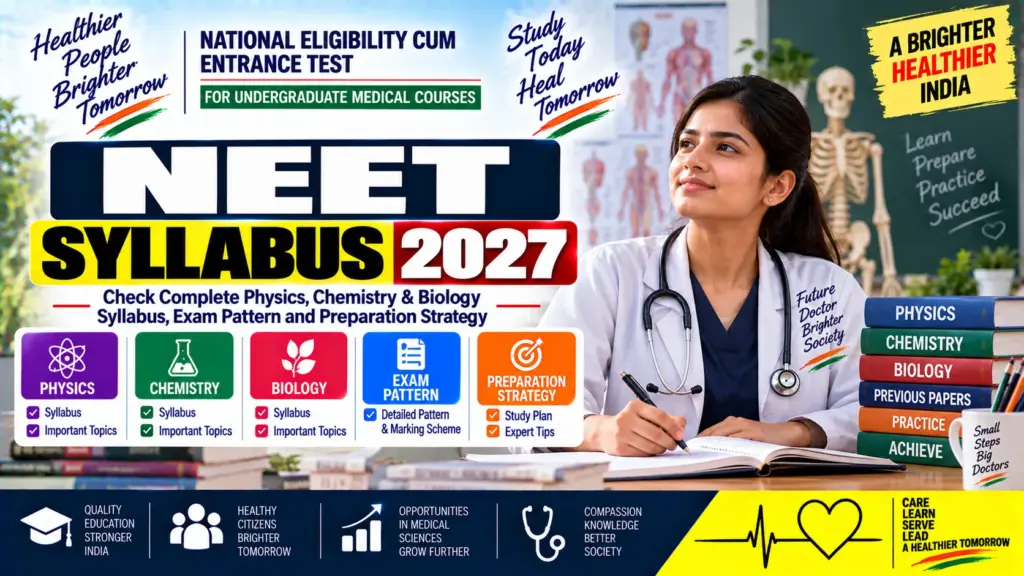
NEET Syllabus 2027: Check Complete Physics, Chemistry & Biology Syllabus, Exam Pattern and Preparation Strategy.Preparing for NEET becomes much easier when you know exactly what needs to be studied. The NEET Syllabus 2027 covers three core subjects — Physics, Chemistry and Biology — with topics drawn from the Class 11 and Class 12 level.
For many students, the biggest challenge is not finding study material but managing such a large syllabus. A clear chapter-wise plan can help you decide what to study, what to revise and where more practice is needed.
The syllabus material available for NEET 2027 covers detailed topics from Physics, Chemistry and Biology. Candidates should also keep checking the latest official examination update for any changes before beginning their final preparation.
Overview of NEET Syllabus 2027
| Particulars | Details |
|---|---|
| Exam Name | National Eligibility cum Entrance Test (NEET UG) |
| Session | 2027 |
| Subjects | Physics, Chemistry and Biology |
| Physics | Class 11 & Class 12 Topics |
| Chemistry | Physical, Inorganic & Organic Chemistry |
| Biology | Botany & Zoology |
| Main Study Base | Class 11 & 12 Curriculum |
| Question Type | Objective Type |
| Correct Answer | +4 Marks |
| Incorrect Answer | -1 Mark |
| Unanswered | 0 Marks |
Important: Candidates should match their preparation with the latest official NEET 2027 notification and syllabus whenever the final examination documents are issued or updated.
NEET 2027 Subject-Wise Syllabus
The complete syllabus is divided into:
- Physics
- Chemistry
- Biology
Instead of trying to complete all three subjects simultaneously, students can divide their preparation into smaller weekly targets.
NEET Physics Syllabus 2027
Physics requires a combination of conceptual understanding, formula revision and numerical practice. Reading a chapter once is rarely enough; students should solve questions after completing every major topic.
The major Physics chapters are:
- Physics and Measurements
- Kinematics
- Laws of Motion
- Work, Energy and Power
- Rotational Motion
- Gravitation
- Properties of Solids and Liquids
- Thermodynamics
- Kinetic Theory of Gases
- Oscillations and Waves
- Electrostatics
- Current Electricity
- Magnetic Effects of Current and Magnetism
- Electromagnetic Induction and Alternating Currents
- Electromagnetic Waves
- Optics
- Dual Nature of Matter and Radiation
- Atoms and Nuclei
- Electronic Devices
- Experimental Skills
1. Physics and Measurements
This chapter covers the fundamentals required for numerical and experimental questions.
Important topics include:
- Units of measurement
- SI units
- Fundamental and derived units
- Least count
- Significant figures
- Errors in measurement
- Dimensions of physical quantities
- Dimensional analysis
- Applications of dimensional analysis
2. Kinematics
Students need to understand how objects move and how their motion can be represented mathematically.
Topics include:
- Frame of reference
- Motion in a straight line
- Position-time graphs
- Speed and velocity
- Average speed
- Instantaneous velocity
- Uniform and non-uniform motion
- Uniformly accelerated motion
- Velocity-time graphs
- Scalars and vectors
- Vector addition and subtraction
- Resolution of vectors
- Relative velocity
- Motion in a plane
- Projectile motion
- Uniform circular motion
3. Laws of Motion
Important areas include:
- Force and inertia
- Newton’s laws of motion
- Momentum
- Impulse
- Conservation of linear momentum
- Equilibrium of concurrent forces
- Static friction
- Kinetic friction
- Rolling friction
- Centripetal force
- Circular motion
- Vehicles on level and banked roads
Exam Tip: Don’t just memorise Newton’s laws. Practise applying them to different situations, especially friction and circular-motion problems.
4. Work, Energy and Power
Topics include:
- Work done by constant force
- Work done by variable force
- Kinetic energy
- Potential energy
- Work-energy theorem
- Power
- Spring potential energy
- Conservation of mechanical energy
- Conservative and non-conservative forces
- Vertical circular motion
- Elastic collisions
- Inelastic collisions
- One-dimensional and two-dimensional collisions
5. Rotational Motion
Prepare the following:
- Centre of mass
- Centre of mass of a two-particle system
- Centre of mass of a rigid body
- Torque
- Moment of force
- Angular momentum
- Conservation of angular momentum
- Moment of inertia
- Radius of gyration
- Parallel axis theorem
- Perpendicular axis theorem
- Equilibrium of rigid bodies
- Rotational motion
- Equations of rotational motion
- Comparison between linear and rotational motion
6. Gravitation
Important topics are:
- Universal law of gravitation
- Acceleration due to gravity
- Variation of gravity with altitude and depth
- Kepler’s laws
- Gravitational potential
- Gravitational potential energy
- Escape velocity
- Satellites
- Orbital velocity
- Time period of satellites
- Energy of satellites
7. Properties of Solids and Liquids
Properties of Solids
- Elastic behaviour
- Stress and strain
- Hooke’s law
- Young’s modulus
- Bulk modulus
- Modulus of rigidity
Properties of Fluids
- Pressure
- Pascal’s law
- Fluid pressure
- Viscosity
- Stokes’ law
- Terminal velocity
- Streamline flow
- Turbulent flow
- Bernoulli’s principle
Surface and Thermal Properties
- Surface tension
- Surface energy
- Angle of contact
- Excess pressure
- Drops and bubbles
- Capillary rise
- Heat and temperature
- Thermal expansion
- Specific heat capacity
- Calorimetry
- Change of state
- Latent heat
- Heat transfer
- Conduction
- Convection
- Radiation
8. Thermodynamics
Important topics include:
- Thermal equilibrium
- Zeroth law of thermodynamics
- Temperature
- Heat
- Work
- Internal energy
- First law of thermodynamics
- Isothermal processes
- Adiabatic processes
- Second law of thermodynamics
- Reversible processes
- Irreversible processes
9. Kinetic Theory of Gases
The syllabus includes:
- Equation of state of an ideal gas
- Work done during compression
- Assumptions of kinetic theory
- Pressure of a gas
- Kinetic interpretation of temperature
- RMS speed
- Degrees of freedom
- Law of equipartition of energy
- Specific heat capacities
- Mean free path
- Avogadro’s number
10. Oscillations and Waves
Important topics are:
- Periodic motion
- Time period
- Frequency
- Displacement as a function of time
- Simple harmonic motion
- SHM equation
- Phase
- Spring oscillations
- Restoring force
- Force constant
- Energy in SHM
- Simple pendulum
- Wave motion
- Longitudinal waves
- Transverse waves
- Progressive waves
- Superposition
- Reflection of waves
- Standing waves
- Strings and organ pipes
- Fundamental mode
- Harmonics
- Beats
11. Electrostatics
Prepare:
- Electric charges
- Conservation of charge
- Coulomb’s law
- Superposition principle
- Continuous charge distribution
- Electric field
- Electric field lines
- Electric dipole
- Electric field due to a dipole
- Torque on a dipole
- Electric potential
- Potential difference
- Capacitors
- Combination of capacitors
- Energy stored in capacitors
12. Current Electricity
Important topics include:
- Electric current
- Drift of electrons
- Resistance
- Resistivity
- Conductivity
- Ohm’s law
- Temperature dependence of resistance
- Series and parallel combinations
- Electrical energy
- Electrical power
- Cells
- Combination of cells
- Kirchhoff’s laws
- Wheatstone bridge
- Metre bridge
13. Magnetic Effects of Current and Magnetism
Topics include:
- Magnetic field
- Biot-Savart law
- Ampere’s law
- Force on a moving charge
- Force on a current-carrying conductor
- Motion of charged particles
- Magnetic dipole
- Torque on a magnetic dipole
- Earth’s magnetism
- Magnetic materials
14. Electromagnetic Induction and Alternating Currents
Important areas include:
- Faraday’s law
- Lenz’s law
- Electromagnetic induction
- Induced EMF
- Eddy currents
- Self-induction
- Mutual induction
- Alternating current
- RMS value
- Reactance
- Impedance
- Resonance
- Transformers
15. Electromagnetic Waves
Students should cover:
- Electromagnetic waves
- Characteristics of electromagnetic waves
- Electromagnetic spectrum
- Applications of different regions of the spectrum
16. Optics
Ray Optics
- Reflection
- Refraction
- Spherical mirrors
- Mirror formula
- Refraction through lenses
- Lens formula
- Magnification
- Total internal reflection
- Optical instruments
Wave Optics
- Wavefront
- Huygens’ principle
- Interference
- Young’s double-slit experiment
- Diffraction
- Polarisation
17. Dual Nature of Matter and Radiation
Important topics:
- Photoelectric effect
- Einstein’s photoelectric equation
- Dual nature of radiation
- Matter waves
- de Broglie wavelength
18. Atoms and Nuclei
Atoms
- Atomic models
- Bohr model
- Energy levels
- Hydrogen spectrum
Nuclei
- Nuclear composition
- Nuclear size
- Mass defect
- Binding energy
- Radioactivity
- Nuclear reactions
- Nuclear fission
- Nuclear fusion
19. Electronic Devices
Topics include:
- Semiconductors
- Intrinsic and extrinsic semiconductors
- p-n junction
- Semiconductor diode
- Rectifiers
- LED
- Photodiode
- Solar cell
- Zener diode
- Logic gates
20. Experimental Skills
Candidates should also understand the practical side of Physics, including:
- Basic measurement techniques
- Experimental observations
- Errors
- Graphs
- Instruments
- Practical applications of Physics concepts
NEET Chemistry Syllabus 2027
Chemistry is divided into three sections:
- Physical Chemistry
- Inorganic Chemistry
- Organic Chemistry
Each section needs a slightly different preparation strategy.
Physical Chemistry
Important chapters include:
Some Basic Concepts in Chemistry
- Mole concept
- Atomic and molecular masses
- Stoichiometry
- Chemical equations
- Concentration terms
Atomic Structure
- Atomic models
- Quantum numbers
- Electronic configuration
- Atomic orbitals
- Fundamental particles
Chemical Bonding and Molecular Structure
- Ionic bonding
- Covalent bonding
- Lewis structures
- VSEPR theory
- Hybridisation
- Molecular shapes
- Molecular orbital concepts
- Hydrogen bonding
Chemical Thermodynamics
- System and surroundings
- State functions
- Internal energy
- Enthalpy
- Heat and work
- Thermochemical equations
- Hess’s law
- Entropy
- Gibbs energy
Equilibrium
- Chemical equilibrium
- Equilibrium constant
- Le Chatelier’s principle
- Ionic equilibrium
- Acids and bases
- pH
- Buffer solutions
- Solubility equilibrium
Redox Reaction and Electrochemistry
- Oxidation and reduction
- Oxidation number
- Redox reactions
- Electrochemical cells
- Electrode potential
- Nernst equation
- Conductance
- Electrolysis
Solutions
- Types of solutions
- Concentration
- Solubility
- Vapour pressure
- Colligative properties
Chemical Kinetics
- Rate of reaction
- Rate law
- Order of reaction
- Molecularity
- Half-life
- Activation energy
- Arrhenius equation
Inorganic Chemistry
The major areas are:
Classification of Elements and Periodicity
- Periodic table
- Periodic law
- Atomic radius
- Ionisation energy
- Electron gain enthalpy
- Electronegativity
- Periodic trends
p-Block Elements
- General properties
- Important compounds
- Chemical reactions
- Oxidation states
- Periodic trends
d- and f-Block Elements
- Transition elements
- General properties
- Oxidation states
- Magnetic behaviour
- Lanthanoids
- Actinoids
Coordination Compounds
- Coordination entities
- Ligands
- Coordination number
- Nomenclature
- Isomerism
- Bonding
- Geometry
- Magnetic properties
- Applications
Organic Chemistry
The syllabus covers:
- Basic principles of Organic Chemistry
- General Organic Chemistry
- Purification and characterization of organic compounds
- Hydrocarbons
- Organic compounds containing halogens
- Organic compounds containing oxygen
- Organic compounds containing nitrogen
- Biomolecules
- Principles related to practical chemistry
Preparation Tip
Organic Chemistry becomes much easier when students understand why a reaction occurs rather than trying to memorise dozens of reactions separately. Make short reaction notes and revise them frequently.
NEET Biology Syllabus 2027
Biology covers both Botany and Zoology and contains a wide range of topics.
The major areas are:
- Diversity in Living Organisms
- Structural Organisation in Animals and Plants
- Cell Structure and Function
- Plant Physiology
- Human Physiology
- Reproduction
- Genetics and Evolution
- Biology and Human Welfare
- Biotechnology and Its Applications
- Ecology and Environment
1. Diversity in Living Organisms
Important topics include:
- What is living?
- Biodiversity
- Classification
- Taxonomy
- Systematics
- Binomial nomenclature
- Monera
- Protista
- Fungi
- Viruses
- Lichens
- Plant classification
- Animal classification
- Non-chordates
- Chordates
2. Structural Organisation in Animals and Plants
Topics include:
- Plant morphology
- Plant modifications
- Plant tissues
- Plant anatomy
- Animal tissues
- Digestive system
- Respiratory system
- Circulatory system
- Related practical concepts
3. Cell Structure and Function
Students should prepare:
- Cell theory
- Cell structure
- Prokaryotic cells
- Eukaryotic cells
- Cell organelles
- Biomolecules
- Proteins
- Carbohydrates
- Enzymes
- Mitosis
- Meiosis
4. Plant Physiology
Important topics include:
- Photosynthesis
- Photosynthetic pathways
- Cellular respiration
- Glycolysis
- TCA cycle
- Plant growth
- Plant development
- Growth regulators
- Auxins
- Gibberellins
- Cytokinins
5. Human Physiology
This section covers:
- Breathing
- Respiratory organs
- Circulatory system
- Heart
- Blood circulation
- Excretory system
- Kidney function
- Nervous system
- Muscular system
6. Reproduction
Sexual Reproduction in Plants
- Sexual reproduction
- Fertilisation
- Reproductive structures
Human Reproduction
- Male reproductive system
- Female reproductive system
- Fertilisation
- Pregnancy
Reproductive Health
- Reproductive health
- Contraception
- Related concepts
7. Genetics and Evolution
Important topics include:
- Mendelian inheritance
- Chromosomal disorders
- Molecular basis of inheritance
- DNA and genetic information
- Evolution theories
- Human evolution
8. Biology and Human Welfare
Topics include:
- Pathogens
- Human diseases
- Malaria
- HIV
- Immunology
- Vaccines
- Microbes
- Microbes in human welfare
9. Biotechnology and Its Applications
Prepare:
- Genetic engineering
- Recombinant DNA technology
- Biotechnology in healthcare
- Agricultural applications
- Genetically modified organisms
- Gene therapy
10. Ecology and Environment
Important topics include:
- Ecosystems
- Energy flow
- Biodiversity
- Conservation
- Biodiversity hotspots
- Extinction
- Red Data Book
- Biosphere reserves
NEET 2027 Preparation Strategy
A good NEET preparation plan doesn’t have to be complicated. What matters is following it consistently.
Start With the Syllabus
Make a chapter checklist for all three subjects and divide chapters into weekly targets.
A simple tracking system can be:
Not Started → In Progress → Completed → Revised → Tested
This makes it easier to identify unfinished portions.
Focus on NCERT-Based Preparation
For Biology and Chemistry in particular, students should read the relevant textbook content carefully instead of depending only on coaching notes.
Underline important points, revise diagrams and make short notes for topics that you repeatedly forget.
Solve Questions After Every Chapter
Don’t wait until the complete syllabus is finished.
Once a chapter is completed:
- Solve chapter-wise questions.
- Check incorrect answers.
- Note recurring mistakes.
- Revise weak concepts.
- Attempt the chapter again after some time.
Subject-Wise Strategy
Physics
Spend more time solving numerical questions. Keep a formula notebook, but make sure you understand when and how each formula is used.
Chemistry
Use different methods for the three sections. Practise numerical questions in Physical Chemistry, revise reactions in Organic Chemistry and repeatedly revise important concepts in Inorganic Chemistry.
Biology
Read carefully and revise frequently. Use diagrams, tables and short notes to remember lengthy information.
NEET 2027 90-Day Preparation Plan
| Period | Main Focus |
|---|---|
| Days 1–30 | Complete pending syllabus and strengthen concepts |
| Days 31–50 | Chapter-wise question practice |
| Days 51–70 | Previous-year questions and mixed tests |
| Days 71–80 | Full-length mock tests |
| Days 81–90 | Final revision and mistake analysis |
Days 1–30
Finish pending chapters and strengthen weak areas.
Days 31–50
Increase question-solving practice and revise completed chapters.
Days 51–70
Focus on previous-year questions and mixed-topic tests.
Days 71–80
Take full-length tests under exam-like conditions.
Days 81–90
Concentrate on revision, formulas, reactions, diagrams and mistakes.
Common Mistakes to Avoid
Studying Without a Plan
Jumping between random chapters can leave important topics unfinished.
Ignoring Class 11
Don’t postpone Class 11 chapters until the end. Keep revising them alongside Class 12 topics.
Only Watching Lectures
Lectures can help with understanding, but question practice is necessary to test that understanding.
Skipping Revision
Completing a chapter once does not mean you will remember it until the examination.
Ignoring Mistakes
Keep a small mistake notebook and revise it before tests.
Depending Only on High-Weightage Topics
Previous-year trends can help you plan revision, but they cannot tell you exactly what will appear in NEET 2027.