
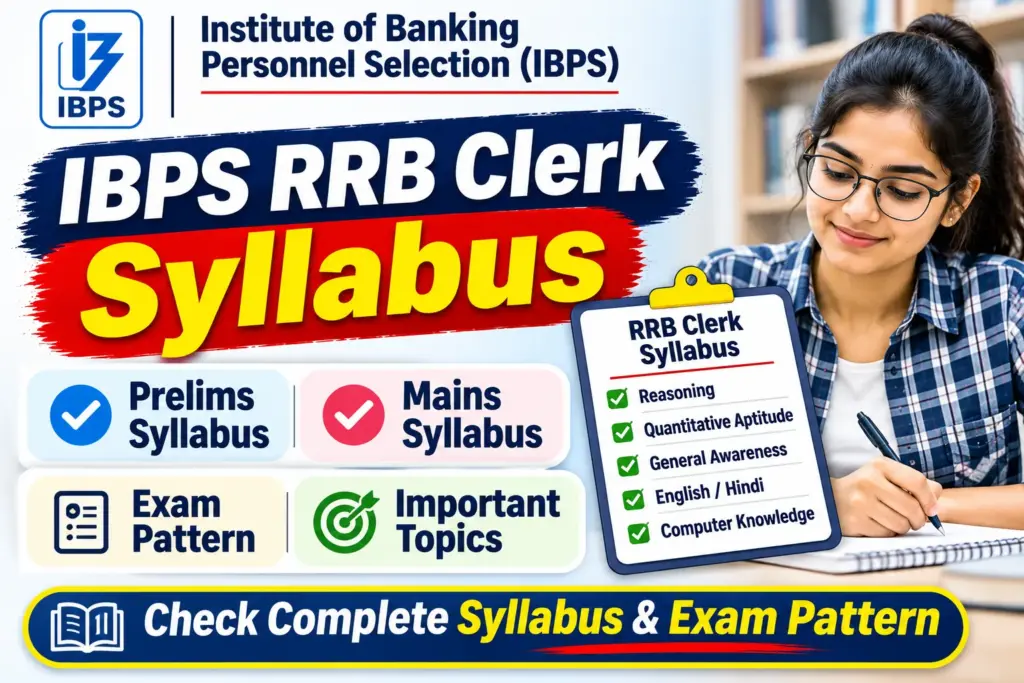
IBPS RRB Clerk Syllabus 2026: Check Complete Prelims & Mains Syllabus, Exam Pattern and Important Topics.Preparing for the IBPS RRB Clerk Exam 2026? Before starting your preparation, it is important to know exactly what the examination covers and how the questions are distributed across different subjects. A clear understanding of the syllabus can help you avoid unnecessary study material and spend more time on topics that matter.
The Institute of Banking Personnel Selection (IBPS) conducts the Regional Rural Banks recruitment examination for the post of Office Assistant (Multipurpose), commonly known as RRB Clerk. The selection process consists of two online examinations: Prelims and Mains. Candidates who qualify in Prelims are shortlisted for the Mains examination. There is no interview for the Office Assistant post.
The IBPS RRB Clerk Prelims 2026 is scheduled for 6, 12 and 13 December 2026, while the Mains examination is scheduled for 30 January 2027, according to the examination schedule included in the supplied material.
The Prelims paper focuses on Reasoning Ability and Numerical Ability. The Mains examination covers five subjects, adding General Awareness, English or Hindi Language, and Computer Knowledge. Here is a closer look at the complete syllabus, exam pattern and topics candidates should cover during preparation.
Overview of IBPS RRB Clerk Syllabus 2026
| Particulars | Details |
|---|---|
| Conducting Body | Institute of Banking Personnel Selection (IBPS) |
| Examination | IBPS RRB Clerk 2026 |
| Post | Office Assistant (Multipurpose) |
| Selection Process | Prelims and Mains |
| Prelims Exam Dates | 6, 12 and 13 December 2026 |
| Mains Exam Date | 30 January 2027 |
| Exam Mode | Online |
| Prelims Questions | 80 |
| Prelims Marks | 80 |
| Mains Questions | 200 |
| Mains Marks | 200 |
| Negative Marking | 0.25 marks for each incorrect answer |
| Interview | No |
| Official Website | ibps.in |
IBPS RRB Clerk Exam Pattern 2026
The first thing candidates should understand is the difference between the Prelims and Mains examinations. Prelims is the screening stage, while the Mains examination plays the deciding role in the final selection.
Both examinations are conducted online and contain objective-type questions. There is also a separate time limit for individual sections, so candidates need to practise answering questions within the allotted time.
IBPS RRB Clerk Prelims Exam Pattern
The Preliminary Examination tests candidates in two areas: Reasoning Ability and Numerical Ability. Both sections carry equal marks, but the time allotted to each is different.
| Section | Questions | Marks | Time |
|---|---|---|---|
| Reasoning Ability | 40 | 40 | 25 minutes |
| Numerical Ability | 40 | 40 | 20 minutes |
| Total | 80 | 80 | 45 minutes |
Candidates get 25 minutes for Reasoning and 20 minutes for Numerical Ability. They should therefore practise each section separately instead of relying only on full-length tests.
IBPS RRB Clerk Mains Exam Pattern
The Mains examination is broader and includes five sections. Reasoning and Numerical Ability carry 50 marks each, while General Awareness, the language section and Computer Knowledge account for the remaining marks.
| Section | Questions | Marks | Time |
|---|---|---|---|
| Reasoning Ability | 40 | 50 | 30 minutes |
| Numerical Ability | 40 | 50 | 30 minutes |
| General Awareness | 40 | 40 | 15 minutes |
| English/Hindi Language | 40 | 40 | 30 minutes |
| Computer Knowledge | 40 | 20 | 15 minutes |
| Total | 200 | 200 | 120 minutes |
Points to remember:
- The Mains examination has 200 questions carrying 200 marks.
- Candidates can choose either English or Hindi for the language section.
- Each section has a separate time limit.
- A penalty of 0.25 marks applies for every incorrect answer.
- There is no interview for the Office Assistant post.
- Final selection is based on Mains marks and the applicable allotment conditions.
IBPS RRB Clerk Prelims Syllabus 2026
The Prelims syllabus is limited to two subjects, but that does not mean candidates can prepare casually. With only 45 minutes available, speed and accuracy are equally important.
1. Reasoning Ability
Reasoning questions test how well candidates understand patterns, relationships and logical conditions. Puzzles and seating arrangements are important parts of this section, but candidates should not ignore the shorter topics that can help them save time.
The following topics are included in the Reasoning syllabus:
| Topic | What to Prepare |
|---|---|
| Seating Arrangement | Linear, circular, triangular, rectangular and square arrangements |
| Puzzles | Floor-based, floor-flat, box-based and scheduling puzzles |
| Syllogism | Statements, conclusions and possibility-based questions |
| Inequality | Direct and coded inequalities |
| Coding-Decoding | Letter, number, symbol and pattern-based coding |
| Blood Relations | Family relationships and coded relations |
| Direction Sense | Direction, distance and movement-based questions |
| Order and Ranking | Ranking from left, right, top and bottom |
| Alphabet/Number/Symbol Series | Identifying patterns and sequences |
| Pair Formation | Letter pairs, number pairs and word-based pairs |
| Word Formation | Creating meaningful words from given letters |
| Data Sufficiency | Questions based on the information provided |
| Miscellaneous Reasoning | Analogy, classification and other logical questions |
Topics to prioritise: Puzzles, seating arrangements, syllogism, inequality, coding-decoding, blood relations and alphanumeric series are useful areas to include in regular practice.
2. Numerical Ability
Numerical Ability checks calculation skills and the ability to solve mathematical problems accurately. Candidates should build their basics in arithmetic before moving towards lengthy calculations and data interpretation sets.
The topic-wise syllabus includes:
| Topic | What to Prepare |
|---|---|
| Simplification | BODMAS, fractions, decimals, square roots and cube roots |
| Approximation | Estimation and approximate calculations |
| Number Series | Missing and wrong number series |
| Quadratic Equations | Solving equations and comparing values |
| Number System | Number system, HCF and LCM |
| Percentage | Basic and successive percentage calculations |
| Ratio and Proportion | Ratio, proportion and distribution |
| Average | Simple and combined averages |
| Profit and Loss | Cost price, selling price, profit and loss |
| Discount | Marked price and discount calculations |
| Simple Interest | Interest-based calculations |
| Compound Interest | Compound interest problems |
| Partnership | Investment and profit-sharing questions |
| Mixture and Alligation | Mixture-based calculations |
| Problems on Ages | Age-related questions |
| Time and Work | Work efficiency and combined work |
| Pipes and Cisterns | Filling and emptying problems |
| Time, Speed and Distance | Speed, distance and time |
| Trains | Train-based problems |
| Boats and Streams | Upstream and downstream calculations |
| Mensuration | 2D and 3D measurements |
| Data Interpretation | Tables, bar graphs, line graphs, pie charts and caselets |
Topics to prioritise: Simplification, approximation, data interpretation, number series and arithmetic should receive consistent attention. Regular calculation practice can make a noticeable difference in this section.
IBPS RRB Clerk Mains Syllabus 2026
The Mains examination requires preparation across five subjects. Candidates should continue practising Reasoning and Numerical Ability while giving enough time to General Awareness, the chosen language and Computer Knowledge.
1. Reasoning Ability
The Mains Reasoning syllabus includes advanced versions of familiar Prelims topics. Questions may involve several conditions, multiple variables or a combination of logical concepts.
Important topics include:
- Advanced puzzles and multi-variable arrangements
- Linear, circular, parallel-row, square and rectangular seating arrangements
- Floor and floor-flat puzzles
- Box-based puzzles involving colour, size and distribution
- Scheduling based on days, dates, months and years
- Input-output and coded input-output
- Data sufficiency based on two or three statements
- Advanced coding-decoding
- Coded inequality
- Blood relations and coded blood relations
- Direction and distance
- Order and ranking
- Syllogism and possibility-based questions
- Statement and assumption
- Statement and conclusion
- Statement and inference
- Cause and effect
- Course of action
- Statement and argument
- Decision making
Candidates should practise puzzles regularly and learn how to identify which questions can be solved quickly. Spending too much time on one complicated set can affect performance in the remaining section.
2. Numerical Ability
The Mains Numerical Ability section covers arithmetic, advanced data interpretation and calculation-based questions. A good understanding of basic mathematical concepts is essential for handling questions that combine different topics.
| Topic | Detailed Coverage |
|---|---|
| Data Interpretation | Table, bar, line, pie, caselet and mixed DI |
| Arithmetic DI | Percentage, ratio, average, interest and profit-based data |
| Simplification | Multi-step calculations |
| Approximation | Estimation and approximate values |
| Number Series | Missing, wrong and double-pattern series |
| Quadratic Equations | Root comparison and equation-based questions |
| Percentage | Basic and successive percentage changes |
| Ratio and Proportion | Distribution and comparison |
| Average | Combined and weighted average |
| Profit, Loss and Discount | Marked price and successive discounts |
| Simple and Compound Interest | Interest calculations and comparisons |
| Partnership | Capital, duration and profit sharing |
| Mixture and Alligation | Price and concentration-based problems |
| Problems on Ages | Complex age relationships |
| Time and Work | Efficiency and combined work |
| Pipes and Cisterns | Filling, emptying and leakage |
| Time, Speed and Distance | Relative and average speed |
| Trains | Crossing-based problems |
| Boats and Streams | Upstream and downstream |
| Mensuration | Two-dimensional and three-dimensional figures |
| Probability | Events and selection |
| Permutation and Combination | Arrangement and selection |
| Quantity Comparison | Comparison of mathematical quantities |
| Data Sufficiency | Statement-based arithmetic questions |
3. General Awareness
General Awareness is included in the Mains examination. This section covers current events as well as banking, finance and economic developments. Since the examination is for recruitment in Regional Rural Banks, candidates should also pay attention to rural banking and related institutions.
The major areas to prepare are:
| Topic | Important Areas |
|---|---|
| Current Affairs | National and international events |
| State Current Affairs | Important state-level developments |
| Banking Awareness | Banking system, terminology and RBI |
| Financial Awareness | Financial markets and institutions |
| Economy | Economic developments and policies |
| Government Schemes | Important schemes and applications |
| Awards and Honours | National and international awards |
| Books and Authors | Important publications |
| Important Days | Dates, themes and organisations |
| Sports | Tournaments, winners and records |
| Appointments | Important appointments |
| Reports and Indices | Rankings, reports and issuing organisations |
| Defence News | Military exercises and developments |
| Science and Technology | Important scientific developments |
| International Affairs | Global events and India’s international relations |
| Obituaries | Important personalities |
Banking Awareness topics:
Candidates should also prepare the following banking-related areas:
- Reserve Bank of India and its functions
- Monetary policy and banking rates
- Repo rate, CRR, SLR, MSF and SDF
- Banking terminology
- Savings, current, fixed and recurring deposit accounts
- UPI, NEFT, RTGS, IMPS and AePS
- Digital banking and payment systems
- Non-Performing Assets (NPA)
- Priority Sector Lending
- Deposit insurance and DICGC
- Banking Ombudsman
- Financial inclusion
- NABARD and rural banking
- Basel norms and banking risks
4. English Language
Candidates opting for English should prepare grammar, vocabulary and comprehension. Reading regularly can help improve understanding of passages, while practice questions can improve accuracy in sentence-based topics.
The English Language syllabus includes:
- Reading Comprehension
- Cloze Test
- Fill in the Blanks
- Error Detection
- Error Correction
- Phrase Replacement
- Sentence Rearrangement
- Word Rearrangement
- Phrase Rearrangement
- Word Swap
- Match the Column
- Connectors
- Starters
- Word Usage
- Spelling Errors
- Idioms and Phrases
- One-Word Inference
5. Hindi Language
Candidates who are more comfortable with Hindi can choose the Hindi Language section. Preparation should cover comprehension, vocabulary, grammar and sentence correction.
The important topics are:
- अपठित गद्यांश
- समानार्थक शब्द
- विलोम शब्द
- रिक्त स्थान
- गद्यांश में रिक्त स्थानों की पूर्ति
- वाक्य में त्रुटि
- शब्द त्रुटि
- वर्तनी त्रुटि
- वाक्यांश के लिए एक शब्द
- मुहावरे और लोकोक्तियाँ
Candidates should choose their language carefully and practise it throughout their preparation rather than leaving it for the final weeks.
6. Computer Knowledge
Computer Knowledge is another section of the Mains examination. The syllabus covers basic computer concepts, operating systems, networking, internet applications and computer security.
| Topic | Detailed Coverage |
|---|---|
| Computer Fundamentals | History, introduction and types of computers |
| Generations of Computers | Different generations of computers |
| Hardware and Software | Operating systems and software types |
| Input and Output Devices | Keyboard, mouse, monitor, printer and other devices |
| Computer Memory | Primary and secondary memory |
| Number System | Binary numbers and conversions |
| Computer Languages | Generations and types of languages |
| DBMS | Database Management System basics |
| Computer Networks | TCP/IP, OSI model, protocols and topology |
| Internet | Basic concepts and terminology |
| Internet Applications | Email, chatting, e-commerce and browsers |
| Network and Data Security | Firewall, virus, malware, spyware and antivirus |
| Cyber Crime and Cyber Security | Online threats and security measures |
| Multimedia | Audio, video, animation and streaming |
| MS Windows | Introduction and basic functions |
| MS Office | MS Word, Excel and PowerPoint |
| Shortcut Keys | Computer and MS Office shortcuts |
| Computer Abbreviations | Important computer-related abbreviations |
IBPS RRB Clerk Syllabus 2026: Important Topics to Focus On
Candidates often spend too much time trying to cover every topic equally. A better approach is to understand the syllabus, identify frequently practised areas and build a balanced study routine.
The following topics are worth including in your regular revision:
| Subject | Topics to Focus On |
|---|---|
| Reasoning Ability | Puzzles, seating arrangement, syllogism, inequality and coding-decoding |
| Numerical Ability | Simplification, data interpretation, number series and arithmetic |
| General Awareness | Current affairs, banking awareness and financial awareness |
| English Language | Reading comprehension, error detection, cloze test and sentence rearrangement |
| Hindi Language | अपठित गद्यांश, वाक्य त्रुटि, रिक्त स्थान and शब्दावली |
| Computer Knowledge | Computer fundamentals, MS Office, networking and internet |
The number of questions from individual topics can change from one examination shift to another. Therefore, candidates should use topic-wise weightage only as a preparation guide, not as a guarantee of what will appear in the paper.
How to Prepare for IBPS RRB Clerk Exam 2026?
A common mistake among banking aspirants is to focus heavily on one subject and leave the remaining sections for later. This can create problems, particularly in Mains, where candidates have to manage five different subjects.
A more practical approach is to divide preparation into smaller daily targets.
1. Start with the syllabus
Keep the complete syllabus in front of you and mark topics as you finish them. This will help you track progress and identify areas that need revision.
2. Practise Reasoning every day
Begin with basic topics such as syllogism, inequality, blood relations and coding-decoding. Once you become comfortable with these, move towards seating arrangements and complex puzzles.
3. Improve calculation speed
Practise multiplication tables, squares, cubes, fractions and percentage conversions. Regular practice of simplification and approximation can also help you save time in Numerical Ability.
4. Do not ignore Data Interpretation
Solve different types of DI sets, including tables, pie charts, bar graphs, line graphs and caselets. Focus on understanding the information before attempting calculations.
5. Make General Awareness part of your routine
Study current affairs and banking-related topics regularly. Revise important information instead of trying to memorise everything in one sitting.
6. Prepare your chosen language
Select English or Hindi according to your comfort level. Work on comprehension, grammar and vocabulary through regular practice.
7. Revise Computer Knowledge
Cover computer fundamentals, MS Office, networking, internet terminology and cyber security. Make short notes of important terms and abbreviations for quick revision.
8. Take mock tests and analyse them
Mock tests are useful only when you review your performance afterwards. Check which questions took too much time, where you made mistakes and which topics need more practice.
Frequently Asked Questions (FAQs)
Q1. What is the IBPS RRB Clerk Syllabus 2026?
The Prelims syllabus includes Reasoning Ability and Numerical Ability. The Mains syllabus includes Reasoning Ability, Numerical Ability, General Awareness, English or Hindi Language and Computer Knowledge.
Q2. How many stages are there in the IBPS RRB Clerk selection process?
There are two stages: Preliminary Examination and Main Examination.
Q3. Is there an interview for IBPS RRB Clerk 2026?
No. The Office Assistant (Multipurpose) selection process does not include an interview.
Q4. How many questions are asked in the IBPS RRB Clerk Prelims?
The Prelims examination has 80 questions: 40 from Reasoning Ability and 40 from Numerical Ability.
Q5. What is the duration of the IBPS RRB Clerk Prelims exam?
The total duration is 45 minutes, with 25 minutes for Reasoning and 20 minutes for Numerical Ability.
Q6. How many questions are asked in the IBPS RRB Clerk Mains exam?
The Mains examination consists of 200 questions carrying 200 marks.
Q7. What is the duration of the IBPS RRB Clerk Mains exam?
The total duration of the Mains examination is 120 minutes.
Q8. Is there negative marking in the IBPS RRB Clerk examination?
Yes. A deduction of 0.25 marks is applicable for every incorrect answer.
Q9. Can candidates choose Hindi for the Mains language section?
Yes. Candidates can choose either English or Hindi for the language section.
Q10. When will the IBPS RRB Clerk 2026 examinations be conducted?
As per the schedule included in the supplied material, Prelims will be held on 6, 12 and 13 December 2026, followed by Mains on 30 January 2027.