
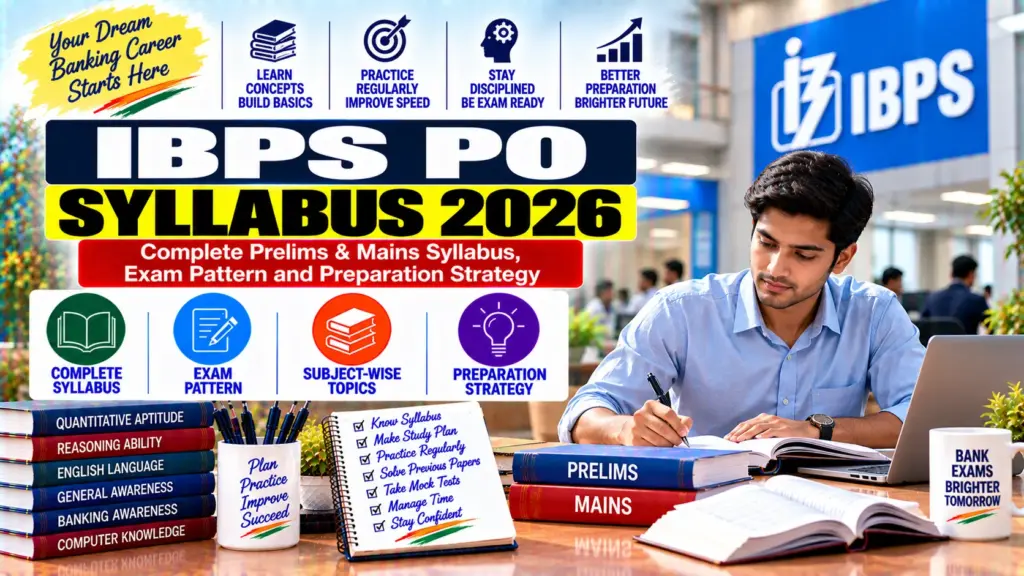
IBPS PO Syllabus 2026: Complete Prelims & Mains Syllabus, Exam Pattern and Preparation Strategy.The IBPS PO exam is one of the most popular banking examinations among graduates looking to build a career as a Probationary Officer in public sector banks. Every year, a large number of candidates appear for the exam, but clearing it requires more than just knowing the syllabus. Candidates need to understand the exam pattern, manage sectional timing, improve calculation speed and stay updated with banking and current affairs.
For IBPS PO 2026, the revised examination pattern makes it even more important to prepare according to the latest structure. The Prelims exam covers English Language, Quantitative Aptitude and Reasoning Ability, while the Mains exam goes deeper into Reasoning, Data Analysis and Interpretation, General/Economy/Banking/Digital/Financial Awareness and English, along with the Descriptive paper.
Here is a detailed and easy-to-understand guide to the IBPS PO Syllabus 2026, including the subject-wise topics, exam pattern and a practical preparation strategy.
IBPS PO Syllabus 2026: Overview
| Particulars | Details |
|---|---|
| Exam Name | IBPS PO/MT 2026 |
| Post | Probationary Officer/Management Trainee |
| Conducting Body | Institute of Banking Personnel Selection |
| Mode of Exam | Online |
| Selection Process | Prelims, Mains, Personality Test and Interview |
| Prelims Questions | 100 |
| Prelims Marks | 100 |
| Prelims Duration | 60 Minutes |
| Mains Objective Questions | 170 |
| Mains Objective Marks | 200 |
| Descriptive Paper | 25 Marks |
| Negative Marking | 1/4th mark for wrong answers |
The examination is conducted in multiple stages. Candidates first have to clear the Preliminary Examination before moving ahead to the Mains stage.
IBPS PO Exam Pattern 2026
Understanding the exam pattern before starting preparation is important because IBPS PO is not only a test of knowledge but also a test of speed and time management.
IBPS PO Prelims Exam Pattern
The Preliminary Examination consists of three sections.
| Subject | Questions | Marks | Time |
|---|---|---|---|
| English Language | 30 | 30 | 20 Minutes |
| Quantitative Aptitude | 35 | 30 | 20 Minutes |
| Reasoning Ability | 35 | 40 | 20 Minutes |
| Total | 100 | 100 | 60 Minutes |
Each section has a separate time limit of 20 minutes. Candidates cannot use the remaining time from one section for another section.
There is negative marking for incorrect answers. One-fourth of the marks assigned to a question is deducted for a wrong answer.
IBPS PO Prelims Syllabus 2026
The Prelims syllabus is divided into three subjects:
- English Language
- Quantitative Aptitude
- Reasoning Ability
Let’s understand each section in detail.
1. IBPS PO English Language Syllabus
The English section mainly tests a candidate’s understanding of grammar, vocabulary, reading ability and sentence structure.
Important Topics
- Reading Comprehension
- Cloze Test
- Para Jumbles
- Fill in the Blanks
- Error Detection
- Error Spotting
- Sentence Correction
- Paragraph Completion
- Word Usage
- Word Swap
- One Word Substitution
- Synonyms and Antonyms
- Idioms and Phrases
- Vocabulary
- Grammar
- Sentence Rearrangement
How to Prepare English
English can become a scoring section if practised regularly. Candidates should develop the habit of reading English articles, editorials and other informative content.
Along with reading, practise grammar-based questions and solve at least one comprehension passage regularly.
Preparation Tip: Maintain a small vocabulary notebook and revise newly learned words instead of simply reading them once.
2. IBPS PO Quantitative Aptitude Syllabus
Quantitative Aptitude is all about understanding concepts and solving questions quickly. Candidates who are comfortable with basic calculations generally find it easier to improve their performance in this section.
Important Topics
- Simplification
- Approximation
- Number System
- Number Series
- Sequence and Series
- Percentage
- Ratio and Proportion
- Average
- Profit and Loss
- Simple Interest
- Compound Interest
- Mixture and Alligation
- Time and Work
- Time, Speed and Distance
- Mensuration
- Quadratic Equations
- Surds and Indices
- Linear Equations
- Permutation and Combination
- Probability
- Data Interpretation
- Data Sufficiency
Data Interpretation
Candidates should practise different types of DI questions, including:
- Table DI
- Bar Graph
- Line Graph
- Pie Chart
- Caselet DI
- Missing DI
- Mixed DI
Exam Tip: Don’t spend too much time calculating everything manually. Learn approximation and faster calculation techniques wherever applicable.
3. IBPS PO Reasoning Ability Syllabus
Reasoning is an important section in both Prelims and Mains. While Prelims generally focuses on shorter questions and manageable sets, Mains requires candidates to handle more complex puzzles and analytical problems.
Important Topics
- Logical Reasoning
- Puzzles
- Seating Arrangement
- Syllogism
- Inequality
- Coding-Decoding
- Blood Relations
- Direction and Distance
- Ranking
- Alphanumeric Series
- Input-Output
- Data Sufficiency
- Ordering
- Tabulation
- Pair Formation
- Missing Series
- Odd One Out
- Analytical Reasoning
Important Puzzle Topics
Candidates should practise:
- Circular Seating Arrangement
- Linear Seating Arrangement
- Floor-Based Puzzle
- Box-Based Puzzle
- Designation-Based Puzzle
- Parallel Row Arrangement
- Square/Rectangular Arrangement
- Floor and Flat Puzzle
- Day/Date/Month Puzzle
- Year/Age Puzzle
- Scheduling Puzzle
Remember: In the actual examination, solving every puzzle is not necessary. The key is to identify the questions that can be solved accurately within the available time.
IBPS PO Mains Syllabus 2026
The Mains examination is more comprehensive than Prelims. Candidates need to work on advanced reasoning and DI along with banking, financial awareness and English.
The objective portion consists of:
- Reasoning Ability
- Data Analysis & Interpretation
- General/Economy/Banking/Digital/Financial Awareness
- English Language
A Descriptive English paper of 25 marks is also included.
1. Reasoning Ability
The Mains Reasoning section requires more practice because questions can be lengthy and may involve multiple conditions.
Important Topics
- Complex Puzzles
- Circular Seating Arrangement
- Linear Seating Arrangement
- Double Lineup
- Scheduling
- Syllogism
- Input-Output
- Coding-Decoding
- Inequality
- Blood Relations
- Directions and Distances
- Ordering and Ranking
- Data Sufficiency
- Verbal Reasoning
- Logical Reasoning
Regular practice is the only reliable way to become comfortable with lengthy reasoning sets.
2. Data Analysis and Interpretation
Data Analysis and Interpretation is an important part of the Mains examination.
Important Topics
- Data Interpretation
- Caselet DI
- Missing DI
- Average
- Percentage
- Ratio and Proportion
- Mixture and Alligation
- Quadratic Equations
- Simple Interest
- Compound Interest
- Problems on Ages
- Profit and Loss
- Number Series
- Speed, Distance and Time
- Time and Work
- Mensuration
- Number System
- Linear Equations
- Permutation and Combination
- Probability
- Data Sufficiency
Candidates should not limit themselves to one type of DI. Practising different formats helps develop the ability to understand unfamiliar data quickly.
3. General, Economy, Banking, Digital and Financial Awareness
This section deserves consistent preparation because it covers a wide range of topics.
General Awareness
Prepare topics such as:
- National Current Affairs
- International Current Affairs
- Important Appointments
- Awards and Honours
- Sports News
- Books and Authors
- Important Days
- Government Schemes
- Important Reports
- Major National Events
- Major International Events
Banking Awareness
Important topics include:
- Banking Terminology
- Types of Banks
- Functions of Banks
- RBI
- Monetary Policy
- Banking Institutions
- Financial Institutions
- Banking Products
- Digital Banking
- Payment Systems
- Financial Inclusion
- Loans and Advances
- Non-Performing Assets
- Priority Sector Lending
Economy and Financial Awareness
Candidates should cover:
- Indian Economy
- GDP
- Inflation
- Fiscal Policy
- Monetary Policy
- Financial Markets
- Money Market
- Capital Market
- Economic Indicators
- Government Financial Schemes
- Important Economic Organisations
- Banking and Financial Developments
Digital and RBI Awareness
Special attention should be given to:
- Digital Banking
- Financial Technology
- Digital Payments
- Recent Banking Developments
- RBI Updates
- Financial Awareness
- Banking-related Current Affairs
Preparation Tip: Don’t try to study the entire current-affairs world. Focus particularly on banking, economy, finance, government schemes and important national and international developments.
4. IBPS PO English Language Mains Syllabus
The Mains English section requires better comprehension and language skills than the basic level.
Important Topics
- Reading Comprehension
- Vocabulary
- Grammar
- Cloze Test
- Error Detection
- Sentence Improvement
- Fillers
- Para Jumbles
- Sentence Rearrangement
- Word Usage
- Word Swap
- Paragraph Completion
- Sentence Completion
- Critical Reading
Candidates should focus on understanding the passage rather than reading it simply to find answers.
5. IBPS PO Descriptive English Syllabus
The Descriptive paper carries 25 marks.
The revised structure focuses on:
Essay Writing
Candidates may be required to write about topics related to areas such as:
- Banking
- Economy
- Technology
- Education
- Digitalisation
- Environment
- Social Issues
- Current Affairs
- Financial Awareness
Comprehension
Candidates should practise:
- Reading passages
- Understanding the central idea
- Identifying important information
- Drawing conclusions
- Answering questions based on a passage
Important: Candidates should not wait until the final stage to begin writing practice. Writing regularly helps improve both speed and clarity.
IBPS PO Personality Test and Interview
Candidates who qualify the written stages proceed to the Personality Test and Interview as applicable under the recruitment process.
The interview can cover a variety of areas, including:
- Banking Awareness
- Current Affairs
- Financial Awareness
- Educational Background
- Career Goals
- Banking Sector
- Personal Interests
- Situational Questions
- Role of a Probationary Officer
Candidates should be able to answer questions naturally instead of simply memorising prepared responses.
IBPS PO Selection Process 2026
The selection process can be understood as:
Prelims → Mains → Personality Test → Interview → Provisional Allotment
Prelims is qualifying in nature, while performance in the later stages is important for final selection.
How to Prepare for IBPS PO 2026?
A good IBPS PO preparation strategy doesn’t mean studying for 10–12 hours every day. What matters more is studying the right topics consistently.
Start With the Basics
Before attempting difficult questions, make sure your fundamentals are clear.
For example:
- Learn basic arithmetic before advanced DI.
- Understand grammar before attempting difficult English questions.
- Learn basic reasoning concepts before complex puzzles.
- Understand banking terminology before moving to advanced financial awareness.
Practise Questions Every Day
Reading theory alone will not be enough.
Try to solve questions daily from:
- Quantitative Aptitude
- Reasoning
- English
- DI
- Banking Awareness
Keep track of the questions you get wrong.
Take Mock Tests Regularly
Mock tests help you understand your actual preparation level.
After every mock test, check:
- Which questions were incorrect?
- Which topics consumed too much time?
- Which questions should have been skipped?
- Where did calculation mistakes occur?
- Which section needs more practice?
The analysis after the mock is often more useful than simply taking another mock.
IBPS PO 90-Day Preparation Strategy
Days 1–30: Build Your Foundation
Focus on:
- Basic Quantitative Aptitude
- Basic Reasoning
- English Grammar
- Vocabulary
- Reading Comprehension
- Banking Fundamentals
- Current Affairs
Don’t worry too much about speed during this phase.
Days 31–60: Move to Advanced Topics
Start concentrating on:
- Puzzles
- Seating Arrangement
- Data Interpretation
- Arithmetic
- Advanced Reasoning
- Banking Awareness
- Economy
- Financial Awareness
- Mains-level English
Start taking sectional tests regularly.
Days 61–75: Focus on Practice
Increase the number of:
- Prelims Mock Tests
- Sectional Tests
- Reasoning Sets
- DI Sets
- Current Affairs Quizzes
- Banking Awareness Tests
Maintain an error notebook and revise it regularly.
Days 76–90: Revision and Mock Tests
The last two weeks should be about consolidation.
Revise:
- Quantitative formulas
- Reasoning concepts
- Vocabulary
- Banking Awareness
- Financial Awareness
- Current Affairs
- RBI-related updates
- DI techniques
- Descriptive writing
Avoid constantly switching between different study materials during this stage.
Daily Study Timetable for IBPS PO
| Subject | Time |
|---|---|
| Quantitative Aptitude/DI | 1.5 Hours |
| Reasoning | 1.5 Hours |
| English | 1 Hour |
| Banking & Financial Awareness | 45 Minutes |
| Current Affairs | 45 Minutes |
| Mock/Sectional Test | 1 Hour |
| Revision | 30 Minutes |
This schedule is only a framework. Candidates can increase or decrease individual study hours depending on their preparation level and daily routine.
Common Mistakes to Avoid
1. Preparing Only for Prelims
Prelims should not be the only target. Mains preparation should begin early.
2. Ignoring Banking Awareness
General awareness alone is not enough for the Mains. Banking and financial awareness need dedicated preparation.
3. Spending Too Long on One Puzzle
If a puzzle is taking too much time, move ahead and return to it later if time permits.
4. Avoiding Descriptive Writing
Writing skills improve through practice. Start early.
5. Taking Mocks Without Analysis
A mock test without analysis gives limited benefit. Always identify your mistakes.
6. Using Too Many Study Materials
More material does not automatically mean better preparation. Choose reliable material and revise it multiple times.