
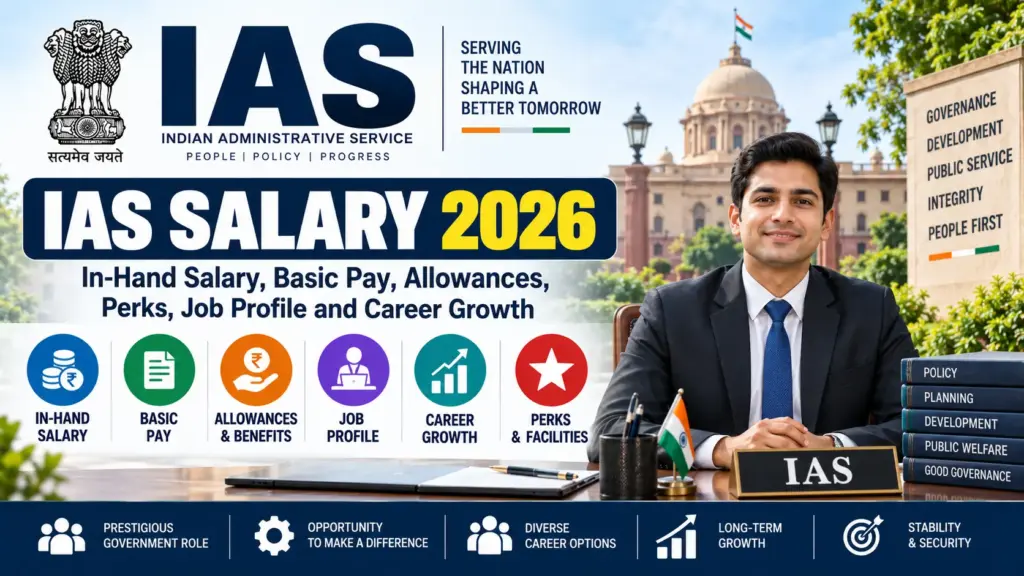
IAS Salary 2026: In-Hand Salary, Basic Pay, Allowances, Perks, Job Profile and Career Growth.Becoming an IAS officer is a dream for thousands of UPSC aspirants. The Indian Administrative Service is not only one of the most respected government services in India, but it also offers a well-structured salary, attractive allowances, government facilities and excellent career growth.
One of the first questions candidates usually ask after understanding the IAS job is: “How much does an IAS officer earn?”
In 2026, an IAS officer starts with a basic pay of ₹56,100 per month at Pay Level 10. As the officer gains experience and moves to higher positions, the salary increases significantly. At the highest level, the basic pay can reach ₹2.50 lakh per month.
But the basic salary is only one part of the overall package. IAS officers can also receive Dearness Allowance, House Rent Allowance, Travel Allowance and several other facilities depending on their posting and position.
Overview of IAS Salary 2026
| Particulars | Details |
|---|---|
| Service Name | Indian Administrative Service |
| Starting Basic Pay | ₹56,100 per month |
| Starting Pay Level | Level 10 |
| Highest Basic Pay | ₹2,50,000 per month |
| Highest Position | Cabinet Secretary |
| Salary System | 7th Pay Commission Pay Matrix |
| Major Allowances | DA, HRA, TA and other applicable benefits |
| Training | LBSNAA, Mussoorie |
| Career Growth | SDM → DM/Collector → Senior Administrative Positions |
IAS Basic Salary 2026
The starting basic salary of an IAS officer is ₹56,100 per month.
This is the basic component and does not represent the complete amount credited to an officer’s account. Applicable allowances are added to the basic pay, while deductions are made according to the applicable rules.
As an officer gains experience and receives promotions, the basic pay moves through different levels of the Pay Matrix.
At the highest level, the basic pay can reach ₹2,50,000 per month for the Cabinet Secretary.
IAS Salary Pay Level 2026
The 7th Pay Commission introduced the Pay Matrix system for government employees. IAS officers move through different pay levels as their career progresses.
| Pay Level | Basic Pay | Career Stage |
|---|---|---|
| Level 10 | ₹56,100 | Entry Level |
| Level 11 | ₹67,700 | Senior Time Scale |
| Level 12 | ₹78,800 | Junior Administrative Grade |
| Level 13 | ₹1,23,100 | Selection Grade |
| Level 14 | ₹1,44,200 | Senior Administrative Level |
| Level 15 | ₹1,82,200 | Higher Administrative Grade |
| Level 17 | ₹2,25,000 | Secretary-level position |
| Level 18 | ₹2,50,000 | Cabinet Secretary |
The designation associated with a particular pay level can vary depending on the officer’s cadre, posting and responsibilities.
IAS Salary in India: Post-Wise
The salary of an IAS officer increases gradually with service experience and promotion.
| Years of Service | Basic Pay | Example Position |
|---|---|---|
| 1–4 Years | ₹56,100 | SDM / Under Secretary |
| 5–8 Years | ₹67,700 | Additional District Magistrate / Deputy Secretary |
| 9–12 Years | ₹78,800 | District Magistrate / Joint Secretary |
| 13–16 Years | ₹1,18,500 | Special Secretary-cum-Director |
| 16–24 Years | ₹1,44,200 | Divisional Commissioner / Senior Secretary-level role |
These stages are indicative. Actual postings depend on cadre, experience, vacancies and government requirements.
IAS In-Hand Salary 2026
The IAS in-hand salary is different from the basic salary.
At entry level, the basic pay is ₹56,100. After adding applicable allowances and deducting items such as taxes and other contributions, the amount actually received by an officer will vary.
For an entry-level officer, the in-hand salary can generally be around ₹80,000 to ₹1 lakh per month, depending on the posting and applicable allowances.
Therefore, there is no single fixed in-hand salary for every IAS officer.
IAS Gross Salary 2026
The gross salary includes the basic pay plus applicable allowances.
An entry-level IAS officer can have a gross monthly salary of around ₹1.5 lakh, depending on the applicable salary components and posting.
The final gross salary can differ because allowances such as DA, HRA and TA are not identical for every officer.
IAS Salary During Training
After selection through the UPSC Civil Services Examination, candidates undergo training before taking up their regular responsibilities.
During the training period, the amount received after deductions can be lower than the regular in-hand salary. The approximate training-period take-home salary is around ₹33,000–₹35,000.
Once the officer completes the relevant training and begins regular service, the applicable salary structure comes into effect.
IAS Salary Allowances 2026
The attractive part of an IAS career is not limited to basic pay. Officers can receive several allowances depending on their posting and service conditions.
Dearness Allowance (DA)
DA is provided to compensate for the impact of inflation and changes in the cost of living.
It is revised periodically, so the amount can change over time.
House Rent Allowance (HRA)
HRA is provided to eligible officers when government accommodation is not being used.
The amount depends on the location of posting. Officers who are allotted government accommodation generally do not receive HRA for the same period.
Travel Allowance (TA)
Travel-related benefits help officers meet eligible expenses associated with official travel.
The applicable amount can vary depending on the rules, nature of travel and other circumstances.
Other Benefits and Allowances
Depending on the posting and responsibilities, IAS officers may also receive facilities or reimbursements related to:
- Medical expenses
- Electricity
- Water
- Telephone/mobile expenses
- Official travel
- Study or professional development
- Retirement benefits
- Special posting-related requirements
IAS Officer Perks and Facilities
Apart from the monthly salary, IAS officers can enjoy several government facilities.
Some of the important benefits include:
- Government accommodation
- Official vehicle for eligible positions
- Medical facilities
- Travel-related benefits
- Telephone facilities
- Electricity and water facilities in applicable cases
- Support staff in certain postings
- Security arrangements for specific assignments
- Retirement-related benefits
- Professional development opportunities
Government accommodation can be particularly useful for officers posted in expensive cities because it can significantly reduce their housing expenses.
IAS Government Accommodation
Government accommodation is one of the facilities associated with many IAS postings.
Depending on the officer’s position, posting and availability, suitable government accommodation may be allotted at a regulated rent.
If an officer uses government accommodation, HRA is generally not paid for the same period.
The type and availability of accommodation can vary from one location to another.
IAS Officer Job Profile 2026
The job of an IAS officer is much more than sitting in an office and handling files.
IAS officers are involved in public administration, implementation of government schemes, development work, policy execution and coordination between different departments.
Their responsibilities can include:
- Implementing government policies
- Supervising development programmes
- Managing government departments
- Monitoring public-service delivery
- Handling public grievances
- Conducting field inspections
- Preparing administrative reports
- Coordinating with different departments
- Managing emergency situations
- Overseeing development projects
- Coordinating relief work during disasters
At the district level, an IAS officer may work as a District Magistrate or Collector, where the officer has broad administrative responsibilities.
Roles and Responsibilities of an IAS Officer
As a Probationary Officer
A newly selected IAS officer undergoes extensive training and learns how government administration functions at the ground level.
This stage helps the officer understand public administration, government schemes, laws, departmental functioning and field responsibilities.
As an SDM
After training, an officer may take up responsibilities as a Sub-Divisional Magistrate.
The work involves administration of the subdivision, coordination with departments, public grievances, revenue matters and other responsibilities assigned by the government.
As District Magistrate or Collector
The District Magistrate/Collector has a wide administrative role.
Major responsibilities may include:
- District administration
- Development programmes
- Revenue administration
- Disaster management
- Public grievance handling
- Coordination among departments
- Monitoring government schemes
This is considered one of the most challenging and important field assignments in an IAS career.
At Senior Levels
As officers move to senior positions, their work becomes increasingly focused on policy, planning, administration and management of larger departments.
They may work in the State Secretariat or Central Government and contribute to broader policy decisions.
IAS Working Hours
IAS officers may have regular office hours, but their working schedule is not always fixed.
Normal office work may often take place around 9 AM to 5 PM, but officers can be required to work beyond these hours during emergencies and important assignments.
For example, additional working hours may be required during:
- Elections
- Natural disasters
- Riots or law-and-order situations
- Government events
- Emergency situations
- Important administrative deadlines
This is particularly common in field postings where situations can change quickly.
IAS Training
IAS officers receive their initial training at the Lal Bahadur Shastri National Academy of Administration (LBSNAA), Mussoorie.
The training focuses on areas such as:
- Public administration
- Government functioning
- Policy implementation
- Leadership
- Law and regulations
- Field administration
- Management skills
After completing the required training, officers begin their practical administrative assignments.
IAS Career Growth and Promotion
Career growth is one of the strongest attractions of the IAS.
An officer can move through several important positions during their career.
A broad career path can be represented as:
IAS Trainee → SDM/Assistant Collector → Additional District Magistrate → District Magistrate/Collector → Divisional Commissioner → Secretary-level Positions → Senior Central/State Government Positions
With increasing seniority, officers may get the opportunity to handle larger departments and more important policy responsibilities.
The actual promotion timeline depends on service rules, performance, vacancies and cadre-related requirements.
IAS Salary After 5 Years
After around five years of service, an IAS officer can move to a higher pay level.
The basic pay at the corresponding stage can be around ₹67,700.
The total monthly salary will be higher after adding applicable allowances. The actual in-hand amount will depend on the posting, benefits and deductions.
IAS Salary After 10 Years
At around the 9–12-year service stage, the basic pay can reach approximately ₹78,800.
By this stage, an IAS officer may be handling important district-level or state-level responsibilities.
The nature of work also becomes more strategic, with greater involvement in administration, planning and policy implementation.
IAS Salary After 15 Years
At higher stages of the career, the basic pay increases considerably.
The salary structure includes basic pay of around ₹1,23,100 at Level 13 and ₹1,44,200 at Level 14.
Officers at these levels can hold senior administrative positions and handle important departments and policy responsibilities.
Highest IAS Salary 2026
The highest basic salary of an IAS officer is ₹2,50,000 per month at the Cabinet Secretary level.
The Cabinet Secretary is the highest-ranking civil servant in the country.
Reaching this level is not automatic. Career progression depends on several factors, including seniority, service record, vacancies and applicable government rules.
IAS vs IPS Salary 2026
IAS and IPS are both prestigious All India Services, and their basic salary structure is broadly similar at corresponding levels.
At the entry level, both services have a basic pay of ₹56,100 per month.
| Particulars | IAS | IPS |
|---|---|---|
| Starting Basic Pay | ₹56,100 | ₹56,100 |
| Starting Pay Level | Level 10 | Level 10 |
| Highest Basic Pay | ₹2,50,000 | ₹2,25,000 |
| Highest Position | Cabinet Secretary | Director General of Police |
The major difference is in the nature of work. IAS officers primarily deal with administration, governance and policy implementation, while IPS officers focus on policing, law enforcement and public safety.
IAS vs IPS: Which Is More Powerful?
This is one of the most common questions among UPSC aspirants, but there is no straightforward answer.
An IAS officer generally has a broader administrative role and may oversee multiple departments at the district level.
An IPS officer, on the other hand, has authority over police and law-enforcement matters and plays a crucial role in maintaining public safety and order.
So, rather than asking which service is more powerful, candidates should consider which type of work matches their interests and personality.
If you enjoy administration, policymaking and development work, IAS may be a better fit. If you are interested in policing, investigation, leadership and law enforcement, IPS may be more suitable.
Challenges of Being an IAS Officer
The salary and facilities are attractive, but IAS is certainly not an easy job.
Officers may have to deal with:
- Heavy workloads
- Public expectations
- Administrative pressure
- Emergency situations
- Sudden transfers
- Long working hours
- Difficult field postings
- Remote areas with limited facilities
- Complex policy decisions
- Balancing development and administrative priorities
An IAS officer needs to be adaptable because transfers and changes in responsibilities are a normal part of the career.
Is IAS a Good Career Option?
For candidates who genuinely want to work in public administration, IAS can be an extremely rewarding career.
The major advantages include:
- Good starting salary
- Regular salary progression
- Attractive allowances
- Government accommodation in eligible postings
- Medical and travel benefits
- Diverse work experience
- Opportunities to work at district, state and central levels
- Strong career progression
- Opportunity to contribute to public policy and development
At the same time, the job demands dedication, patience, leadership and the ability to work under pressure.