
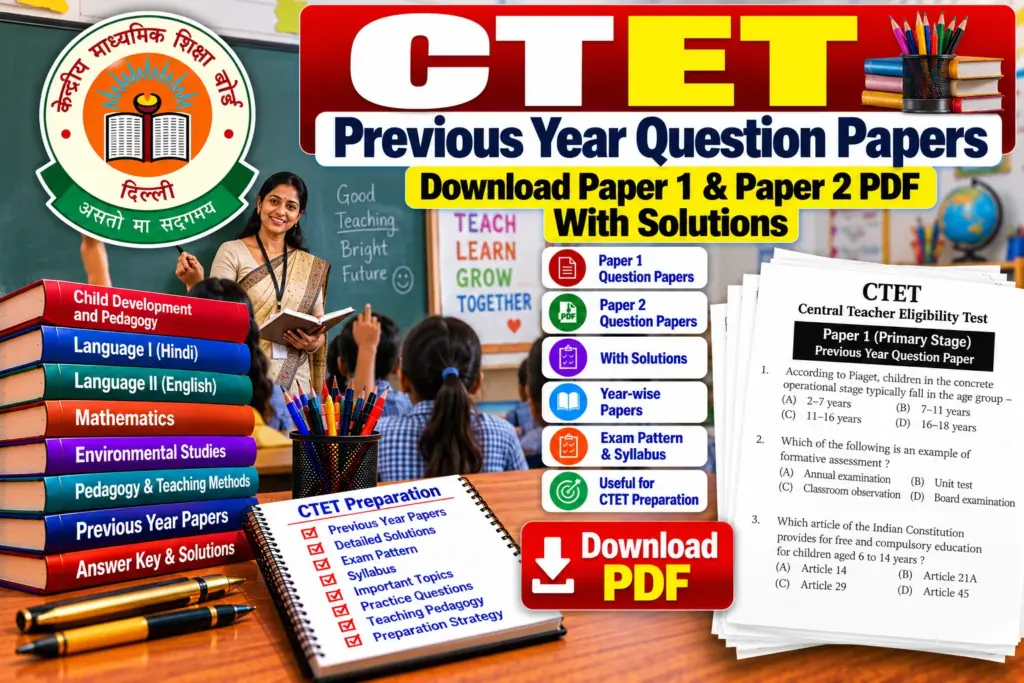
CTET Previous Year Question Papers: Download Paper 1 & Paper 2 PDF With Solutions.If you are preparing for the Central Teacher Eligibility Test (CTET), solving previous year question papers should be an important part of your study plan. Reading textbooks helps you understand the concepts, but practising actual exam questions shows you how well you can apply that knowledge.
CTET Previous Year Question Papers with Solutions help candidates understand the question pattern, practise under time limits and identify topics that need more revision. They are also useful for checking your preparation before the examination.
Candidates can practise both Paper 1 and Paper 2 using the available question-paper collections. These include papers from recent sessions, such as 2026 and 2024, along with previous papers from 2023, 2022, 2021, 2020 and older years.
Whether you are preparing for the primary teacher level or the upper primary level, working through previous papers can help you approach the examination with a clearer strategy.
CTET Previous Year Question Papers PDF – Overview
| Particulars | Details |
|---|---|
| Exam Name | Central Teacher Eligibility Test (CTET) |
| Conducting Body | Central Board of Secondary Education (CBSE) |
| Exam Level | National |
| Paper 1 | Teaching Classes 1 to 5 |
| Paper 2 | Teaching Classes 6 to 8 |
| Available Papers | Paper 1 and Paper 2 |
| Question Paper Format | |
| Available Years | 2026, 2024, 2023, 2022, 2021 and earlier |
| Solutions and Answer Keys | Available for selected papers |
Candidates preparing for Classes 1 to 5 should focus on Paper 1, while those aiming to teach Classes 6 to 8 should prepare for Paper 2. If you want to meet the eligibility requirements for both levels, you should prepare for both papers.
CTET Previous Year Question Papers: Year-Wise Collection
The available collections cover several examination sessions, allowing candidates to practise different sets and review questions from earlier years.
| Year | Available Question Papers |
|---|---|
| 2026 | February and March examination papers |
| 2024 | January, July and December sessions |
| 2023 | Paper 1 and Paper 2, including different sets |
| 2022 | Paper 1 and Paper 2 |
| 2021 | Question Paper December 2021 and QUESTION PAPER JANUARY 2021 |
| 2020 | Paper 1 and Paper 2 |
| 2019 | July and December examination papers |
| 2018 | Paper 1 and Paper 2 |
| 2016 | Paper 1 and Paper 2 |
| 2015 | Paper 1 and Paper 2 |
The availability of individual sets, language versions, answer keys and detailed solutions varies by examination session. Candidates should check the details of each paper before using it for practice.
CTET 2026 Question Papers
The available material includes question papers from the February and March 2026 examination sessions.
CTET February 2026 Papers
The February collection includes question papers from 7 and 8 February 2026. It covers Paper 1 and Paper 2, with some Paper 2 materials organised according to the subject combination.
The available material includes:
- Paper 1 question papers from different sets.
- Paper 2 Mathematics and Social Studies/Social Science papers.
- Subject-specific Paper 2 materials.
- Language-specific papers, including Sanskrit, Telugu, Bengali, Odia, Tamil and Urdu.
These papers can help candidates become familiar with the question formats used in the available examination sessions.
CTET March 2026 Papers
The supplied collection also includes papers from the examination held on 1 March 2026.
The listed materials include Paper 1 Sets 1, 2, 3 and 4, along with Paper 2 Mathematics and Social Studies/Social Science sets.
When selecting a paper, make sure its paper number, set and subject combination match your preparation requirements. This is particularly important for candidates preparing for Paper 2.
CTET 2024 Previous Year Question Papers
The available CTET 2024 collection includes papers from the January, July and December sessions.
| Examination Session | Available Question Papers |
|---|---|
| January 2024 | Paper 1 and Paper 2 |
| July 2024 | Paper 1 Sets A–D and Paper 2 Sets I–L |
| December 2024 | Paper 1 and Paper 2 papers from different codes |
The July collection contains multiple sets for both papers, while the December collection includes question papers and answer keys for selected codes.
These papers are useful when you want to practise more than one set. Attempt each paper independently, check your answers afterwards and note the topics that caused difficulty.
CTET 2023 Question Papers
The available 2023 collection includes set-wise question papers for both Paper 1 and Paper 2.
Paper 1 materials include Sets A, B, C and D, while Paper 2 materials include Sets E, F, G and H in the listed collection. The material also includes language-specific versions for selected sets.
Additional January 2023 papers cover different examination dates and language combinations.
Practising these papers can help you review the syllabus and understand how questions are framed. Instead of memorising answers, focus on the concepts behind the questions so that you can apply the same understanding to unfamiliar problems.
CTET 2022 and 2021 Question Papers
Candidates can also use the available Paper 1 and Paper 2 collections from 2022 and 2021.
The 2021 material includes language-wise question papers, with options such as Assamese, Bengali, Garo, Gujarati, Kannada, Khasi and Malayalam, among others.
These papers offer additional practice after you have completed the recent examination material. They can also help you identify topics that require another round of revision.
If you are preparing for Paper 2, select papers that match your subject combination rather than practising an unrelated set.
CTET 2020, 2019, 2018 and Older Papers
The available collections include question papers from 2020, 2019, 2018, 2016 and 2015.
The 2019 collection includes July and December papers for Paper 1 and Paper 2. Older collections also provide papers for both levels.
You can use these papers to practise more questions once you have completed the recent sessions. They are particularly useful for revision and for checking whether you can apply familiar concepts in different question formats.
Keep the current syllabus and examination pattern in mind when practising older papers, as the structure and requirements applicable to your target session should guide your preparation.
CTET Paper 1 Exam Pattern
CTET Paper 1 is intended for candidates who want to teach Classes 1 to 5. The supplied exam-pattern material lists five sections, with 30 questions in each section.
| Subject | Questions | Marks |
|---|---|---|
| Child Development and Pedagogy | 30 | 30 |
| Language I | 30 | 30 |
| Language II | 30 | 30 |
| Mathematics | 30 | 30 |
| Environmental Studies | 30 | 30 |
| Total | 150 | 150 |
Key details include:
- Total questions: 150
- Maximum marks: 150
- Duration: 2 hours 30 minutes
- Question type: Multiple-choice questions
- Marks for each correct answer: 1
- Negative marking: None, according to the supplied pattern
CTET Paper 2 Exam Pattern
Paper 2 is for candidates who want to teach Classes 6 to 8. It contains four sections, with the final section depending on the candidate’s subject choice.
| Subject | Questions | Marks |
|---|---|---|
| Child Development and Pedagogy | 30 | 30 |
| Language I | 30 | 30 |
| Language II | 30 | 30 |
| Mathematics and Science OR Social Studies/Social Science | 60 | 60 |
| Total | 150 | 150 |
Key details include:
- Total questions: 150
- Maximum marks: 150
- Duration: 2 hours 30 minutes
- Question type: Multiple-choice questions
- Marks for each correct answer: 1
- Negative marking: None, according to the supplied pattern
Candidates should consult the official notification for their examination session to confirm the applicable pattern and instructions.
Why Are CTET Previous Year Question Papers Important?
Previous year papers are more than a collection of old questions. They give you a practical way to check your understanding and make your preparation more focused.
1. Understand the Actual Question Style
You may understand a topic while reading it but find it difficult to answer questions based on that concept.
Previous year papers help you become familiar with how questions are worded and how knowledge is tested. This is particularly useful for Child Development and Pedagogy, where questions may require you to apply teaching concepts to classroom situations.
2. Find Your Weak Areas
A practice paper can quickly show you which subjects need more attention.
For example, you may perform well in Language I but struggle with Mathematics or Environmental Studies. Instead of revising every subject equally, use your results to identify where extra effort is needed.
3. Improve Speed and Time Management
Completing 150 questions within the allotted time requires a steady pace.
Practising full papers helps you understand how long you spend on different types of questions. It also teaches you when to move on from a difficult question instead of losing too much time on it.
4. Make Revision More Effective
Previous year questions can help you revise concepts in a practical way.
Whenever you get a question wrong, return to the relevant topic and review the concept. This approach helps you focus on what you have not understood rather than repeatedly studying everything from the beginning.
5. Learn From Solutions
An answer key tells you whether your response is correct. A detailed solution can help you understand why the answer is correct.
Whenever solutions are available, read the explanation for questions you answered incorrectly or guessed. Understanding the reasoning will be more useful than simply remembering the correct option.
6. Build Confidence Through Practice
Your first full-length paper may feel difficult, especially if you have not practised under timed conditions.
Do not let one low score discourage you. Use it to understand your mistakes, revise the weak areas and try another paper. Regular practice can make the examination format feel more familiar.
How to Download CTET Previous Year Question Papers PDF
Candidates can look for previous year question papers and answer keys through the official CTET website and the available year-wise collections.
Follow these steps:
- Visit the official CTET website.
- Look for the relevant examination, question-paper or answer-key section.
- Select the examination year and session.
- Choose Paper 1 or Paper 2.
- Check the set, language and subject combination.
- Open the PDF and save it for practice.
If you are using a third-party collection, check whether the selected paper includes an answer key or detailed solutions. Not every question paper necessarily comes with explanations.
How to Prepare for CTET Using Previous Year Papers
Solving papers is most effective when you combine it with syllabus study and regular revision.
Step 1: Understand the Syllabus
Before starting full-length practice, review the syllabus for your chosen paper. Make sure you understand the major topics and identify areas where you need to strengthen your basics.
Step 2: Attempt a Recent Paper
Choose a recent question paper that matches your preparation level. Try to complete it independently without checking answers during the test.
Step 3: Follow the Time Limit
Set a timer for 2 hours 30 minutes and attempt the paper in one sitting. This will help you practise maintaining concentration throughout the examination.
Step 4: Check Your Answers
After completing the paper, compare your responses with the available answer key or solutions. Record your score and mark the questions you found difficult.
Step 5: Understand Your Mistakes
Ask yourself why you got a question wrong. Was the concept unclear? Did you misunderstand the question? Did you choose an answer without sufficient confidence?
Identifying the reason will help you correct the problem more effectively.
Step 6: Revise Before Attempting Another Paper
Return to the topics where you made mistakes. Once you have revised them, attempt another paper and compare your performance.
This cycle of practice, analysis and revision is more useful than solving papers simply to increase the number completed.
Subject-Wise CTET Preparation Strategy
Child Development and Pedagogy
Focus on understanding child development, learning processes and teaching-related concepts. When reviewing a question, make sure you understand the principle behind the correct answer.
Language I and Language II
Practise comprehension and review the language concepts included in your syllabus. Read passages carefully and pay attention to what each question is actually asking.
Mathematics
Strengthen your basic concepts and practise applying them to different question types. If you repeatedly struggle with a topic, revise the fundamentals before moving to more questions.
Environmental Studies
For Paper 1, use previous papers to revise Environmental Studies concepts and identify topics where your understanding is incomplete.
Mathematics and Science or Social Studies/Social Science
For Paper 2, choose practice material that matches your subject combination. Review incorrect answers and revise the relevant concepts before attempting another set.
How Many CTET Previous Year Papers Should You Solve?
There is no single number of papers that guarantees success. The right target depends on your preparation level and how much time you have before the examination.
A practical plan is to:
- Start with recent question papers.
- Practise Paper 1, Paper 2 or both, depending on your goal.
- Check your answers after each paper.
- Revise the topics where you lose marks.
- Use older papers for additional practice.
- Continue studying the syllabus alongside question-paper practice.
Remember that completing a paper is only one part of preparation. Reviewing your mistakes and correcting them is what makes each practice session worthwhile.
Common Mistakes to Avoid While Solving CTET Papers
Candidates should avoid these common mistakes:
- Downloading question papers but not attempting them.
- Solving papers without following a time limit.
- Checking answers before completing the test.
- Memorising solutions without understanding the concepts.
- Ignoring incorrect and doubtful answers.
- Practising the wrong paper or subject combination.
- Relying only on old papers without revising the current syllabus.
- Focusing on the score while ignoring repeated mistakes.
The aim is not to finish as many PDFs as possible. It is to improve your understanding and become more comfortable with the examination format.