
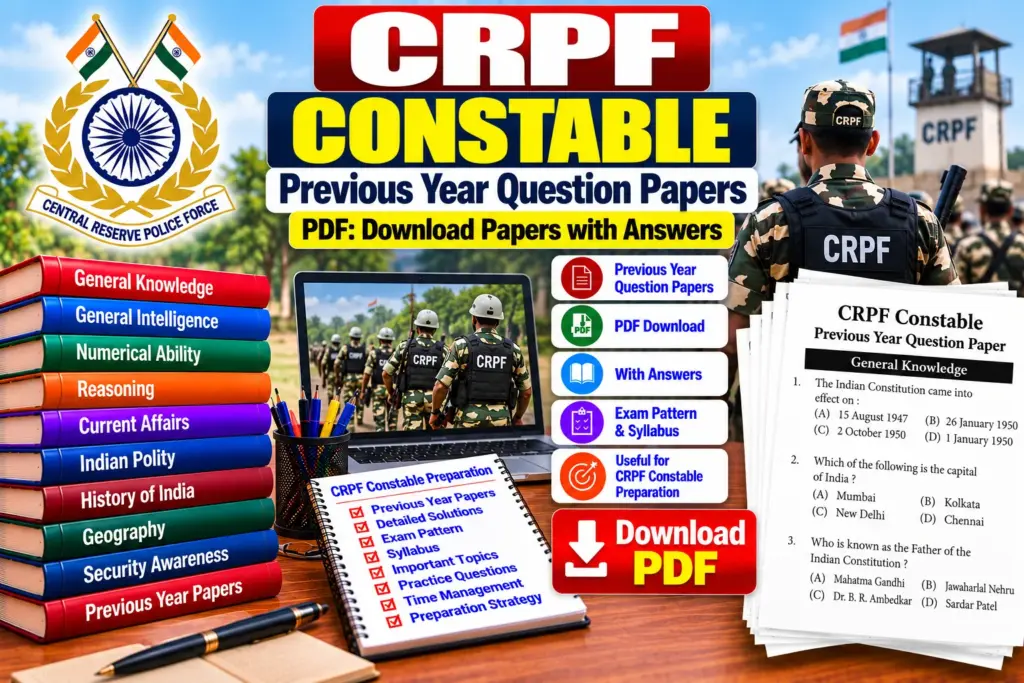
CRPF Constable Previous Year Question Papers PDF: Download Papers with Answers.Preparing for a CRPF recruitment examination takes more than reading books and memorising facts. Candidates also need to understand how questions are asked, how much time they should spend on each section and which topics require additional practice. This is where previous year question papers become useful.
For candidates preparing for CRPF Constable, Technical & Tradesman or Head Constable Ministerial recruitment, solving relevant old papers can make preparation more organised. Instead of studying without knowing your progress, you can attempt a paper, check your answers and identify the areas where you need to improve.
In this article, we cover the CRPF Constable Previous Year Question Papers PDF, available paper resources, Tradesman question papers, Head Constable papers, the exam pattern and practical preparation tips.
CRPF Constable Previous Year Papers: Overview
| Particulars | Details |
|---|---|
| Organisation | Central Reserve Police Force (CRPF) |
| Posts Covered | Constable, Technical & Tradesman, Head Constable Ministerial |
| Examination Mode | CBT, where applicable |
| Paper Type | Objective-type questions for the CBT |
| Previous Paper Years Mentioned | 2023, 2018, 2017, 2016–17 and other year-wise collections |
| Languages | Hindi and English, depending on the paper |
| Solutions | Available with selected paper resources |
| Official Website | CRPF recruitment portal |
Note: CRPF recruits candidates for different posts, and the examination pattern may differ. Always choose a paper that matches the post you are preparing for and check the latest official notification for the applicable rules.
CRPF Constable Previous Year Question Papers PDF
Candidates can use previous year papers to practise questions and become familiar with the format of the examination. The supplied materials mention question-paper collections covering several years, including 2023, 2022, 2021, 2020, 2019, 2018, 2017, 2016 and 2015.
The availability of individual papers varies by post and trade. The following table summarises the years and resources mentioned in the supplied documents.
| Year | Paper Resources Mentioned |
|---|---|
| 2023 | Technical & Tradesman papers from different dates and shifts |
| 2022 | Included in a year-wise collection |
| 2021 | Included in a year-wise collection |
| 2020 | Included in a year-wise collection |
| 2019 | Included in a year-wise collection |
| 2018 | General Intelligence paper mentioned |
| 2017 | Tradesman and trade-specific paper resources |
| 2016–17 | Carpenter, Electrician, Mason, Painter and Plumber papers |
| 2015 | Included in a year-wise collection |
These entries do not mean that every paper is available for every CRPF post. Before downloading or practising a paper, check its title, year, shift and post name.
CRPF Constable Technical & Tradesman Question Papers 2023
The supplied materials include several CRPF Constable Technical & Tradesman question-paper resources from July 2023. Papers are listed for different dates and shifts, and selected resources are identified as Hindi-language papers.
| Exam Date | Paper Resources Mentioned |
|---|---|
| 1 July 2023 | Shifts 1, 2 and 3 |
| 3 July 2023 | Shifts 1, 2 and 3 |
| 4 July 2023 | Shifts 1, 2 and 3 |
| 5 July 2023 | Shift 1 |
| 6 July 2023 | Shifts 1 and 3 |
| 10 July 2023 | Shift 3 |
| 11 July 2023 | Shift 1 |
| 12 July 2023 | Shifts 1 and 3 |
Use these papers to practise the question formats represented in the available material. If you are preparing for a particular trade, make sure the paper is relevant to your recruitment examination rather than assuming that all CRPF papers follow the same pattern.
CRPF Constable Tradesman Previous Year Question Papers
Candidates preparing for the Constable (Technical & Tradesman) examination can benefit from practising general CBT papers as well as relevant trade-specific resources.
The supplied documents mention papers for the following trades:
- Carpenter
- Electrician
- Mason
- Painter
- Plumber
These papers can help candidates practise questions related to the resources available for their trade. They should be used alongside the prescribed syllabus and the requirements of the trade test, where applicable.
CRPF Constable Tradesman Exam Pattern
One of the supplied Tradesman resources describes the examination as a computer-based test with 100 questions, 100 marks and a duration of two hours.
| Exam Detail | Information |
|---|---|
| Exam Mode | Computer-Based Test (CBT) |
| Total Questions | 100 |
| Total Marks | 100 |
| Duration | 2 hours |
| Negative Marking | 0.25 marks per incorrect answer, as stated in the supplied material |
The same resource gives the following subject-wise distribution:
| Subject | Questions | Marks |
|---|---|---|
| General Intelligence & Reasoning | 25 | 25 |
| General Knowledge & Awareness | 25 | 25 |
| Elementary Mathematics | 25 | 25 |
| English/Hindi | 25 | 25 |
| Total | 100 | 100 |
This pattern is taken from the supplied Tradesman material. Candidates should verify the examination scheme and marking rules in the official notification applicable to their recruitment cycle.
CRPF Head Constable Ministerial Previous Year Papers
Candidates preparing for CRPF Head Constable Ministerial recruitment should practise papers designed for that post. The supplied material mentions previous year papers in PDF format, including Hindi-language resources, and also refers to CRPF ASI papers.
Although some general questions may be useful for additional practice, Head Constable Ministerial, ASI and Constable Tradesman examinations should not be treated as interchangeable. Their syllabuses and selection requirements may differ.
Before attempting a paper, confirm that it matches your target post. This will help you focus on the right subjects and avoid spending too much time on material that does not match your examination.
Why Should You Solve CRPF Previous Year Question Papers?
Previous year papers are useful because they allow you to test your preparation instead of relying only on how much you have studied.
1. Get familiar with the question format
Reading a chapter gives you subject knowledge, but solving questions helps you understand how that knowledge may be tested. Old papers provide practice with the formats represented in the available resources.
2. Find out which subjects need more attention
You may find General Knowledge manageable but struggle with Mathematics or Reasoning. Reviewing your answers helps you identify these weak areas and plan your revision more effectively.
3. Improve speed and accuracy
Solving questions under timed conditions teaches you to distribute your time more carefully. Reviewing mistakes can also help you avoid repeating the same errors.
4. Check your preparation level
When a matching answer key is available, calculate your score after completing the paper. Your result can help you decide whether to revise basic concepts, practise more questions or move on to a full-length mock test.
5. Become more comfortable with exam conditions
The first few timed attempts may feel difficult, particularly when you are not used to completing a full paper in one sitting. Regular practice can make the process more familiar and help you manage exam pressure.
Important Topics to Practise
The supplied Tradesman material identifies four broad subject areas. It mentions the following example topics for practice.
General Intelligence and Reasoning
- Analogies
- Coding-decoding
- Number series
- Blood relations
- Direction-based questions
General Knowledge and Awareness
- Current affairs
- History
- Geography
- Indian polity
- General science
Elementary Mathematics
- Percentage
- Profit and loss
- Time and work
- Ratio and proportion
- Simplification
English/Hindi
- Grammar
- Vocabulary
- Comprehension
- Synonyms and antonyms
These topics are drawn from the supplied Tradesman material. Candidates preparing for Head Constable Ministerial or another CRPF post should use the syllabus specified for their own examination.
How to Prepare for CRPF Using Previous Year Papers
Collecting PDFs is only the first step. The real benefit comes from attempting the papers properly and learning from the results.
Step 1: Read the applicable syllabus
Start with the latest notification for your post. Note the subjects, examination stages, time limit and marking scheme before planning your preparation.
Step 2: Revise the basics first
Make sure you understand the important concepts in each subject. If you attempt papers without understanding the basics, you may repeatedly make the same mistakes.
Step 3: Solve one paper without checking the answers
Choose a relevant previous year paper and complete it independently. Avoid using notes or looking at the answer key while you are still solving the questions.
Step 4: Follow the time limit
Practise under the duration prescribed for your examination. For the Tradesman pattern described in the supplied material, the stated duration is two hours; confirm that this applies to your recruitment cycle.
Step 5: Review every incorrect answer
Do not stop after calculating your score. Check why you selected the wrong option and revise the concept behind the question.
Step 6: Keep a record of your mistakes
Maintain a notebook containing difficult questions, formulas and facts that you tend to forget. Revisiting these notes can make revision more focused.
Step 7: Practise papers from different shifts
Where suitable papers are available, practise more than one date or shift. This gives you broader exposure to the question formats represented in the collection.
Step 8: Use mock tests to measure progress
After revising the syllabus and attempting previous papers, take mock tests. Compare your results over time and give additional attention to subjects where your performance remains weak.
Common Mistakes to Avoid
Candidates should avoid these common errors while preparing with previous year papers:
- Solving papers meant for a different CRPF post.
- Treating trade-specific papers as general Constable papers.
- Following an old examination pattern without checking the latest notification.
- Looking at answers before completing the paper.
- Using an answer key that does not match the question paper.
- Memorising answers without understanding the concepts.
- Ignoring weak subjects after receiving a low score.
- Depending only on previous year papers instead of studying the prescribed syllabus.
A paper is most valuable when you use it to understand your mistakes and improve your next attempt.