
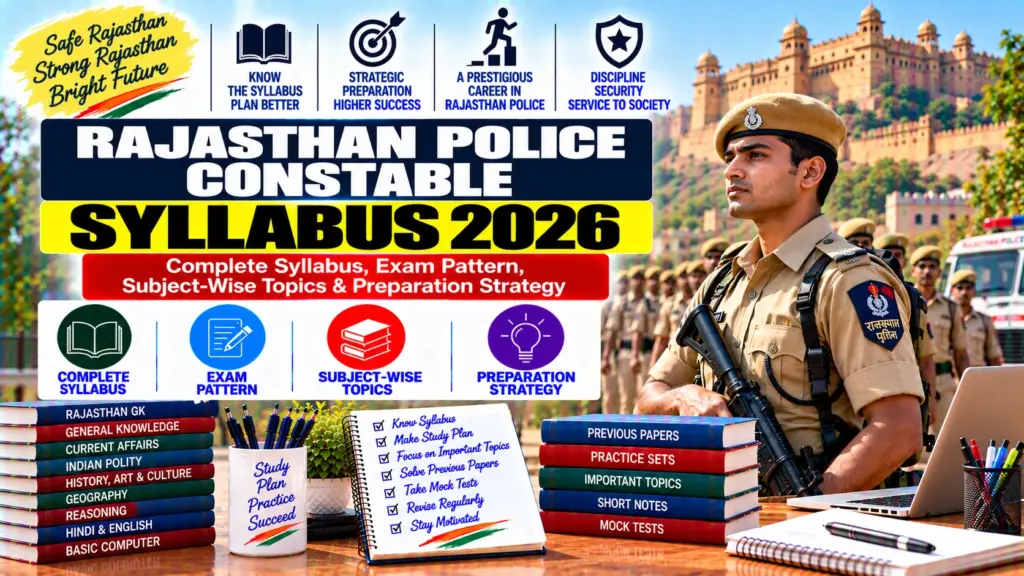
Rajasthan Police Constable Syllabus 2026: Complete Syllabus, Exam Pattern, Subject-Wise Topics & Preparation Strategy.The Rajasthan Police Constable Exam 2026 is an important opportunity for candidates who are preparing for a government job in the police department. But before starting serious preparation, the first thing every candidate should do is understand the syllabus and exam pattern properly.
The Rajasthan Police Constable syllabus covers Reasoning, Computer Knowledge, General Knowledge, General Science, Social Science, Current Affairs, laws related to women and children, and Rajasthan-specific History, Culture, Geography, Polity and Economy.
Instead of studying everything randomly, candidates should divide the syllabus into small sections and prepare each subject according to its marks and difficulty level. This article explains the complete Rajasthan Police Constable Syllabus 2026 in simple language, along with a practical preparation strategy.
Overview of Rajasthan Police Constable Syllabus 2026
| Particulars | Details |
|---|---|
| Exam Name | Rajasthan Police Constable Exam 2026 |
| Post | Constable |
| Exam Type | Objective Type |
| Total Questions | 150 |
| Total Marks | 150 |
| Exam Duration | 2 Hours |
| Negative Marking | 1/4 Mark |
| Major Subjects | Reasoning, Computer, GK, Science, Current Affairs, Laws, Rajasthan GK |
The written examination contains 150 questions for 150 marks, and candidates get 120 minutes to complete the paper. There is also negative marking for incorrect answers.
Rajasthan Police Constable Exam Pattern 2026
The written examination is divided into four major sections.
| Part | Subjects | Questions | Marks |
|---|---|---|---|
| Part A | Reasoning & Logical Ability + Computer Knowledge | 60 | 60 |
| Part B | General Knowledge, General Science, Social Science & Current Affairs | 35 | 35 |
| Part C | Laws Related to Crimes Against Women & Children | 10 | 10 |
| Part D | Rajasthan History, Culture, Art, Geography, Polity & Economy | 45 | 45 |
| Total | All Subjects | 150 | 150 |
Important Points
- Total Questions: 150
- Total Marks: 150
- Time: 2 Hours
- Question Type: Objective
- Negative Marking: 1/4 mark for an incorrect answer
Since the paper has negative marking, candidates should focus not only on attempting more questions but also on improving accuracy.
Rajasthan Police Constable Syllabus 2026
Part A: Reasoning and Logical Ability + Computer Knowledge
This is the largest section of the written examination, carrying 60 marks.
It is also a section where regular practice can make a noticeable difference in performance.
Reasoning Syllabus
The important topics include:
- Analogy
- Classification
- Coding-Decoding
- Blood Relations
- Direction Test
- Number Series
- Alphabet Series
- Venn Diagram
- Data Interpretation
- Logical Reasoning
- Non-Verbal Reasoning
- Ranking
- Statement and Conclusion
- Puzzles
- Seating Arrangement
- Arithmetic Reasoning
- Similarities and Differences
- Pattern-Based Questions
How to Prepare Reasoning
Reasoning is not a subject that improves by simply reading theory. You need to solve questions regularly.
Start with basic questions and gradually move towards moderate and difficult-level problems. Once you understand a particular type of question, practise it with a timer.
Exam Tip: Keep a separate notebook for questions in which you repeatedly make mistakes. Revise these questions every few days.
Computer Knowledge Syllabus
Computer questions are mainly based on basic computer awareness and commonly used applications.
Important Topics
- Introduction to Computers
- Characteristics of Computers
- Hardware and Software
- CPU
- Memory
- RAM and ROM
- Input Devices
- Output Devices
- Storage Devices
- Operating Systems
- Windows
- Linux
- MS Word
- MS Excel
- MS PowerPoint
- Internet
- Information Technology
- Computer Networks
- Basic Cyber Security
Preparation Strategy
Don’t make the computer section unnecessarily complicated.
Focus first on basic terminology, computer components, memory, operating systems, MS Office, internet and networking. After completing the basics, solve objective questions to check your understanding.
Part B: General Knowledge, General Science, Social Science & Current Affairs
This section carries 35 marks and covers several different areas.
General Knowledge
Important areas include:
- Indian History
- Indian Geography
- Indian Polity
- Indian Economy
- General Science
- Sports
- Awards and Honours
- Important Days
- Books and Authors
- Important Organisations
- Government Schemes
- National Events
- International Events
Candidates should avoid trying to memorise everything at once. Make short notes and revise them regularly.
General Science Syllabus
The science section mainly focuses on basic concepts that candidates can relate to everyday life.
Physics
Important topics include:
- Newton’s Laws of Motion
- Gravitation
- Force
- Energy
- Heat
- Electricity
- Magnetism
- Light
- Lenses
- Mirrors
- Sound
- Waves
Chemistry
Focus on:
- Atoms and Molecules
- Metals and Non-Metals
- Alloys
- Acids and Bases
- Chemical Changes
- Physical Changes
- Important Compounds
Biology
Important topics include:
- Human Body
- Human Organ Systems
- Tissues
- Nutrition
- Balanced Diet
- Human Diseases
- Causes and Prevention of Diseases
- Basic Genetics
- Environment
- Ecosystem
- Biodiversity
Preparation Tip: Basic science becomes easier when you understand the concept rather than memorising definitions word-for-word.
Current Affairs
Current Affairs is an important part of the preparation because questions can come from both Rajasthan and national-level developments.
Focus on:
- Rajasthan Current Affairs
- National Current Affairs
- International Events
- Government Schemes
- Important Appointments
- Awards
- Sports
- Science and Technology
- Economy
- Environment
- Important Personalities
- Major Government Programmes
- Important Social and Cultural Events
Make short monthly notes instead of collecting huge amounts of information.
Part C: Laws Related to Women and Children
This section contains 10 marks.
Although it is a smaller section, candidates should not leave it for the last moment because the syllabus is comparatively focused.
Important Topics
- Laws related to women
- Laws related to children
- Dowry Prohibition Act, 1961
- Protection of Women from Domestic Violence Act, 2005
- Sexual Harassment of Women at Workplace Act, 2013
- Immoral Traffic-related provisions
- Laws related to child marriage
- Child protection provisions
- Juvenile Justice-related provisions
- POCSO-related provisions
- Important provisions concerning crimes against women and children
How to Study This Section
For each law, make short notes covering:
Name of Act → Year → Purpose → Who it protects → Important provisions
This makes revision much easier before the examination.
Part D: Rajasthan History, Culture, Art, Geography, Polity & Economy
This section carries 45 marks, making Rajasthan-specific preparation extremely important.
Rajasthan History
Important topics include:
- Ancient Civilizations
- Important Archaeological Sites
- Major Dynasties
- Important Rulers
- Major Historical Events
- Revolt of 1857
- Peasant Movements
- Tribal Movements
- Praja Mandal Movement
- Freedom Movement in Rajasthan
- Integration of Rajasthan
- Important Historical Personalities
Preparation Tip
Prepare Rajasthan History chronologically. When events are studied in sequence, remembering rulers, movements and important developments becomes easier.
Rajasthan Art and Culture
Rajasthan Culture is a broad topic, so make separate short notes for different areas.
Important Topics
- Architecture
- Forts and Palaces
- Paintings
- Folk Music
- Musical Instruments
- Folk Dances
- Folk Drama
- Folk Deities
- Religious Sects
- Fairs and Festivals
- Dresses
- Ornaments
- Customs and Traditions
- Languages
- Dialects
- Literature
- Famous Personalities
A good approach is to revise culture through tables. For example, keep separate lists for dance, place, community and speciality.
Rajasthan Geography
Important Topics
- Location and Extent of Rajasthan
- Physical Features
- Climate
- Soil
- Rivers
- Lakes
- Drainage System
- Forests
- Wildlife
- Wildlife Conservation
- Agriculture
- Major Crops
- Irrigation Projects
- Mineral Resources
- Energy Resources
- Population
- Population Distribution
- Literacy
- Sex Ratio
- Tourism
- Important Tourist Places
- Environmental Issues
- Disaster Management
Preparation Tip
Use maps wherever possible. Rajasthan’s rivers, districts, mineral areas, lakes, crops and geographical regions become much easier to remember visually.
Rajasthan Polity and Administration
Candidates should understand the basic structure of Rajasthan’s political and administrative system.
Important Topics
- Governor
- Chief Minister
- Council of Ministers
- State Legislature
- High Court
- Rajasthan Public Service Commission
- State Election Commission
- State Information Commission
- State Human Rights Commission
- State Administration
- District Administration
- Local Self-Government
- Panchayati Raj
Don’t simply memorise names and positions. Understand the basic role and function of each institution.
Rajasthan Economy
Important areas include:
- Rajasthan Economy
- Agriculture
- Animal Husbandry
- Industries
- Mineral Sector
- State Income
- State Budget
- Handicraft Industry
- Unemployment
- Drought
- Famine
- Welfare Schemes
- Development Institutions
- Small Enterprises
- Financial Institutions
- Rural Development
- Panchayati Raj Institutions
Current government schemes and major economic developments should also be revised regularly.
Rajasthan Police Constable Selection Process 2026
The recruitment process involves different stages depending on the post and applicable requirements.
Main Stages
- Written Examination
- Physical Efficiency Test (PET)
- Physical Standard Test (PST)
- Proficiency Test, wherever applicable
- Document Verification
- Medical Examination
Candidates should start physical preparation along with their written exam preparation instead of waiting until after the written examination.
Rajasthan Police Constable Preparation Strategy
A simple and consistent approach works better than studying for long hours without a plan.
1. Start With the High-Weightage Sections
Give regular time to:
- Reasoning + Computer
- Rajasthan GK
- General Science
- Current Affairs
These sections together cover a large portion of the paper.
2. Study Rajasthan GK Every Day
Even 45–60 minutes of daily Rajasthan GK can make a big difference over several months.
Divide it into:
History → Culture → Geography → Polity → Economy → Current Affairs
3. Practise Reasoning Daily
Spend at least 30–45 minutes solving reasoning questions.
The objective should be to improve both speed and accuracy.
4. Keep Current Affairs Notes Short
Don’t write entire news articles in your notebook.
Write only:
- What happened?
- Where?
- When?
- Who was involved?
- Why is it important?
5. Take Mock Tests
Once you have covered a reasonable portion of the syllabus, start taking sectional tests.
Later, move towards full-length mock tests.
After every mock, check:
- Wrong answers
- Questions left unanswered
- Questions that took too much time
- Topics where mistakes are repeated
This analysis is often more useful than simply looking at the final score.
90-Day Study Plan
Days 1–30: Foundation
Focus on:
- Rajasthan History
- Rajasthan Geography
- Rajasthan Culture
- Reasoning Basics
- Computer Fundamentals
- General Science
- Basic Polity
- Important Laws
The objective is to understand the complete syllabus once.
Days 31–60: Complete the Syllabus
Cover:
- Rajasthan Economy
- Advanced Reasoning
- Computer Applications
- Indian GK
- Current Affairs
- Women and Child Laws
- Science Revision
- Rajasthan Polity
Start topic-wise MCQ practice during this stage.
Days 61–75: Intensive Practice
Focus mainly on:
- Previous-year questions
- Sectional tests
- Rajasthan GK MCQs
- Reasoning practice
- Computer questions
- Science questions
- Current Affairs
- Law-related questions
Maintain a mistake notebook.
Days 76–90: Final Revision
The final 15 days should be about revision rather than learning completely new topics.
Revise:
- Rajasthan GK
- Current Affairs
- Important Laws
- Computer Basics
- Science
- Reasoning concepts
- Frequently repeated questions
Attempt full-length papers regularly and work on time management.
Daily Study Timetable
| Subject | Suggested Time |
|---|---|
| Rajasthan GK | 1.5 Hours |
| Reasoning | 1 Hour |
| Computer | 45 Minutes |
| General Science | 45 Minutes |
| Current Affairs | 30 Minutes |
| Women & Child Laws | 30 Minutes |
| MCQ Practice | 1 Hour |
| Revision | 30 Minutes |
| Physical Preparation | 45–60 Minutes |
You can change the timings according to your routine. The important thing is to maintain consistency.
Common Mistakes to Avoid
1. Studying Without Looking at the Syllabus
This often leads to spending too much time on unnecessary topics.
2. Ignoring Rajasthan GK
Rajasthan-specific subjects have significant weightage, so they should remain a daily part of your preparation.
3. Leaving Current Affairs for the End
Current Affairs should be studied throughout the preparation period.
4. Ignoring Computer
Computer carries a substantial share of the written paper and should not be treated as an optional subject.
5. Not Practising With a Timer
Knowing the answer is not enough. You also need to solve questions within the available time.
6. Taking Negative Marking Lightly
Random guessing can reduce your score. Attempt questions carefully and improve accuracy through practice.
7. Starting Physical Preparation Late
Keep physical fitness in your routine from the beginning.