
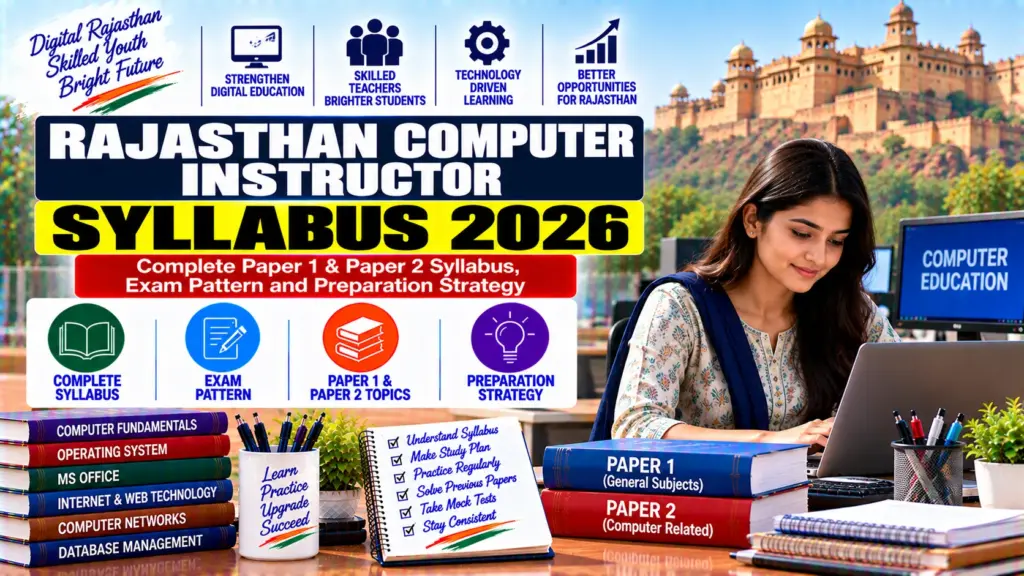
Rajasthan Computer Instructor Syllabus 2026: Complete Paper 1 & Paper 2 Syllabus, Exam Pattern and Preparation Strategy.The Rajasthan Computer Instructor Exam 2026 is an important opportunity for candidates looking to build a career in the field of computer education. The examination is not limited to basic computer knowledge. Along with Rajasthan General Knowledge and General Ability, candidates have to prepare programming, data structures, operating systems, networking, DBMS, cybersecurity, pedagogy and several other technical subjects.
This is why understanding the syllabus before starting preparation can save a lot of time. Once the subjects are divided into smaller sections, the preparation becomes much easier to manage.
The Rajasthan Computer Instructor examination consists of two objective papers, Paper 1 and Paper 2. Both papers carry 100 marks and have a duration of two hours.
Overview of Rajasthan Computer Instructor Syllabus 2026
| Particulars | Details |
|---|---|
| Exam Name | Rajasthan Computer Instructor Exam 2026 |
| Posts | Basic Computer Instructor / Senior Computer Instructor |
| Number of Papers | 2 |
| Paper 1 | 100 Marks |
| Paper 2 | 100 Marks |
| Questions in Each Paper | 100 |
| Exam Duration | 2 Hours per Paper |
| Question Type | Objective / MCQ |
| Negative Marking | 1/3 Mark for Wrong Answer |
Both papers are important, but Paper 2 requires special attention because it covers a wide range of professional computer science topics.
Rajasthan Computer Instructor Exam Pattern 2026
Paper 1
Paper 1 mainly tests the candidate’s knowledge of Rajasthan along with general ability.
Main Areas
- Rajasthan Art and Culture
- Rajasthan History
- Rajasthan Geography
- General Science
- Current Affairs
- General Ability
There are 100 questions for 100 marks, and candidates get 2 hours to complete the paper.
Paper 2
Paper 2 is the technical and professional paper.
It includes:
- Pedagogy
- Mental Ability
- Fundamentals of Computer
- Data Processing
- Programming Fundamentals
- Data Structures and Algorithms
- Computer Organisation and Operating System
- Communication and Network Concepts
- Network Security
- Database Management System
- System Analysis and Design
- Internet of Things and Applications
Paper 2 also contains 100 questions for 100 marks, with a duration of 2 hours.
Rajasthan Computer Instructor Paper 1 Syllabus 2026
Paper 1 may appear easier compared with the technical paper, but candidates should not underestimate it. Rajasthan-specific questions can cover a broad range of topics.
1. Rajasthan History
Prepare the important aspects of Rajasthan’s history, including:
- Major dynasties
- Important rulers
- Historical events
- Important personalities
- Freedom movement
- Integration of Rajasthan
- Major historical developments
Candidates should prepare these topics in chronological order. This makes it easier to remember important events and personalities.
2. Rajasthan Art and Culture
This section covers the cultural heritage of the state.
Important Topics
- Folk culture
- Folk traditions
- Fairs and festivals
- Folk music
- Folk dances
- Traditional dresses
- Handicrafts
- Paintings
- Forts
- Palaces
- Historical monuments
- Cultural traditions
Preparation Tip: Make short notes for fairs, festivals, folk dances, paintings and important monuments. These topics contain many facts, so repeated revision is useful.
3. Rajasthan Geography
Important areas include:
- Physical features of Rajasthan
- Climate
- Rivers
- Irrigation systems
- Agriculture
- Natural resources
- Minerals
- Industries
- Population-related information
- Economic development
- Major geographical regions
Rajasthan Geography should be prepared along with maps wherever possible. Visualising locations can make rivers, regions and geographical features easier to remember.
4. Rajasthan Current Affairs
Current affairs should be studied regularly rather than collected at the last minute.
Focus on:
- Rajasthan government schemes
- Major state-level developments
- Important appointments
- Awards
- Sports
- Economy
- Social developments
- Important government decisions
- Major events in Rajasthan
Keep a monthly notebook for important current affairs and revise it regularly.
5. General Ability
The General Ability section tests basic reasoning, numerical ability and analytical thinking.
Important Topics
- Logical Reasoning
- Decision Making
- Problem Solving
- Mental Ability
- Analytical Ability
- Basic Numeracy
- Data Interpretation
Reasoning Topics
Candidates should practise:
- Analogy
- Classification
- Number Series
- Coding-Decoding
- Direction Sense
- Blood Relations
- Logical Reasoning
- Basic Puzzles
- Problem Solving
Basic Numeracy
The preparation should include:
- Number System
- Percentage
- Ratio
- Average
- Profit and Loss
- Simple Interest
- Compound Interest
- Time and Work
- Time and Distance
Data Interpretation
Practise basic:
- Tables
- Bar Graphs
- Line Graphs
- Pie Charts
- Data-based questions
The level of basic numeracy and data interpretation is around the school-level foundation, so candidates should first make their basic calculations strong.
Rajasthan Computer Instructor Paper 2 Syllabus 2026
Paper 2 is the section where candidates need to spend most of their technical preparation time.
Instead of treating it as one large subject, divide it into separate modules.
1. Pedagogy
Pedagogy deals with teaching and learning concepts.
Important areas include:
- Teaching-learning process
- Basic principles of teaching
- Teaching methods
- Classroom interaction
- Instructional techniques
- Teaching aids
- Educational psychology
- Learning concepts
- Motivation
- Child development
- Assessment and evaluation
- ICT in education
Candidates preparing for a computer teaching post should understand not only computer concepts but also how those concepts can be taught effectively.
2. Mental Ability
The Mental Ability section includes:
- Decision Making
- Problem Solving
- Data Interpretation
- Data Sufficiency
- Logical Reasoning
- Analytical Ability
- Developments in the IT field
Regular practice is important here because solving speed improves only after working through different types of questions.
3. Fundamentals of Computer
This is the foundation of the technical syllabus.
Important Topics
- Overview of Computer System
- Characteristics of Computers
- Computer Components
- Input Devices
- Output Devices
- Pointing Devices
- Scanner
- Digital and Analog Data
- Data Representation
- Number Systems
- Decimal
- Binary
- Hexadecimal
- Files and File Types
Candidates should understand how different components work instead of simply memorising definitions.
4. Data Processing
The syllabus includes commonly used software and data-processing tools.
Important Topics
- MS Word
- Word Processing
- MS Excel
- Spreadsheet
- MS PowerPoint
- Presentation
- MS Access
- Basic Database Software Concepts
For MS Office-related topics, candidates should understand common features, functions and practical uses.
5. Programming Fundamentals
Programming is an important part of Paper 2.
The syllabus includes:
- C
- C++
- Java
- .NET
- Python
- Object-Oriented Programming
- IDE
- Artificial Intelligence
- Machine Learning
- Blockchain
What to Focus On
While preparing programming languages, pay attention to:
- Basic syntax
- Variables
- Data types
- Operators
- Conditional statements
- Loops
- Functions
- Arrays
- Classes and objects
- OOP concepts
- Basic programming logic
Exam Tip: Don’t spend all your time reading programming theory. Practise small programs and concept-based MCQs.
6. Data Structures and Algorithms
This section requires conceptual understanding.
Important Topics
- Arrays
- Linked Lists
- Stack
- Queue
- Binary Trees
- Graphs
- Searching
- Sorting
- C-based Data Structures
- C++-based Data Structures
Candidates should understand the difference between different data structures and where they are used.
7. Computer Organisation and Operating System
This section covers both computer architecture and operating-system concepts.
Computer Organisation
Prepare:
- Basic Computer Structure
- CPU
- Instructions
- Memory Organisation
- Input/Output Organisation
Operating System
Important areas include:
- Operating System Basics
- Process Management
- File Management
- Memory-related concepts
- Operating System functions
8. Communication and Network Concepts
Networking is another major part of Paper 2.
Important Topics
- Computer Networks
- Network Layers
- Network Models
- Networking Devices
- Communication Concepts
- Mobile Communication
Candidates should understand how computers communicate with each other and how different networking components work.
9. Network Security
Cybersecurity has become increasingly important, and it is included in the syllabus.
Prepare:
- Computer Viruses
- Cyber Attacks
- Firewall
- Data Backup
- LAN Security
- WAN Security
- Basic Cybersecurity Practices
- Ethical Hacking
Focus on understanding the purpose of different security mechanisms rather than memorising isolated definitions.
10. Database Management System
DBMS is an important technical topic and should be prepared systematically.
Important Topics
- Database Concepts
- DBMS
- RDBMS
- Tables
- Records
- Data Management
- Relational Database
- SQL
- Database Operations
Candidates should revise common SQL concepts and understand how relational databases work.
11. System Analysis and Design
This section deals with the basic concepts involved in analysing and designing information systems.
Prepare:
- System Concepts
- System Analysis
- System Design
- Information Systems
- System Development
- Basic system development concepts
This topic becomes easier when studied through the sequence of how a system is planned, analysed and developed.
12. Internet of Things and Its Applications
IoT is one of the newer areas included in the syllabus.
Important topics include:
- Meaning of IoT
- IoT Devices
- Sensors
- Connected Devices
- Communication
- IoT Applications
- Practical Uses of IoT
Try to relate IoT concepts to real-life examples such as smart homes, connected vehicles and industrial automation.
How to Prepare for Rajasthan Computer Instructor Exam 2026?
The biggest challenge in this examination is the size of the syllabus. The solution is not to study everything simultaneously.
Step 1: Complete Computer Fundamentals First
Start with:
- Computer Basics
- Number Systems
- Memory
- Input/Output Devices
- Operating Systems
- Basic Networking
These topics create the foundation for the rest of the technical syllabus.
Step 2: Move Towards Core Technical Subjects
Once the basics are clear, start:
- Programming
- Data Structures
- DBMS
- Networking
- Operating Systems
- Cybersecurity
Give each subject enough time rather than trying to finish several subjects in one day.
Step 3: Keep Rajasthan GK Running Alongside
Spend at least some time every day on:
- Rajasthan History
- Geography
- Art and Culture
- Current Affairs
- General Science
This prevents the general section from becoming a last-minute burden.
Step 4: Start MCQ Practice Early
Don’t wait until the syllabus is completely finished.
After completing every major topic, solve questions from that topic. This will quickly show you which concepts need another round of revision.
Rajasthan Computer Instructor 90-Day Preparation Plan
Days 1–30: Foundation
Focus on:
- Rajasthan History
- Rajasthan Geography
- Rajasthan Art and Culture
- General Science
- Computer Fundamentals
- Number Systems
- Operating System Basics
- Basic Reasoning
The goal should be to understand the fundamentals.
Days 31–60: Technical Preparation
Cover:
- Programming
- Data Structures
- Algorithms
- DBMS
- Computer Organisation
- Networking
- Network Security
- Pedagogy
- IoT
- System Analysis and Design
Start taking topic-wise tests during this phase.
Days 61–75: Practice Phase
Now increase the focus on:
- Previous-year questions
- Technical MCQs
- Rajasthan GK questions
- Reasoning tests
- Full-length practice papers
- Data Interpretation
Maintain an error notebook and revise it frequently.
Days 76–90: Final Revision
The final stage should be focused on revision rather than collecting new material.
Revise:
- Computer Fundamentals
- Programming
- Data Structures
- DBMS
- Networking
- Operating Systems
- Cybersecurity
- Rajasthan GK
- Current Affairs
- Pedagogy
- Mental Ability
Take mock tests regularly and analyse every mistake.
Daily Study Timetable
| Subject | Time |
|---|---|
| Computer Science | 2 Hours |
| Programming/Data Structures | 1 Hour |
| Rajasthan GK | 1 Hour |
| Networking/DBMS/OS | 1 Hour |
| Reasoning & Mental Ability | 45 Minutes |
| Current Affairs | 30 Minutes |
| MCQ Practice | 1 Hour |
| Revision | 30 Minutes |
If you have less time available, reduce the duration but try to touch the important subjects every day.
Common Mistakes Candidates Should Avoid
Ignoring Paper 1
Technical preparation is important, but Paper 1 can also make a significant difference.
Leaving Rajasthan GK for the End
Rajasthan GK contains many factual topics and needs repeated revision.
Memorising Computer Concepts Without Understanding Them
Programming, DBMS, networking and operating systems become much easier when you understand how they actually work.
Avoiding Mock Tests
Mock tests are essential for improving speed and managing negative marking.
Guessing Too Many Answers
With negative marking, random attempts can hurt your overall score. Attempt questions only when you have reasonable confidence.
Changing Study Material Too Often
Stick to a limited set of reliable study material and revise it properly.