
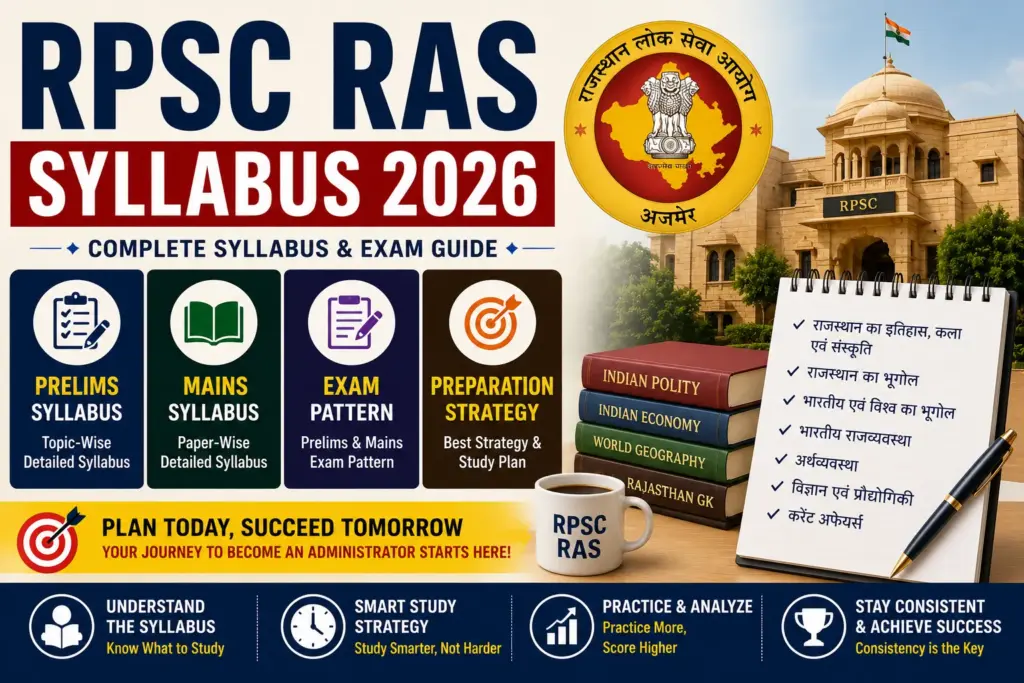
The Rajasthan Public Service Commission (RPSC) conducts the Rajasthan Administrative Service (RAS) examination for recruitment to administrative posts under the Rajasthan State and Subordinate Services. For candidates preparing for RAS 2026, understanding the latest syllabus is one of the first things to get right.
The RAS examination is not just about memorising facts. The Prelims tests broad knowledge and accuracy, while the Mains examination places greater emphasis on analytical thinking, descriptive answers, administration, Rajasthan-specific issues and effective communication.
According to the latest RPSC Mains scheme dated January 9, 2026, the written examination consists of four compulsory papers, each carrying 200 marks and having a duration of three hours.
Overview of RPSC RAS Syllabus 2026
| Particular | Details |
|---|---|
| Exam Name | Rajasthan State and Subordinate Services Combined Competitive Examination |
| Conducting Body | Rajasthan Public Service Commission |
| Selection Process | Prelims, Mains and Personality Test |
| Prelims | Objective Type |
| Mains | Descriptive/Analytical |
| Prelims Paper | General Knowledge & General Science |
| Prelims Marks | 200 |
| Prelims Questions | 150 |
| Prelims Duration | 3 Hours |
| Mains Papers | 4 |
| Mains Total Marks | 800 |
| Mains Duration | 3 Hours per paper |
| Syllabus Link | https://rpsc.rajasthan.gov.in/syllabus |
| Pre Exam (Hindi) | Syllabus for Raj. State And Sub. Services Comb. Comp (Pre) Exam (Hindi Version) |
| Pre Exam (English) | Syllabus for Raj. State And Sub. Services Comb. Comp (Pre) Exam (English Version) |
| Main Exam (Hindi) | Syllabus for Raj. State And Sub. Services Comb. Comp (Mains) Exam (Hindi Version) |
| Main Exam (English) | Syllabus for Raj. State And Sub. Services Comb. Comp (Mains) Exam (English Version) |
The Prelims is a screening stage, while candidates qualifying for the Main Examination have to appear in four compulsory descriptive/analytical papers.
RPSC RAS Prelims Exam Pattern 2026
The RAS Preliminary Examination consists of one objective paper on General Knowledge and General Science. The paper contains 150 questions for 200 marks, and candidates get three hours to complete it.
There is also negative marking, with one-third mark deducted for each incorrect answer.
Prelims Pattern at a Glance
| Feature | Details |
|---|---|
| Paper | General Knowledge & General Science |
| Questions | 150 |
| Maximum Marks | 200 |
| Duration | 3 Hours |
| Question Type | Objective/MCQ |
| Negative Marking | 1/3 mark for each wrong answer |
| Purpose | Screening for Mains |
The syllabus covers Rajasthan history and culture along with Indian history, geography, polity, economy, science and technology, reasoning and current affairs.
RPSC RAS Prelims Syllabus 2026
Rajasthan History, Art and Culture
Rajasthan-specific preparation should be given special attention. Important areas include:
- Ancient and medieval Rajasthan
- Political and cultural achievements of rulers
- Revenue and administrative systems
- Revolt of 1857
- Peasant and tribal movements
- Political awakening and mass movements
- Integration of Rajasthan
- Folk music and dances
- Handicrafts and architecture
- Fairs and festivals
- Tribes and traditions
- Literature and Rajasthani language
- Saints and folk deities
- Heritage and tourism
Indian History and World History
Candidates should cover Ancient, Medieval and Modern Indian History, the Indian National Movement, socio-religious reform movements and post-Independence developments.
World History areas include the Renaissance, Reformation, American War of Independence, French Revolution, Industrial Revolution, Russian Revolution, Fascism, Nazism, World Wars and the Cold War.
Geography
Geography preparation should cover World, India and Rajasthan.
Important topics include:
- Physical geography
- Earth’s interior
- Mountains, plateaus, plains and deserts
- Earthquakes and volcanoes
- Climate
- Environmental issues
- Indian physiography
- Rivers and drainage
- Monsoon
- Natural resources
- Population
- Rajasthan’s rivers and lakes
- Agriculture
- Minerals
- Wildlife and biodiversity
- Tribes
- Tourism
Polity and Governance
Important areas include:
- Indian Constitution
- Fundamental Rights
- Directive Principles
- Fundamental Duties
- Parliament
- Judiciary
- Constitutional bodies
- Local government
- Panchayati Raj
- Rajasthan administration
- Governor and Chief Minister
- Legislative Assembly
- State commissions
Economy
The syllabus covers both the Indian Economy and Rajasthan Economy.
Candidates should prepare agriculture, industry, infrastructure, public finance, banking, government schemes, development, employment, poverty and welfare-related topics.
For Rajasthan, candidates should also focus on the state’s agriculture, industrial development, infrastructure, development projects and welfare schemes.
Science and Technology
Science preparation should not be restricted to school-level basics. The syllabus includes modern developments such as:
- Biotechnology
- Artificial Intelligence
- Machine Learning
- Big Data
- Cloud Computing
- Internet of Things
- Blockchain
- Cybersecurity
- Robotics
- Nanotechnology
- Quantum Computing
- Space technology
- Defence technology
- Drone technology
The syllabus also covers India’s space programme, satellites, launch vehicles, remote sensing and indigenous defence technologies.
Current Affairs and Reasoning
Current affairs preparation should include Rajasthan, national and international developments, government schemes, awards, important personalities, science and technology and major events.
Reasoning topics include logical reasoning, coding-decoding, analogy, number series, direction sense and data interpretation.
RPSC RAS Mains Exam Pattern 2026
The RPSC RAS Mains is the stage where candidates need to move beyond one-line factual preparation. The examination is descriptive and analytical in nature, with brief, medium and long-answer questions. Each paper is conducted for three hours.
| Paper | Subject | Marks | Duration |
|---|---|---|---|
| Paper I | General Studies-I | 200 | 3 Hours |
| Paper II | General Studies-II | 200 | 3 Hours |
| Paper III | General Studies-III | 200 | 3 Hours |
| Paper IV | General Hindi & General English | 200 | 3 Hours |
| Total | 800 |
This makes answer writing an important part of RAS preparation rather than something that should be left until after Prelims.
RPSC RAS Mains Paper I Syllabus
Paper I covers History, Economics and Sociology, Management, Accounting and Auditing.
Major Areas
History: Rajasthan history and culture, Indian history and culture, Indian National Movement and modern world history.
Economy: Indian and Rajasthan economy, agriculture, industry, infrastructure, public finance, banking and development-related issues.
Sociology: Caste and class, social change, urbanisation, modernisation, globalisation, family and marriage, poverty, unemployment and problems faced by weaker sections.
Management: Management functions, decision-making, organisational behaviour, marketing, human resource management and strategic management.
Accounting & Auditing: Accounting principles, financial statements, cash flow statements, GST and different forms of auditing.
RPSC RAS Mains Paper II Syllabus
Paper II focuses on:
- Administrative Ethics
- General Science & Technology
- Earth Science – Geography & Geology
Administrative Ethics
This section includes ethics and human values, integrity, impartiality, transparency, Gandhian ethics, Bhagwad Geeta and ethics in administration, moral thinkers, ethical dilemmas, social justice and accountability.
One important area in the latest syllabus is Artificial Intelligence versus conscience in administrative decision-making, highlighting contemporary administrative challenges.
Science and Technology
The paper covers chemistry, physics, biology, biotechnology, ICT, AI and emerging technologies. It also includes space and defence technology.
Geography and Geology
The Earth Science portion covers world geography and geology, Indian geography and detailed Rajasthan geography, including rivers, climate, soil, agriculture, minerals, tribes, biodiversity and tourism.
RPSC RAS Mains Paper III Syllabus
Paper III is particularly important for aspirants interested in polity, governance and administration.
It covers:
- Indian Constitution
- Parliament and constitutional institutions
- Federalism
- Judiciary
- Electoral reforms
- Internal security
- Rajasthan politics
- Panchayati Raj
- Urban local government
- Public policy
- E-governance
- India’s foreign policy
- International relations
- International organisations
- Current affairs
- Rajasthan government schemes
The syllabus also covers India’s participation in platforms such as UN, WTO, ASEAN, BRICS, G20, QUAD, I2U2 and AUKUS, along with climate and green diplomacy.
Public Administration
Public Administration includes theories and principles of administration, organisational structure, leadership, accountability, administrative institutions, personnel administration and administrative reforms.
Candidates must also study State and District Administration, including the Governor, Chief Minister, State Secretariat, Chief Secretary, Police Administration, Revenue Board and the role of the District Collector.
Behaviour and Law
The Behaviour section includes intelligence, leadership, communication, workplace behaviour, stress and burnout.
The Law section includes:
- Right to Information Act, 2005
- Information Technology Act, 2000
- Intellectual Property Rights
- Laws relating to women and children
- Rajasthan Tenancy Act
- Rajasthan Land Revenue Act
- Bharatiya Nyay Sanhita, 2023
- Bharatiya Nagrik Suraksha Sanhita, 2023
RPSC RAS Mains Paper IV: General Hindi and English
Paper IV carries 200 marks and is designed to assess language skills and effective expression. The standard of General Hindi and General English is specified as Senior Secondary level.
General Hindi
Important areas include:
- Word and sentence correction
- Prefixes and suffixes
- Idioms and proverbs
- Administrative terminology
- Precis writing
- Expansion of ideas
- Translation
- Letter writing
- Office orders
- Memorandum
- Report writing
- Official drafting
General English
The English section includes:
- Grammar and usage
- Prepositions
- Phrasal verbs and idioms
- One-word substitution
- Commonly confused words
- Comprehension
- Precis writing
- Hindi-to-English translation
- Theme elaboration
- Official letter writing
- Memorandum and report writing
RPSC RAS Essay Syllabus 2026
The essay section carries 40 marks. Candidates have to write an essay of around 600 words in either Hindi or English.
The six broad themes are:
- Language, Literature and Cultural Heritage
- Society, Governance and Public Affairs
- Science, Technology, Environment and Sustainable Development
- Economy, Agriculture, Industry and Commerce
- Current Affairs, Disasters and National Development Initiatives
- Tourism, Culture and Contemporary Issues with reference to Rajasthan
The essay should remain relevant to the topic and present ideas in a clear, logical and well-organised manner.
Latest Changes in RPSC RAS Syllabus 2026
The updated syllabus puts more emphasis on analytical and descriptive preparation. There is also expanded coverage of law-related topics and changes in the essay and descriptive-answer structure.
For candidates, this means that simply memorising Rajasthan GK or current-affairs facts will not be enough for the Mains. Preparation should gradually shift towards understanding issues, forming arguments and writing structured answers.
How to Prepare for RPSC RAS 2026?
A practical preparation strategy can make the large syllabus easier to handle.
1. Start With the Syllabus
Before choosing books or making notes, read the complete syllabus once. Mark topics that overlap between Prelims and Mains.
2. Give Rajasthan Special Attention
Rajasthan-related history, geography, economy, administration, culture and current affairs appear repeatedly. Keep a separate Rajasthan notebook for quick revision.
3. Don’t Ignore Current Affairs
Current affairs should not be studied only for Prelims. Try to connect major events with governance, economy, administration, society and Rajasthan for Mains answer writing.
4. Begin Answer Writing Early
Even two or three answers a week can help initially. Gradually increase the frequency and practise completing answers within the prescribed word limits.
5. Revise More Than You Collect
RAS has a huge syllabus, so continuously adding new material can become counterproductive. Regular revision of limited, reliable study material is more useful.
6. Practise Previous-Year Papers
Previous-year questions help candidates understand the style of questions and identify which topics they need to strengthen.
7. Prepare for Both Stages
The best approach is not to completely separate Prelims and Mains preparation. Build concepts with Mains in mind, while regularly practising MCQs for Prelims.