
Odisha Police Constable Syllabus 2026: Check Subject-Wise Topics, Exam Pattern and Marking Scheme.Preparing for the Odisha Police Constable examination becomes easier when you know what to study and how the marks are distributed. Rather than trying to cover every subject at once, candidates should divide the syllabus into smaller topics and follow a consistent study routine.
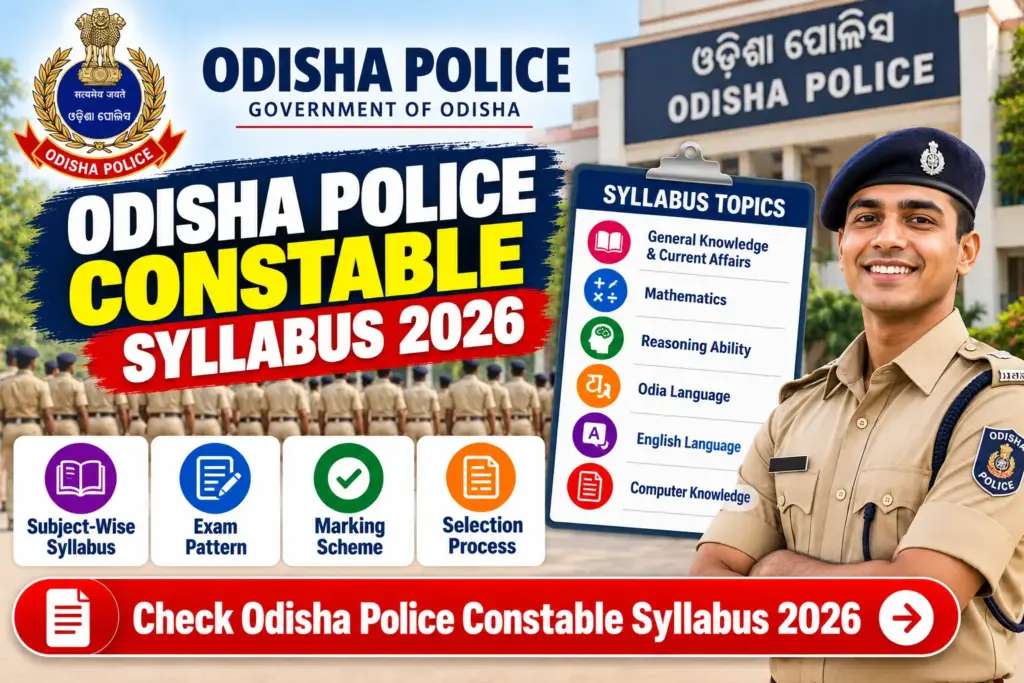
The Odisha Police Constable Syllabus 2026 covers Odia Language, English Language, Arithmetic, General Knowledge, Situational Awareness and Logical Reasoning, and Basic Computer Knowledge. Odisha-specific history, geography, culture and current affairs are also important areas to include in your preparation.
According to the available syllabus material, the general Constable written examination consists of 100 questions for 100 marks, with a duration of two hours. The referenced pattern also provides for negative marking of 0.25 mark for each incorrect answer.
Candidates should note that the syllabus and examination structure can differ for Constable (Communication), Driver PMT and Firefighting Driver posts. It is important to prepare according to the requirements of the particular post you are applying for.
Overview of Odisha Police Constable Syllabus 2026
| Particulars | Details |
|---|---|
| Examination Name | Odisha Police Constable Recruitment 2026 |
| Post | Constable/Sepoy and other notified posts |
| Recruiting Organisation | Odisha Police and the applicable recruitment authority |
| Examination Mode | As specified in the recruitment notification |
| Question Type | Multiple-choice questions |
| Total Questions | 100 for the general Constable examination |
| Total Marks | 100 |
| Exam Duration | 2 hours |
| Subjects | Odia, English, Arithmetic, General Knowledge, Reasoning and Computer Basics |
| Negative Marking | 0.25 mark per incorrect answer in the referenced pattern |
| Selection Process | Written examination, physical tests and other applicable stages |
Odisha Police Constable Exam Pattern 2026
The referenced examination pattern divides the written test into six sections. General Knowledge carries the highest number of marks, followed by Arithmetic.
| Subject | Questions | Marks |
|---|---|---|
| Odia Language | 15 | 15 |
| English Language | 15 | 15 |
| Arithmetic | 20 | 20 |
| General Knowledge | 25 | 25 |
| Situational Awareness and Logical Reasoning | 15 | 15 |
| Basic Computer Knowledge | 10 | 10 |
| Total | 100 | 100 |
The examination duration is two hours under this pattern. Each correct answer carries one mark, while an incorrect answer attracts a deduction of 0.25 mark.
Preparation tip: General Knowledge and Arithmetic deserve regular attention because they account for 45 marks combined. However, candidates should not ignore the remaining subjects, as they can make a meaningful difference to the overall score.
Odisha Police Constable Syllabus 2026: Subject-Wise Details
1. Odia Language
The Odia Language section tests vocabulary, grammar, comprehension and the correct use of words. Candidates should be comfortable with basic language rules and practise identifying grammatical errors.
Important topics include:
- Reading comprehension
- Translation
- Vocabulary and word usage
- Synonyms and antonyms
- Idioms and phrases
- Fill in the blanks
- Nouns, pronouns and adjectives
- Gender and number
- Sandhi and Samasa
- Prefixes and suffixes
- Verb forms and tenses
- Sentence correction
- Common grammatical errors
- Proverbs and expressions
- Meaning and interpretation of sentences
How to prepare: Revise grammar rules topic by topic. Practise comprehension passages and sentence-correction questions, and maintain a notebook of unfamiliar Odia words. Regular revision will help you remember vocabulary more effectively.
2. English Language
The English section focuses on grammar, vocabulary and reading comprehension. Candidates who practise regularly can improve their accuracy and become more comfortable with different question formats.
The main topics are:
- Synonyms and antonyms
- Vocabulary
- One-word substitution
- Idioms and phrases
- Articles and determiners
- Prepositions
- Tenses
- Subject-verb agreement
- Parts of speech
- Active and passive voice
- Direct and indirect speech
- Error detection
- Sentence correction
- Fill in the blanks
- Sentence completion
- Paragraph completion
- Sentence rearrangement
- Cloze test
- Reading comprehension
How to prepare: Start with the basics of grammar, particularly tenses, articles, prepositions and subject-verb agreement. Solve short practice sets daily and read passages to improve comprehension. Keep revising new words instead of relying on memorisation alone.
3. Arithmetic
Arithmetic is an important section of the examination. It tests basic mathematical knowledge, calculation skills and the ability to solve numerical problems within a reasonable time.
The syllabus includes:
- Number system
- Simplification
- Decimals and fractions
- HCF and LCM
- Percentage
- Ratio and proportion
- Average
- Profit and loss
- Simple interest
- Compound interest
- Partnership
- Mixture and alligation
- Problems on ages
- Time and work
- Pipes and cisterns
- Time, speed and distance
- Boats and streams
- Number series
- Banker’s discount
- Mensuration
- Area
- Volume and surface area
- Heights and distances
- Chain rule
- Probability
- Permutation and combination
How to prepare: Begin with number systems, percentages, averages, ratio and proportion, and profit and loss. Once the basic concepts are clear, move on to topics that require more steps, such as time and work, mensuration and probability.
Practise questions after every chapter and note down the formulas you find difficult to remember. Timed practice will help you improve calculation speed without compromising accuracy.
4. General Knowledge
General Knowledge carries 25 marks in the referenced examination pattern. It includes static subjects, general science and current affairs.
Candidates should give particular attention to Odisha-related topics alongside national-level general knowledge.
History
- Ancient Indian history
- Medieval Indian history
- Modern Indian history
- Indian National Movement
- Important historical events
- History and cultural heritage of Odisha
Geography
- Physical geography of India
- Natural resources
- Indian agriculture
- Rivers, mountains and other geographical features
- Physical geography of Odisha
- Economic geography of Odisha
Indian Polity
- Constitution of India
- Fundamental Rights and Duties
- Directive Principles of State Policy
- Union and State Governments
- Indian Parliament
- Local self-government
- Basic civic and political concepts
Economy
- Basic concepts of the Indian economy
- Economic development
- Important economic developments
General Science
- Everyday science
- Physics up to the Class 10 level
- Chemistry up to the Class 10 level
- Biology up to the Class 10 level
- Environmental science
- Scientific developments and discoveries
Current Affairs and Static GK
- Odisha state current affairs
- National and international events
- Sports
- Awards and honours
- Important days
- Books and authors
- Countries, capitals and currencies
- Tourism and famous places
- Literature
- Inventions and discoveries
- Important personalities
- Science and technology developments
How to prepare: Divide General Knowledge into smaller subjects and study them throughout the week. Prepare concise notes for history, geography, polity and science. Revise current affairs regularly and include Odisha GK in your routine rather than leaving it until the end.
5. Situational Awareness and Logical Reasoning
This section tests logical thinking, analytical ability, pattern recognition and decision-making. Questions may involve identifying relationships, interpreting statements or finding the next item in a sequence.
Important topics include:
- Analogy
- Classification
- Alphabetical series
- Number series
- Coding and decoding
- Blood relations
- Direction and distance
- Order and ranking
- Syllogism
- Data interpretation
- Statements and conclusions
- Statements and arguments
- Decision-making
- Arithmetical reasoning
- Clocks and calendars
- Cubes and dice
- Embedded figures
- Mirror images
- Non-verbal series
- Figure analogy
- Pattern recognition
How to prepare: Start with analogy, series, coding-decoding and direction-based questions. Practise a few questions daily and review the ones you get wrong. As your accuracy improves, move on to mixed question sets under timed conditions.
6. Basic Computer Knowledge
Computer Knowledge carries 10 marks in the referenced pattern. Candidates should understand basic computer operations, common devices and everyday digital applications.
Important topics include:
- Computer fundamentals
- History of computers
- Generations of computers
- Computer hardware and software
- Computer languages
- Input and output devices
- Operating systems
- Computer networking
- Internet and email
- MS Office basics
- Digital payment systems
- Cyber safety
- Social media awareness
- Basic government digital services
- Recent developments in computer technology
How to prepare: Start with computer fundamentals, hardware, software, memory and operating systems. Then cover office applications, internet basics, networking and cyber safety. Short notes and multiple-choice practice questions can help you revise important terms quickly.
Special Syllabus for Constable (Communication)
Candidates applying for Constable (Communication) should prepare the specialised syllabus rather than relying only on the general Constable topics.
The available syllabus material describes a separate examination at the +2 Science standard, with 100 multiple-choice questions carrying 300 marks and a duration of 120 minutes.
Physics
- Electrostatics
- Current electricity
- Magnetic effects of current and magnetism
- Electromagnetic induction and alternating current
- Electromagnetic waves
- Ray optics and wave optics
- Dual nature of radiation and matter
- Atoms and nuclei
- Semiconductor electronics
- Communication systems
Computer Science
- Computer fundamentals
- Computer hardware and software
- Operating systems
- Data representation and number systems
- Programming fundamentals
- Algorithms and flowcharts
- Problem-solving techniques
- Basic data structures, including arrays, stacks and queues
- Database concepts, including tables, keys and queries
- Computer networks and the internet
- Cybersecurity and information security
- Digital communication systems
Candidates should check the applicable recruitment advertisement to confirm the exact examination structure and subject requirements.
Syllabus for Driver PMT and Firefighting Driver
The available material describes a separate written examination for Driver PMT and Firefighting Driver posts, carrying 50 marks across 50 questions with a duration of 60 minutes.
The main areas include:
Vehicle knowledge and maintenance
- Vehicle parts and systems
- Engine components
- Fuel systems
- Transmission
- Braking and steering systems
- Suspension and electrical systems
- Lubrication and maintenance
- Periodic and pre-driving checks
- Tyre maintenance
- Minor troubleshooting
Traffic rules and road safety
- Traffic signals
- Road markings
- Hand signals
- Mandatory and warning signs
- Right-of-way rules
- Defensive driving
- Relevant motor vehicle regulations
A practical driving test may also apply. Candidates should check the specific requirements for their post before preparing.
Odisha Police Constable Selection Process 2026
The selection stages depend on the post and the applicable recruitment notification. The available material describes the following stages:
- Written examination: Candidates take the examination prescribed for their post.
- Physical Measurement Test (PMT): Physical measurements are checked against the required standards.
- Physical Efficiency Test (PET): Candidates undertake the prescribed physical activities.
- Driving test, where applicable: Candidates applying for relevant driving posts may need to demonstrate driving skills.
- Medical examination: Candidates must meet the applicable medical standards.
- Document verification: Required certificates and documents are checked.
Candidates should not assume that every stage applies identically to every post. Check the relevant notification for the exact selection process.
How to Prepare for Odisha Police Constable 2026
A clear study routine can make the syllabus easier to manage. You do not need to finish every subject in a few days; consistent preparation and revision are more important.
1. Follow the Marks Distribution
Give regular attention to General Knowledge and Arithmetic because they carry the largest combined share of marks in the referenced pattern. Continue practising Odia, English, Reasoning and Computer Knowledge alongside them.
2. Focus on Odisha GK
Include the state’s history, geography, cultural heritage and current affairs in your weekly study plan. This helps you cover state-specific topics instead of concentrating only on national GK.
3. Practise Arithmetic Every Day
Solve questions from the topics you have studied and revise formulas regularly. Keep track of calculation errors so that you can work on the areas where you lose marks.
4. Strengthen Both Language Sections
Practise Odia and English grammar, vocabulary and comprehension. Regular practice can help you answer language questions more confidently.
5. Solve Previous-Year Papers and Practice Sets
Question papers and practice sets can help you understand question formats and identify weak areas. After every practice session, review incorrect answers and revise the related concepts.
6. Take Timed Mock Tests
Practise within the prescribed examination duration. Mock tests can help you improve time management and identify which sections need more attention.
7. Prepare for Physical Tests Where Required
If your post includes PMT or PET, make physical preparation part of your routine. Follow the applicable standards and prepare gradually rather than leaving fitness preparation until the last moment.
Odisha Police Constable 2026: 60-Day Preparation Plan
If you have around two months to prepare, the following schedule can help you organise your work.
| Period | Preparation Target |
|---|---|
| Days 1–15 | Build foundations in Arithmetic, Odia, English and Computer Knowledge |
| Days 16–30 | Cover Reasoning, General Science, Indian Polity and Geography |
| Days 31–40 | Focus on Odisha GK, History, Economy and current affairs |
| Days 41–50 | Complete remaining topics and practise subject-wise questions |
| Days 51–60 | Revise short notes, attempt mock tests and analyse mistakes |
Adjust the schedule according to your current preparation level. If you have already covered the basics, spend more time on revision and mock-test analysis.
Common Mistakes to Avoid
- Studying without checking the syllabus for your specific post
- Ignoring Odisha-specific GK
- Spending too much time on one subject
- Neglecting Odia or English practice
- Memorising formulas without solving questions
- Leaving Computer Knowledge until the final days
- Taking mock tests without reviewing mistakes
- Skipping revision
- Ignoring physical preparation when it is required
Frequently Asked Questions (FAQs)
1. What is the Odisha Police Constable Syllabus 2026?
The referenced general Constable syllabus includes Odia Language, English Language, Arithmetic, General Knowledge, Situational Awareness and Logical Reasoning, and Basic Computer Knowledge.
2. How many questions are asked in the written examination?
The referenced general Constable pattern contains 100 questions carrying 100 marks.
3. What is the duration of the Odisha Police Constable examination?
The referenced general Constable examination lasts two hours. Other posts may have a different examination structure.
4. Is there negative marking?
The supplied syllabus material describes a deduction of 0.25 mark for each incorrect answer in the general Constable pattern. Candidates should confirm the applicable marking scheme in their recruitment notification.
5. Which subject carries the highest weightage?
General Knowledge carries the highest weightage in the referenced pattern, with 25 questions for 25 marks.
6. What are the main Arithmetic topics?
The main topics include number systems, simplification, percentages, ratio and proportion, averages, profit and loss, interest, time and work, time and distance, and mensuration.
7. Is Odisha GK important?
Yes. Odisha’s history, geography, cultural heritage and current affairs are included in the available syllabus material and should be part of your preparation.
8. Is Computer Knowledge included in the syllabus?
Yes. Basic Computer Knowledge carries 10 marks in the referenced general Constable pattern.
9. Is the syllabus the same for all Odisha Police posts?
No. The available material describes separate examination requirements for Constable (Communication), Driver PMT and Firefighting Driver. Candidates should follow the syllabus for their specific post.
10. What is the best way to prepare for the examination?
Study according to the subject-wise syllabus, practise Arithmetic and Reasoning regularly, revise Odisha GK, strengthen both language sections and take timed mock tests. Prepare for physical tests if they apply to your post.