
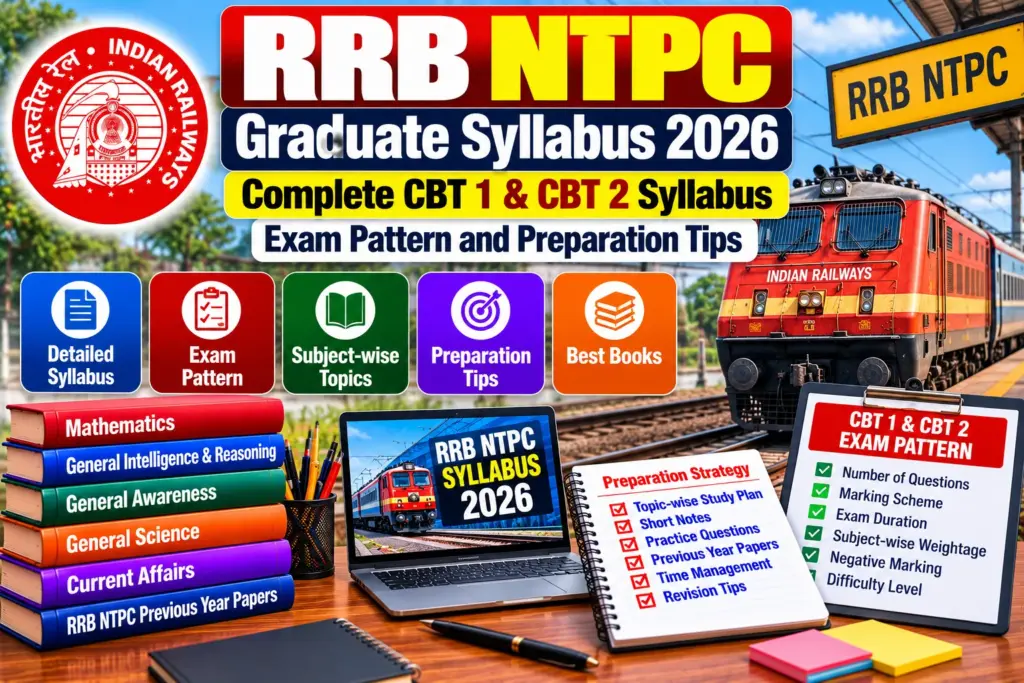
RRB NTPC Graduate Syllabus 2026: Complete CBT 1 & CBT 2 Syllabus, Exam Pattern and Preparation Tips.Preparing for the RRB NTPC Graduate Level examination becomes much easier when you know exactly what to study and how the examination is structured. Many candidates spend months preparing for Railway exams, but without a clear understanding of the syllabus, they often end up spending too much time on some topics while leaving others unfinished.
The RRB NTPC Graduate Level recruitment under CEN 06/2026 has announced 3,548 vacancies. Candidates preparing for these posts should focus on three main subjects: Mathematics, General Intelligence and Reasoning, and General Awareness.
Both CBT 1 and CBT 2 cover these subjects, but the number of questions and marks differs. Candidates should therefore prepare for both stages from the beginning instead of treating CBT 1 as their only target.
In this article, we explain the complete RRB NTPC Graduate Syllabus 2026, subject-wise topics, examination pattern, negative marking and preparation strategy in a simple and practical way.
Overview of RRB NTPC Graduate Syllabus 2026
| Particular | Details |
|---|---|
| Examination | RRB NTPC Graduate Level 2026 |
| Notification Number | CEN 06/2026 |
| Conducting Authority | Railway Recruitment Boards |
| Vacancies | 3,548 |
| Exam Mode | Computer-Based Test |
| Subjects | Mathematics, General Intelligence and Reasoning, General Awareness |
| CBT 1 | 100 Questions, 100 Marks |
| CBT 2 | 120 Questions, 120 Marks |
| Duration | 90 Minutes per CBT |
| Negative Marking | 1/3 mark for each incorrect answer |
| Selection Stages | CBT 1, CBT 2, Document Verification and Medical Examination |
| Syllabus & Exam Pattern Link | Download PDF |
RRB NTPC Graduate Selection Process 2026
The recruitment process consists of two computer-based examinations, followed by document verification and a medical examination.
1. CBT 1: This is the first stage of the selection process. Candidates are shortlisted for CBT 2 based on their performance and merit.
2. CBT 2: Candidates who qualify for the next stage appear for CBT 2. Their performance is important for further shortlisting.
3. Document Verification: Shortlisted candidates must produce the required educational certificates, identity documents and other applicable records.
4. Medical Examination: Candidates must satisfy the medical standards applicable to their allotted post.
Important: Under CEN 06/2026, the Computer-Based Typing Skill Test has been dispensed with for Junior Accounts Assistant cum Typist and Senior Clerk cum Typist. CBAT is not included because Station Master and Traffic Assistant are not among the posts notified under this recruitment.
RRB NTPC Graduate CBT 1 Exam Pattern 2026
CBT 1 contains 100 objective-type questions carrying one mark each. General Awareness accounts for the largest share of questions in this stage.
| Subject | Questions | Marks |
|---|---|---|
| General Awareness | 40 | 40 |
| Mathematics | 30 | 30 |
| General Intelligence and Reasoning | 30 | 30 |
| Total | 100 | 100 |
- Total duration: 90 minutes
- Correct answer: 1 mark
- Incorrect answer: 1/3 mark deducted
- Question format: Multiple-choice questions
The section-wise distribution is indicative, so candidates should be prepared for variations in the actual question paper.
RRB NTPC Graduate CBT 2 Exam Pattern 2026
CBT 2 includes 120 questions for 120 marks. The subjects remain the same as CBT 1, but the number of questions increases.
| Subject | Questions | Marks |
|---|---|---|
| General Awareness | 50 | 50 |
| Mathematics | 35 | 35 |
| General Intelligence and Reasoning | 35 | 35 |
| Total | 120 | 120 |
The examination duration is 90 minutes, and one-third of a mark is deducted for every incorrect answer.
Candidates should practise both stages under timed conditions. This will help them become familiar with the examination format and improve their speed without sacrificing accuracy.
RRB NTPC Graduate Syllabus 2026: Subject-Wise Topics
1. Mathematics Syllabus
Mathematics is a scoring section for candidates who understand the concepts and practise regularly. The questions cover arithmetic as well as elementary algebra, geometry, trigonometry and statistics.
The complete list of topics includes:
- Number System
- Decimals
- Fractions
- LCM and HCF
- Ratio and Proportion
- Percentage
- Mensuration
- Time and Work
- Time and Distance
- Simple Interest
- Compound Interest
- Profit and Loss
- Elementary Algebra
- Geometry
- Trigonometry
- Elementary Statistics
How to Prepare for Mathematics
Start with basic arithmetic and make sure you understand each concept before moving to shortcuts. Percentage, ratio and proportion, profit and loss, and time and work are useful topics to practise consistently.
After completing a chapter, solve topic-wise questions and review every incorrect answer. Maintain a notebook of formulas and calculation mistakes for quick revision.
As your accuracy improves, begin solving mixed questions within a time limit. This will help you prepare for the pace required in the actual examination.
2. General Intelligence and Reasoning Syllabus
The Reasoning section tests your ability to recognise patterns, analyse information and reach logical conclusions. Regular practice is particularly important because many questions require you to identify the correct approach quickly.
The syllabus includes:
- Analogies
- Number Series
- Alphabetical Series
- Coding and Decoding
- Mathematical Operations
- Similarities and Differences
- Relationships
- Analytical Reasoning
- Syllogism
- Jumbling
- Venn Diagrams
- Puzzles
- Data Sufficiency
- Statement and Conclusion
- Statement and Courses of Action
- Decision Making
- Maps
- Interpretation of Graphs
How to Prepare for Reasoning
Begin with series, analogy, coding-decoding and similarities and differences. Once you are comfortable with these topics, practise puzzles, syllogism, data sufficiency and analytical reasoning.
Do not focus only on the number of questions you solve. Try to understand why a particular answer is correct and where your reasoning went wrong. This approach will help you handle unfamiliar questions more effectively.
3. General Awareness Syllabus
General Awareness is the largest section in both CBT 1 and CBT 2. It covers a wide range of subjects, so preparing it through a regular study routine is more effective than trying to memorise everything shortly before the examination.
The important areas are listed below.
Current Affairs
- National and international events
- Important developments in India and abroad
- Major government programmes
- Important personalities and events
General Science and Life Science
- General Science up to the Class 10 CBSE level
- Life Science
- Scientific and technological developments
- India’s space programme
- India’s nuclear programme
History and Culture
- History of India
- Indian Freedom Struggle
- Art and Culture of India
- Indian Literature
- Monuments and important places of India
- Games and Sports
Geography
- Physical Geography of India and the world
- Social Geography
- Economic Geography
- Important geographical features and places
Indian Polity and Governance
- Indian Constitution
- Political system
- Governance
- Important government and public sector organisations
Economy and Environment
- Indian Economy
- Environmental issues concerning India and the world
- Flagship government programmes
- Flora and fauna of India
Computers and Other Important Topics
- Basics of Computers
- Computer Applications
- Common Abbreviations
- Transport Systems in India
- United Nations and other important world organisations
- Famous personalities of India and the world
How to Prepare for General Awareness
Divide the syllabus into smaller sections and cover them one by one. Prepare short notes for static GK topics such as history, geography, polity and science.
For current affairs, follow a consistent monthly revision routine. Revisit important facts regularly instead of reading new material every day without revising what you have already studied.
RRB NTPC Graduate Minimum Qualifying Marks
The minimum qualifying percentages specified for the examination are as follows:
| Category | Minimum Qualifying Percentage |
|---|---|
| General (UR) | 40% |
| EWS | 40% |
| OBC (Non-Creamy Layer) | 30% |
| SC | 30% |
| ST | 25% |
These percentages represent minimum qualifying requirements, not guaranteed selection marks. Shortlisting depends on merit and the applicable recruitment rules. The notification also provides for a possible relaxation of two marks for eligible PwBD candidates in specified circumstances.
How to Prepare for RRB NTPC Graduate 2026
A practical preparation plan should cover the complete syllabus, regular practice and revision. You do not need to study every subject for the same amount of time every day. Give additional attention to topics in which you make frequent mistakes.
1. Make a Topic-Wise Study Plan
Write down all the topics from Mathematics, Reasoning and General Awareness. Mark each topic as pending, in progress or completed. This simple habit will help you track your progress and avoid repeatedly studying the same material.
2. Practise Mathematics Every Day
Set aside a fixed period for calculations and numerical questions. Start with basic concepts and gradually increase the difficulty. Regular practice will help you improve both speed and accuracy.
3. Give Reasoning Consistent Attention
Solve a variety of reasoning questions daily. If a particular topic takes too much time, revise its method and practise similar questions until the approach becomes clear.
4. Revise General Awareness Regularly
Use concise notes and revise them at regular intervals. Give attention to static GK, science, history, geography, polity, economy and current affairs.
5. Solve Previous Year Question Papers
Previous year papers help you understand the style of questions and identify areas that need more practice. After attempting a paper, review incorrect answers and revise the related concepts.
6. Take Mock Tests
Start with sectional tests and gradually move to full-length mock examinations. Attempt each test within the prescribed time and analyse your performance afterwards.
7. Avoid Blind Guesswork
Negative marking can reduce your score if you attempt too many questions without sufficient confidence. Focus on solving questions accurately and managing your time sensibly.
RRB NTPC Graduate 2026: 90-Day Study Plan
Candidates with around three months available for preparation can follow this general schedule.
| Preparation Period | Main Target |
|---|---|
| Days 1–30 | Strengthen Mathematics fundamentals, basic Reasoning and static GK |
| Days 31–60 | Complete the remaining syllabus and practise topic-wise questions |
| Days 61–75 | Take sectional tests, attempt mock tests and work on weak areas |
| Days 76–90 | Revise formulas, review mistakes and practise full-length tests |
This is a suggested plan rather than a fixed requirement. Candidates who have already completed part of the syllabus can spend more time on revision and mock-test analysis.
Daily Study Timetable for RRB NTPC
| Study Session | Recommended Activity |
|---|---|
| Morning | Mathematics concepts and practice questions |
| Late Morning | General Intelligence and Reasoning |
| Afternoon | General Awareness and static GK |
| Evening | Science, history, geography or polity revision |
| Night | Current affairs and review of mistakes |
| Before Finishing | Quick revision of formulas and difficult questions |
Adjust the timings according to your daily routine. The aim is to give all three subjects regular attention and leave enough time for revision.
Common Mistakes Candidates Should Avoid
- Starting preparation without reading the complete syllabus
- Ignoring General Awareness because it contains many topics
- Memorising shortcuts without understanding the concepts
- Taking mock tests but not analysing mistakes
- Leaving revision until the final few days
- Guessing answers without considering negative marking
- Changing study materials too frequently
- Preparing only for CBT 1 and neglecting CBT 2