
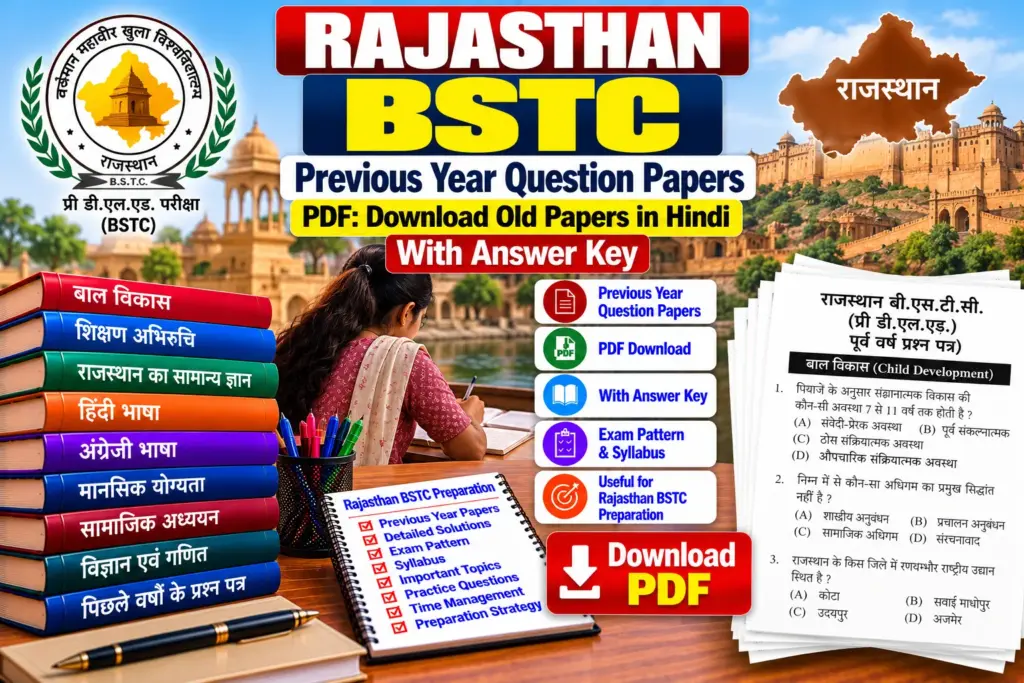
Rajasthan BSTC Previous Year Question Papers PDF: Download Old Papers in Hindi With Answer Key.If you are preparing for the Rajasthan BSTC entrance examination, solving previous year question papers can make your preparation more organised and effective. Many candidates study for months but struggle to manage their time or understand the question pattern when they attempt a complete paper. Practising old papers helps you become familiar with the examination and identify the areas that need more attention.
Rajasthan BSTC, also known as Pre D.El.Ed, is an entrance examination for candidates seeking admission to the Diploma in Elementary Education course. Before appearing for the examination, candidates should understand the syllabus, revise the important subjects, and practise questions from previous years.
In this article, we have covered Rajasthan BSTC Previous Year Question Papers PDF, including the years listed in the supplied materials, Hindi question papers, answer-key information, the exam pattern, and preparation tips.
Overview of Rajasthan BSTC Previous Year Question Papers
| Details | Information |
|---|---|
| Examination Name | Rajasthan BSTC / Pre D.El.Ed |
| Exam Type | Entrance Examination |
| State | Rajasthan |
| Conducting Authority Mentioned in the Materials | VMOU, Kota |
| Course | Diploma in Elementary Education (D.El.Ed) |
| Question Paper Type | Objective-type questions |
| Previous Papers | Multiple years and sets |
| Paper Language | Hindi and English are mentioned in the supplied materials |
| Total Questions | 200, as listed in the supplied exam-pattern documents |
| Total Marks | 600, as listed in the supplied exam-pattern documents |
| Exam Duration | 3 hours, as listed in the supplied exam-pattern documents |
Rajasthan BSTC Previous Year Question Papers PDF Download
Candidates can use previous year question papers to understand how questions are presented in the examination and practise the subjects included in the syllabus. The supplied materials list question papers from several years, along with different sets for some examinations.
The following year-wise list will help you identify the papers mentioned in the available resources.
| Year | Question Paper Details |
|---|---|
| 2026 | Pre D.El.Ed papers with different sets and shifts are listed |
| 2025 | Rajasthan BSTC previous year paper |
| 2024 | Rajasthan BSTC question paper, including a paper dated 30 June 2024 |
| 2023 | Previous year question paper |
| 2022 | BSTC question paper in Hindi |
| 2021 | Previous year question paper |
| 2020 | BSTC question paper in Hindi |
| 2019 | Previous year question paper |
| 2018 | Sets A, B, C and D |
| 2017 | Previous year paper in Hindi |
| 2016 | Previous year paper in Hindi |
| 2011 | Old question paper |
| 2010 | Old question paper |
| 2009 | Old question paper |
The supplied materials also mention 2026 paper entries associated with different sets and shifts, including references to papers dated 20 May 2026. Always check the examination date, shift and set before practising a particular PDF.
Please note: This list reflects the paper categories mentioned in the supplied documents. It does not confirm that every listed PDF or answer key is currently available or independently verified. The materials identify resources but do not provide verified working download links in this article.
Why Should You Solve Rajasthan BSTC Previous Year Papers?
Reading books and revising notes are important, but they do not always show how well you can perform in an examination. A previous year paper allows you to test your knowledge and find out whether you can apply what you have studied.
Here are some practical benefits of solving Rajasthan BSTC old papers.
1. Get familiar with the question pattern
When you solve previous year papers, you become more comfortable with the objective-question format and the subjects covered in the examination. This familiarity can help you approach a new paper with a clearer plan.
2. Find your weak subjects
You may feel confident about a topic while studying but struggle to answer questions about it. Previous papers help you identify these gaps so that you can revise the relevant concepts instead of spending all your time on subjects you already know well.
3. Improve speed and time management
Completing a paper within the prescribed time takes practice. Solving full papers regularly helps you learn how much time to spend on a question and when to move forward rather than getting stuck.
4. Practise with answer keys
Where a matching answer key is available, compare your responses after completing the paper. Do not simply count your correct answers; review the questions you got wrong and understand why the correct option is right.
5. Measure your progress
Keep a record of your scores across different practice sessions. If your performance improves after revising a weak topic, you will know that your preparation is moving in the right direction.
Rajasthan BSTC Exam Pattern
The supplied materials describe the Rajasthan BSTC examination as an objective-type test with 200 questions carrying 600 marks. They list a total duration of three hours.
However, the documents present the subject distribution in two different formats. One divides the examination into four broad sections, while another separates English and Hindi/Sanskrit.
Exam Pattern: Four-Section Format
| Subject | Questions | Marks |
|---|---|---|
| Mental Ability | 50 | 150 |
| Rajasthan General Knowledge | 50 | 150 |
| Teaching Aptitude | 50 | 150 |
| Language Ability | 50 | 150 |
| Total | 200 | 600 |
Subject-wise Distribution: Separate Language Sections
| Subject | Questions | Marks |
|---|---|---|
| General Knowledge | 50 | 150 |
| Reasoning | 50 | 150 |
| Teaching Aptitude | 50 | 150 |
| English | 20 | 60 |
| Hindi or Sanskrit | 30 | 90 |
| Total | 200 | 600 |
These are the two formats shown in the supplied resources. Candidates should check the official notification for their examination year to confirm the applicable subject distribution.
The supplied documents also state that the examination lasts three hours and has no negative marking. Verify these rules against the latest applicable official notification before using them to plan your exam strategy.
Important Subjects for Rajasthan BSTC Preparation
Candidates should prepare every subject included in the applicable syllabus rather than depending entirely on questions remembered from old papers.
Mental Ability and Reasoning
Practise reasoning questions regularly. Focus on understanding the method used to solve each question instead of memorising the answer. Reviewing mistakes will help you recognise similar question types in future practice sessions.
Rajasthan General Knowledge
Revise Rajasthan-related general knowledge according to the syllabus. Use your notes to review relevant facts and practise questions to check how much information you can recall without assistance.
Teaching Aptitude
Give proper attention to teaching-related concepts and situations. Read each question carefully and try to understand what it is asking before selecting an answer.
English
Prepare the English topics included in the current syllabus. Regular practice can help you recognise the areas where you need more revision and improve your confidence with language-based questions.
Hindi or Sanskrit
Prepare the language subject relevant to your examination. Revise the prescribed topics and solve practice questions to identify recurring mistakes.
How to Download Rajasthan BSTC Previous Year Question Papers
Candidates can follow these steps to find the required question papers:
- Visit the official Rajasthan Pre D.El.Ed or VMOU examination website.
- Look for the examination-related resources or previous question papers section.
- Select the required examination year.
- Choose the relevant set or shift, if more than one is listed.
- Check whether an answer key or solution is available for the same paper.
- Open the PDF and verify the title, examination year and other details.
- Save the file on your device so that you can use it during revision.
If you download a paper from an educational website, make sure that the answer key matches the same year and set. An incorrect answer key can lead to confusion while evaluating your performance.
How to Prepare Effectively With BSTC Old Papers
Simply collecting PDFs is not enough. The real benefit comes from solving them properly and learning from your mistakes.
Step 1: Start with the syllabus
Before attempting a complete paper, review the syllabus for your examination year. Divide the subjects into smaller topics and set achievable study targets.
Step 2: Strengthen your basics
Study the relevant concepts and revise your notes before moving to full-length papers. This will help you understand questions instead of relying on guesswork.
Step 3: Attempt one paper independently
Choose a previous year paper and solve it without checking the answers. Follow the applicable examination time limit and avoid interruptions as much as possible.
Step 4: Check your answers carefully
Use a matching answer key if one is available. Mark every incorrect answer and note the topic behind the mistake.
Step 5: Revise the topics you find difficult
Return to your books or notes and revise the concepts where you struggled. After revision, attempt similar questions to check whether your understanding has improved.
Step 6: Practise different years and sets
Once you have reviewed your first paper, move on to other available papers. Practising a range of years and sets will give you broader experience with the question formats represented in the resources.
Step 7: Take mock tests
Use mock tests to practise completing a paper within the applicable time limit. After each test, compare your performance with previous attempts and adjust your study plan where necessary.
Mistakes to Avoid During BSTC Preparation
While preparing for Rajasthan BSTC, candidates should avoid the following mistakes:
- Downloading question papers but not solving them.
- Looking at the answer key before attempting the questions.
- Ignoring subjects that feel difficult.
- Practising only one year or one question-paper set.
- Memorising answers without understanding the underlying concepts.
- Using an answer key that does not match the paper.
- Depending on old papers instead of following the current syllabus.
- Ignoring time management during full-length practice.
A simple habit can make a significant difference: after every paper, spend time reviewing your mistakes before starting another one.