
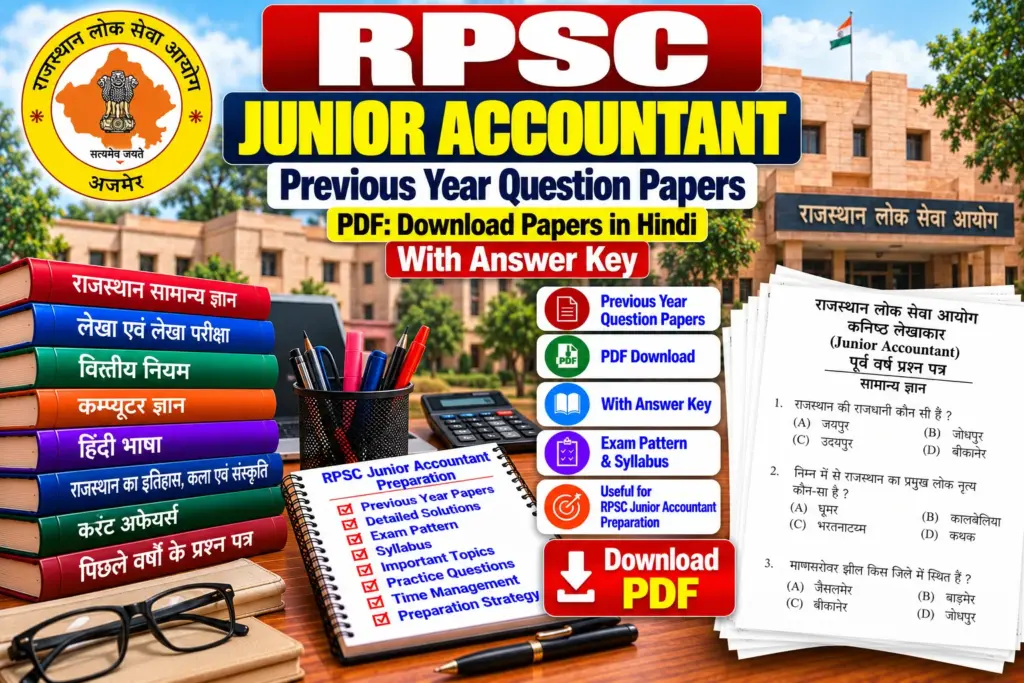
RPSC Junior Accountant Previous Year Question Papers PDF: Download Papers in Hindi With Answer Key.Candidates preparing for the RPSC Junior Accountant examination should make previous year question papers an important part of their preparation. Studying the syllabus is essential, but solving actual examination papers helps candidates understand how questions are framed, how different subjects are covered, and where they need to improve.
RPSC Junior Accountant Previous Year Question Papers are useful for candidates who want to practise both Paper I and Paper II before the examination. Previous papers can also help aspirants improve their speed, accuracy, and confidence while preparing for the Rajasthan Junior Accountant recruitment examination.
In this article, candidates can check the available Rajasthan Junior Accountant previous year papers, including papers listed for 2024, 2016, 2013, and 2011. The article also covers the exam pattern mentioned in the supplied materials, the benefits of solving old papers, preparation tips, and frequently asked questions.
RPSC Junior Accountant Previous Year Question Papers: Overview
| Particulars | Details |
|---|---|
| Exam Name | RPSC Junior Accountant Previous Year Question Papers |
| Examination | Rajasthan Junior Accountant |
| State | Rajasthan |
| Exam-related authority references | RPSC, RSSB/RSMSSB, depending on the examination cycle |
| Previous Papers | 2024, 2016, 2013 and 2011 |
| Paper Format | Paper I and Paper II |
| Language | Hindi papers are listed in the supplied resources |
| Answer Key | Available for some listed papers |
| Purpose | Exam practice, revision and understanding question patterns |
Important: The term RPSC Junior Accountant Previous Year Question Papers is commonly used by candidates searching for Rajasthan Junior Accountant papers. However, the supplied resources refer to different recruitment boards and examination cycles. Candidates should check the board name and examination details printed on each paper before using it.
RPSC Junior Accountant Previous Year Papers PDF Download
Practising previous year papers is a practical way to prepare for the Rajasthan Junior Accountant examination. The uploaded materials list question papers from different years, including Hindi-language papers and answer-key resources for some examinations.
The following table summarises the paper categories mentioned in the supplied documents.
| Exam Year | Available Paper Categories |
|---|---|
| Junior Accountant & Tehsil Revenue Accountant 2023 | Junior Accountant & Tehsil Revenue Accountant 2023:Master Question Paper (Paper I) |
| Junior Accountant & Tehsil Revenue Accountant 2023 | Junior Accountant & Tehsil Revenue Accountant 2023:Master Question Paper (Paper II) |
| 2016 | Junior Accountant Paper I and Paper II |
| 2013 | Junior Accountant Paper I and Paper II |
| 2011 | Junior Accountant Paper I and Paper II |
The supplied materials also mention Junior Accountant and TRA papers associated with the examination dated 4 October 2016, although these appear under a 2013 paper label in one resource. Check the title and examination date on the PDF before treating it as a particular year’s paper.
The uploaded documents identify these resources but do not provide verified working download URLs in this article. Candidates should obtain the PDFs from the relevant official recruitment-board website or a reliable question-paper resource.
Why Are RPSC Junior Accountant Previous Year Question Papers Important?
A previous year paper allows you to test what you have studied instead of relying only on reading and revision. It also helps you identify the difference between understanding a topic and being able to solve questions accurately under time pressure.
1. Understand the examination pattern
By solving RPSC Junior Accountant previous year papers, candidates can become familiar with the structure of Paper I and Paper II and the types of questions included in the available papers.
2. Identify important subjects and topics
Previous papers can help you recognise topics that deserve additional revision. Rather than assuming that a particular question will be repeated, use the papers to understand the style of questions and practise the concepts behind them.
3. Improve speed and accuracy
Time management becomes easier when you regularly solve complete papers. You learn when to move on from a difficult question, how to avoid spending too long on one section, and how to check your answers efficiently.
4. Find weak areas before the examination
A practice paper can reveal gaps in your preparation. You may find that you understand a concept but make calculation errors, forget important rules, or struggle with factual questions. Identifying these issues early gives you time to correct them.
5. Build confidence through regular practice
The first full paper may feel difficult, particularly if you have not practised under timed conditions. With regular attempts and careful analysis, the examination format becomes more familiar.
RPSC Junior Accountant Exam Pattern
The supplied exam-pattern materials describe the written examination in two parts: Paper I and Paper II. Each paper is shown with 150 questions and a total of 450 marks.
RPSC Junior Accountant Paper I Pattern
| Subject | Questions | Marks |
|---|---|---|
| Hindi | 25 | 75 |
| English | 25 | 75 |
| General Knowledge/Rajasthan General Knowledge | 25 | 75 |
| General Science | 25 | 75 |
| Mathematics | 25 | 75 |
| Basic Computer Knowledge | 25 | 75 |
| Total | 150 | 450 |
Paper I covers language, general knowledge, science, mathematics, and computer-related topics. Candidates should prepare each subject according to the syllabus applicable to their recruitment cycle.
RPSC Junior Accountant Paper II Pattern
| Subject | Questions | Marks |
|---|---|---|
| Bookkeeping and Accountancy | 25 | 75 |
| Business Methods/Business Methodology | 25 | 75 |
| Auditing | 25 | 75 |
| Indian Economy/Economics | 25 | 75 |
| Rajasthan Service Rules | 25 | 75 |
| G.F. and A.R. | 25 | 75 |
| Total | 150 | 450 |
Paper II focuses on accounting, business methods, auditing, economics, and financial or service rules. These subjects require regular revision and question-solving practice, so candidates should not leave them until the final weeks.
Exam Duration and Negative Marking
The supplied documents contain conflicting information about the examination duration and negative-marking rules. One source lists 2 hours and 30 minutes for each paper and a deduction of one mark for an incorrect answer. Other supplied material reports different timings and deductions.
Therefore, candidates should confirm the exact duration and negative-marking scheme from the official notification applicable to their examination. Do not use an unverified marking scheme to calculate mock-test scores or decide how many questions to attempt.
How to Download RPSC Junior Accountant Previous Year Question Papers
Candidates can follow these steps to locate the relevant papers:
- Visit the official website of the recruitment board responsible for the relevant examination cycle.
- Look for the Junior Accountant previous year question papers or examination-related resources.
- Select the required year, such as 2024, 2016, 2013, or 2011.
- Choose Paper I or Paper II.
- Check whether an answer key or solution document is available.
- Open the PDF and verify its title, year, paper number, and examination date.
- Save the paper on your device so that you can practise it during revision.
If you are using a third-party resource, check the paper carefully before adding it to your preparation material. A correctly labelled paper will make it easier to track your progress and compare your performance across attempts.
How to Prepare for the RPSC Junior Accountant Examination Using Previous Papers
The best way to use previous year papers is to combine them with syllabus-based study. Solving papers without reviewing your mistakes may help you become familiar with the format, but it will not necessarily address the gaps in your preparation.
Step 1: Complete the syllabus systematically
Start by reviewing the syllabus for the relevant recruitment cycle. Divide the subjects into manageable topics and set weekly targets for study and revision.
Step 2: Revise the basic concepts
Build a strong foundation in accounting, bookkeeping, auditing, business methods, mathematics, and the other subjects included in the syllabus. Understanding the concepts will help you handle questions that are framed differently from those in older papers.
Step 3: Attempt previous papers independently
Choose one paper and solve it without checking the answers midway. Follow the applicable official time limit and avoid unnecessary interruptions.
Step 4: Analyse your performance
After completing the paper, review every incorrect and unanswered question. Identify whether the problem was a lack of knowledge, a calculation mistake, confusion between similar concepts, or poor time management.
Step 5: Maintain a separate revision notebook
Write down important formulas, difficult accounting concepts, confusing rules, and factual points that you repeatedly forget. Review this notebook regularly.
Step 6: Practise Paper I and Paper II equally
Give both papers adequate attention. If you perform well in general subjects but struggle with technical topics, adjust your study schedule accordingly rather than repeating only the sections you already find comfortable.
Step 7: Reattempt difficult questions
Return to previously incorrect questions after revising the relevant concepts. The aim is to understand why an answer is correct, not simply to remember its option number.
Step 8: Take full-length mock tests
Once you have covered the syllabus, use mock tests to assess your overall preparation. Follow the current official examination scheme and use your results to decide which subjects need more work.
Common Mistakes to Avoid
Candidates preparing with RPSC Junior Accountant previous year papers should avoid these common mistakes:
- Reading solutions before attempting the paper: Try the questions independently to assess your actual understanding.
- Ignoring Paper II: Accounting and other technical subjects need consistent practice.
- Using outdated exam information: Check the current syllabus, paper structure, duration, and marking scheme.
- Solving papers without analysing errors: Reviewing mistakes is one of the most valuable parts of practice.
- Memorising answers without understanding concepts: Focus on the reasoning behind an answer.
- Practising without a time limit: Timed practice helps you prepare for the pressure of a full examination.
- Trusting every PDF label: Verify the examination year and date, especially when the resource contains inconsistent labels.