
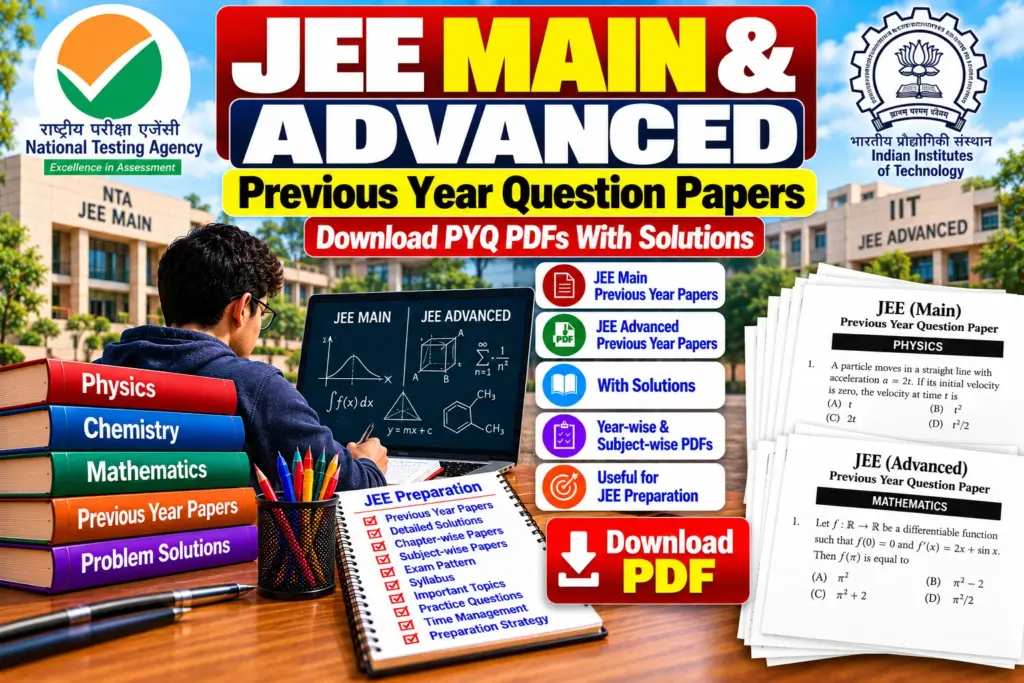
JEE Main & Advanced Previous Year Question Papers: Download PYQ PDFs With Solutions.Preparing for JEE Main and JEE Advanced is not just about completing the syllabus. Students also need to learn how to apply concepts, solve problems efficiently and manage their time during the examination. One of the most practical ways to develop these skills is by solving previous year question papers.
JEE Main and JEE Advanced Previous Year Question Papers with Solutions help students understand the style of questions asked in earlier examinations, assess their preparation and identify topics that require more practice. They are useful whether you are just beginning your preparation or revising after completing the syllabus.
The available JEE Main collections cover papers from 2026, 2025, 2024, 2023, 2022 and earlier years, including session-wise, shift-wise and subject-wise material. For JEE Advanced, students can practise Paper 1 and Paper 2 from previous examination years to improve their conceptual understanding and problem-solving approach.
If you are preparing for engineering entrance examinations, using these papers regularly can help you turn your daily study into more focused practice.
JEE Main and JEE Advanced Previous Year Papers: Overview
| Particulars | Details |
|---|---|
| Examinations | JEE Main and JEE Advanced |
| Main Subjects | Physics, Chemistry and Mathematics |
| JEE Main Papers | Session-wise, shift-wise and subject-wise |
| JEE Advanced Papers | Paper 1 and Paper 2 |
| Available JEE Main Years | 2026, 2025, 2024 and older years |
| PDF Format | Available for selected papers and collections |
| Answer Keys | Available for selected papers |
| Detailed Solutions | Available for selected papers and question sets |
The two examinations have different requirements, so your practice should reflect your target. JEE Main preparation needs regular work on speed, accuracy and question selection. JEE Advanced preparation requires particular attention to conceptual depth and solving challenging problems.
JEE Main Previous Year Question Papers PDF
JEE Main previous year papers are available in several formats, including complete question papers and separate Physics, Chemistry and Mathematics PDFs. Many collections also organise papers by examination session and shift.
Practising different shifts helps you experience a wider variety of questions rather than becoming familiar with just one paper.
JEE Main 2026 Question Papers
The available 2026 collection includes January session papers from 21, 22, 23, 24 and 28 January. The April session material includes papers from 2, 4, 5, 6 and 8 April 2026.
Selected papers are available in shift-wise and subject-wise formats. Some April session resources are identified as memory-based, so check whether a paper is an official question paper or a reconstruction based on students’ recollections.
If you are preparing for a future attempt, use these papers to practise recent questions and review the methods needed to solve them. Try answering the questions yourself before looking at the solutions.
JEE Main 2025 Question Papers
The available 2025 collections include January papers from 22, 23, 24, 28 and 29 January. April session papers are listed for 2, 3, 4, 7 and 8 April 2025.
These papers can help you practise different question sets and understand how you perform across Physics, Chemistry and Mathematics.
After completing a paper, do not stop at checking your score. Review the questions you answered incorrectly and identify whether the problem was a weak concept, an incorrect formula, a calculation error or poor time management.
JEE Main 2024 Question Papers
The 2024 collection includes papers from the January–February and April sessions.
The January–February material covers dates including 27, 29, 30 and 31 January and 1 February 2024. The April collection includes papers from 4, 5, 6, 8 and 9 April.
Students can use these papers for full-length mock tests or subject-wise revision. If Mathematics is taking too much of your time, for example, practise its questions separately before attempting another complete paper.
JEE Main 2023, 2022 and Older Question Papers
The available collections also include papers from 2023, 2022, 2021, 2020, 2019, 2018, 2017, 2016, 2015 and 2014.
These older papers are useful when you want additional practice after completing recent question sets. They can also help you revisit concepts that you studied earlier but have not revised recently.
However, examination patterns and syllabuses can change. Before using an older paper as a full mock test, check whether its structure and content match the requirements of your target examination.
JEE Advanced Previous Year Question Papers PDF
Students aiming for admission to an IIT should include JEE Advanced previous year papers in their preparation. These papers help you practise applying concepts to problems that may require several steps of reasoning.
JEE Advanced preparation should not be limited to memorising formulas or repeating familiar examples. You need to understand why a method works and how to use your knowledge when a question is presented in an unfamiliar way.
JEE Advanced Paper 1
Paper 1 covers Physics, Chemistry and Mathematics. Practising previous papers helps you work through different problem types and develop a systematic approach to solving challenging questions.
While attempting a paper, avoid rushing through difficult problems. Read each question carefully, identify the concepts involved and decide how to approach it before starting lengthy calculations.
After the test, review the questions that you could not solve independently. Understanding the reasoning behind those problems is an important part of preparation.
JEE Advanced Paper 2
Paper 2 also covers Physics, Chemistry and Mathematics. It deserves separate practice rather than being treated as an extension of Paper 1.
Attempt the paper under suitable time conditions and review your performance in each subject. If you find that your concentration drops during a longer practice session, include regular full-paper practice in your study routine.
When practising both papers together, follow the examination instructions applicable to the relevant year.
Year-Wise JEE Advanced Papers
Students can look for JEE Advanced previous year papers through the official examination website and available educational collections.
| Paper Material | How It Helps |
|---|---|
| Recent examination papers | Familiarise you with recent question styles |
| Paper 1 | Practise the first paper independently |
| Paper 2 | Build confidence with the second paper |
| Subject-wise questions | Focus on difficult topics in Physics, Chemistry or Mathematics |
| Solved papers | Understand the reasoning and methods behind answers |
| Older papers | Provide additional practice and revision |
The availability of individual years, answer keys and detailed solutions may differ across collections. Check the paper details before downloading.
Difference Between JEE Main and JEE Advanced PYQs
Both examinations test Physics, Chemistry and Mathematics, but students should use their question papers for different practice goals.
| Feature | JEE Main | JEE Advanced |
|---|---|---|
| Main Focus | Speed, accuracy and efficient question selection | Conceptual depth and analytical problem-solving |
| Practice Material | Session-wise and shift-wise papers | Paper 1 and Paper 2 |
| Useful Practice | Timed full papers and chapter-wise questions | Challenging problems and complete paper practice |
| Revision Approach | Identify weak topics and improve accuracy | Understand the reasoning behind complex problems |
Students preparing for both examinations should not rely on one type of paper alone. Practise JEE Main to develop speed and accuracy, while using JEE Advanced questions to strengthen deeper conceptual understanding.
Subject-Wise Previous Year Question Papers
Practising each subject separately can be helpful when you have completed a chapter but are not yet ready to attempt a full-length paper.
Physics Previous Year Question Papers
Physics requires a clear understanding of concepts and the ability to apply them to numerical and conceptual problems.
Begin by solving chapter-wise questions from the topics you have studied. Pay attention to formulas, units, signs and the reasoning behind each step.
When you make a mistake, return to the underlying concept rather than simply memorising the solution. This will help you handle similar problems presented in different ways.
Chemistry Previous Year Question Papers
Chemistry preparation involves conceptual learning, numerical practice and regular revision.
Use previous year questions to practise Physical, Organic and Inorganic Chemistry. When solutions are available, study the explanation carefully and make a note of concepts you repeatedly forget.
Understanding why an answer is correct is more useful than remembering the correct option without understanding the chemistry behind it.
Mathematics Previous Year Question Papers
Mathematics improves with consistent practice. Solving previous year questions helps you become more comfortable with different problem types and recognise suitable methods.
If a question takes too long, study the solution and then try solving it again without assistance. Over time, this can help you improve your approach and avoid unnecessary calculations.
Why Should You Solve JEE Main and JEE Advanced Previous Year Papers?
Previous year question papers help you understand how well you can apply what you have studied. They also make it easier to plan revision around your actual weaknesses.
1. Understand How Questions Are Asked
Reading a chapter gives you the theoretical foundation, but solving exam questions tests whether you can use that knowledge independently.
Previous year papers expose you to different ways in which concepts are tested. They also help you become familiar with the structure of the examination.
2. Identify Weak Topics
You may feel confident while studying a chapter but struggle when you face a question based on it.
After solving a paper, note the topics that caused difficulty. Revise those areas before attempting another paper instead of repeatedly practising only the subjects you already find easy.
3. Improve Speed and Accuracy
Time management is an important part of entrance exam preparation.
Regular timed practice helps you understand how long you take to solve different questions. It also teaches you to recognise when a problem is taking too much time and when it is better to move on.
4. Learn Better Problem-Solving Methods
Detailed solutions can help you understand a question from a different perspective. Sometimes, you may reach the correct answer but use a longer method than necessary.
Compare your approach with the explanation and identify whether there is a clearer or more efficient way to solve the problem.
5. Make Revision More Focused
A previous year paper can serve as a practical revision test. It shows you which concepts you remember well and which ones need more work.
Maintain a short list of weak topics and revisit it regularly. This keeps revision connected to your actual performance rather than relying only on a fixed timetable.
6. Build Confidence Through Practice
The first few papers may feel difficult, especially if you have not attempted a complete test before.
Do not treat a low initial score as a final judgement of your preparation. Use it to identify mistakes, revise the relevant concepts and measure your improvement in later attempts.
How to Download JEE Main and JEE Advanced Previous Year Papers
Candidates can look for previous year question papers through the official JEE Main and JEE Advanced websites and available educational collections.
Follow these steps:
- Visit the relevant examination website.
- Look for the question-paper, archive or previous examination section.
- Select the year you want to practise.
- For JEE Main, choose the relevant session, shift or subject where applicable.
- For JEE Advanced, select Paper 1 or Paper 2.
- Check whether an answer key or detailed solution is available.
- Download the PDF and save it for revision.
If you download a paper from an educational collection, check whether it is an official question paper or a memory-based version. This is particularly important when using recent papers for score analysis.
How to Prepare With Previous Year Question Papers
The best way to use PYQs is to combine them with concept learning and regular revision.
Step 1: Study the topic. Make sure you understand the basic concepts before attempting a large set of questions.
Step 2: Start with chapter-wise PYQs. Practise questions related to the chapter you have just completed.
Step 3: Attempt full papers. Once you have covered enough of the syllabus, solve complete papers under timed conditions.
Step 4: Check your answers. Use the available answer keys or solutions to review your performance.
Step 5: Record your mistakes. Note the concepts, formulas and methods that caused difficulty.
Step 6: Revise before the next test. Work on your weak areas and then attempt another paper to see whether your performance has improved.
If you are preparing for both examinations, keep separate practice sessions for JEE Main and JEE Advanced so that you can work on their different requirements.
How Many Years of PYQs Should You Solve?
There is no fixed number of question papers that guarantees a particular score or rank. Your target should depend on your preparation level, the time available and how much syllabus you have completed.
A practical approach is to:
- Begin with recent JEE Main papers.
- Practise JEE Advanced Paper 1 and Paper 2 separately.
- Use chapter-wise questions while revising individual topics.
- Attempt full-length papers under timed conditions.
- Review your mistakes before moving to the next paper.
- Use older papers for additional practice.
Remember that solving more papers is useful only when you analyse them properly. A smaller number of carefully reviewed papers can be more beneficial than completing a large collection without revisiting mistakes.
Common Mistakes to Avoid While Solving PYQs
Students should avoid these common mistakes during question-paper practice:
- Looking at solutions before making a genuine attempt.
- Practising only familiar or easy questions.
- Ignoring incorrect answers and calculation errors.
- Repeating papers without revising weak concepts.
- Using older papers without checking syllabus changes.
- Focusing only on scores instead of understanding mistakes.
- Neglecting JEE Advanced practice while targeting IIT admission.
- Attempting full papers without following a suitable time limit.
The purpose of solving previous year papers is not simply to complete more PDFs. It is to improve your understanding, accuracy and approach to problem-solving.