
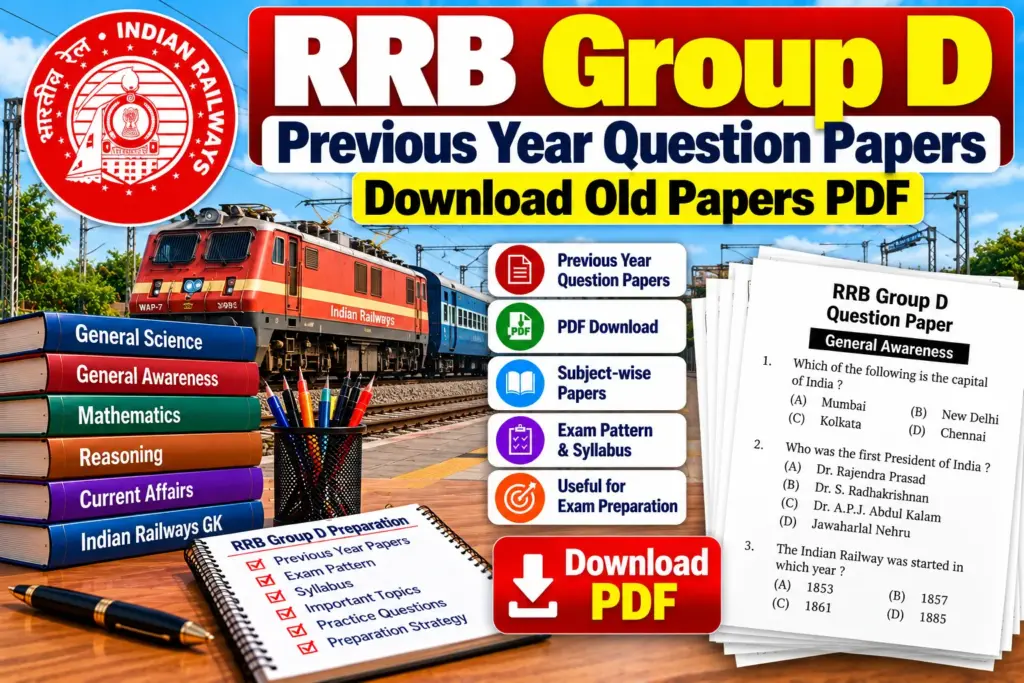
Preparing for the RRB Group D Exam is not just about completing the syllabus. Once your basic concepts are clear, the next step is to understand how questions are actually asked in the examination. This is where RRB Group D Previous Year Question Papers become extremely useful.
Previous year papers give you a practical idea of the question pattern, difficulty level, time pressure and important topics. More importantly, they help you find out where your preparation is strong and where you still need more practice.
The available question-paper collections cover different examination cycles, including 2026, 2025, 2022 and 2018, with several shift-wise papers and solved-paper resources.
RRB Group D Previous Year Question Papers
There is a big difference between reading a chapter and actually solving questions from that chapter.
You may understand a topic while studying it, but when you see an exam-level question, you may realise that you need more practice. Previous year papers help bridge that gap.
By solving RRB Group D previous year papers regularly, candidates can:
- Understand the actual question pattern
- Get an idea of the difficulty level
- Improve speed and accuracy
- Practise time management
- Identify weak topics
- Revise important concepts
- Build confidence for the examination
The available collections include question papers in English and Hindi, giving candidates the flexibility to practise in their preferred language.
RRB Group D Previous Year Papers PDF
Candidates can practise papers from different years instead of depending on a single set of questions.
| Year | Paper Availability |
|---|---|
| 2026 | Multiple dates and shifts |
| 2025 | Multiple dates and shifts |
| 2022 | Multiple shift-wise papers |
| 2018 | Solved previous year papers |
The 2025 collection contains papers from numerous examination dates and shifts, providing a large amount of practice material.
The 2022 collection also includes papers from several dates and shifts, while solved papers from 2018 are available for additional practice.
RRB Group D 2026 Question Paper
The latest RRB Group D question papers are especially useful for candidates who want to understand the recent examination pattern.
| Exam Name | Exam Shift/Paper PDF |
| RRB Group D 2026 | 3 August 2026 Shift 1 |
| RRB Group D 2026 | 3 August 2026 Shift II |
| RRB Group D 2026 | 3 August 2026 Shift III |
| RRB Group D 2026 | 4 August 2026 Shift I |
| RRB Group D 2026 | 4 August 2026 Shift II |
| RRB Group D 2026 | 4 August 2026 Shift III |
The available 2026 material includes memory-based papers from several examination dates in August 2026.
According to the available material, the RRB Group D 2026 examination consists of:
- 100 questions
- 100 marks
- 90 minutes
- 1 mark for each question
- One-third negative marking for an incorrect answer
The paper covers:
- General Science
- Mathematics
- General Intelligence & Reasoning
- General Awareness and Current Affairs
RRB Group D 2026 Exam Pattern
| Subject | Questions | Marks |
|---|---|---|
| General Science | 25 | 25 |
| Mathematics | 25 | 25 |
| General Intelligence & Reasoning | 30 | 30 |
| General Awareness & Current Affairs | 20 | 20 |
| Total | 100 | 100 |
The examination duration is 90 minutes, so candidates need to maintain a good balance between speed and accuracy.
RRB Group D 2025 Previous Year Papers
The RRB Group D 2025 question papers provide a large collection for practice.
Papers are available from numerous examination dates between November and December 2025, with different shifts covered.
This is particularly helpful because candidates can practise questions from different shifts instead of repeatedly solving the same type of mock paper.
If you have already completed your basic preparation, working through these papers can give you a much clearer idea of your actual preparation level.
RRB Group D 2022 Previous Year Papers
The RRB Group D 2022 previous year papers are also useful for candidates who want additional practice.
The available collection includes papers from different dates in August and September 2022 and covers multiple shifts.
These papers can be attempted after completing the latest papers, especially when you want to increase your exposure to different question types.
RRB Group D 2018 Previous Year Papers
Older papers can also be useful during preparation.
The available material includes RRB Group D 2018 solved papers, including Shift 1 and Shift 2 papers.
These papers provide additional exam-style questions and can be used for revision once you have worked through the more recent papers.
Why Should You Solve RRB Group D Previous Year Papers?
Understand the Real Examination
A syllabus tells you what you need to study. A previous year paper shows you how those topics are actually tested.
This makes your preparation more practical.
Improve Your Speed
Knowing the answer is only one part of the exam. You also need to solve questions within the available time.
Regular practice helps you become quicker with familiar question types.
Improve Accuracy
Repeated practice can help reduce avoidable mistakes, especially in calculation-based questions.
Identify Weak Areas
Your mistakes tell you where you need more work.
If you repeatedly get questions from a particular topic wrong, it is a clear indication that you should revisit that topic.
Learn Time Management
A time-bound examination requires a proper strategy.
Previous papers allow you to experiment with your question-attempting approach and understand which sections consume more time.
Build Confidence
The more papers you solve, the more familiar the examination format becomes.
That familiarity can make a big difference when you finally sit for the actual exam.
How to Solve RRB Group D Previous Year Papers
Don’t simply download the papers and keep them on your computer.
The real benefit comes from solving them properly.
Step 1: Choose a Recent Paper
Start with a recent RRB Group D question paper.
Step 2: Set a Timer
Give yourself the same amount of time available in the examination.
Keep your phone away and avoid unnecessary interruptions.
Step 3: Attempt the Complete Paper
Try to solve the paper in one sitting.
Don’t check the answer after every question.
Step 4: Check Your Answers
Once the paper is complete, check your responses and calculate your score.
Step 5: Analyse Your Mistakes
This is the most important part.
Ask yourself:
- Did I not understand the concept?
- Did I forget a formula?
- Did I make a calculation mistake?
- Did I misunderstand the question?
- Did I spend too much time on one question?
Once you know the reason behind your mistake, it becomes much easier to correct it.
Make a Separate Mistake Notebook
A simple mistake notebook can make your preparation more organised.
Whenever you get a question wrong, write down:
- Topic
- Question type
- Your mistake
- Correct method
- Important formula or fact
For example:
Mathematics: Percentage — calculation mistake
Reasoning: Venn Diagram — concept unclear
General Science: Chemical Reaction — factual mistake
General Awareness: Important fact not revised
After solving several papers, this notebook can become one of your most useful revision resources.
RRB Group D Preparation Strategy Using Previous Papers
A simple approach can work very well:
First, Build Your Concepts
Complete the basic syllabus and make sure you understand the important concepts.
Then Start Solving PYQs
Begin with recent papers and attempt them under a proper time limit.
Analyse Every Paper
Don’t move immediately to the next paper. Spend some time understanding your mistakes.
Revise Weak Topics
Return to your books or notes and revise the topics where you are repeatedly losing marks.
Attempt Another Paper
After revision, solve another paper and check whether your performance has improved.
The cycle should be:
Solve → Check → Analyse → Revise → Solve Again
This is much more useful than simply trying to complete a large number of PDFs.
Don’t Focus Only on Your Score
Your score is important, but it doesn’t tell the entire story.
Suppose you score 70 marks in one paper.
Instead of simply thinking about how to reach 80, first ask yourself why you lost those 30 marks.
Perhaps:
- 10 marks were lost because of calculation mistakes
- 5 questions took too much time
- 5 questions came from topics you had not studied
- The remaining mistakes were caused by careless errors
Now you know exactly what needs to be improved.
This is the real value of previous year paper practice.
How Many RRB Group D Previous Year Papers Should You Solve?
There is no fixed number that guarantees success.
Quality matters more than quantity.
It is better to solve one paper carefully, analyse every mistake and revise the weak areas than to solve five papers without reviewing your performance.
As your preparation improves, gradually increase the number of papers you attempt and include papers from different years and shifts.
Common Mistakes Candidates Make
While solving RRB Group D previous year papers, avoid these mistakes:
- Solving papers without a timer
- Checking answers during the test
- Ignoring incorrect questions
- Focusing only on the final score
- Practising only one year’s papers
- Skipping analysis
- Not revising weak topics
- Treating previous papers as a replacement for syllabus preparation
Previous year papers should support your preparation, not replace it.