
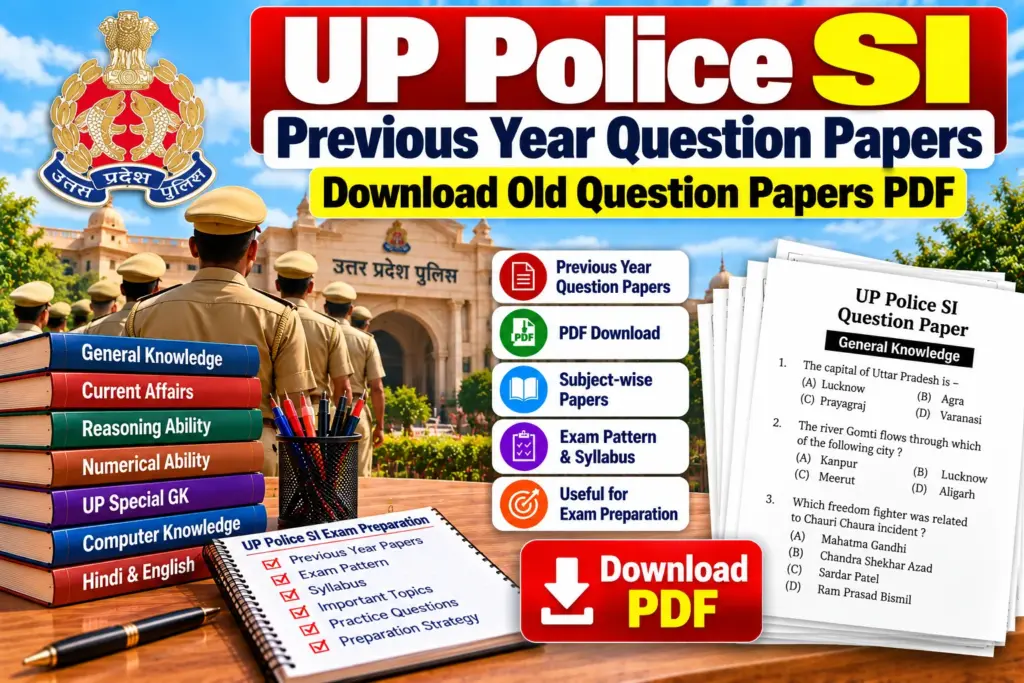
UP Police SI Previous Year Question Papers: Download Old Question Papers PDF.Preparing for the UP Police SI Exam requires more than just completing the syllabus. Once your basic preparation is done, you need to understand how questions are actually asked in the examination. This is where UP Police SI Previous Year Question Papers become extremely useful.
Previous year papers help candidates understand the question pattern, difficulty level, important topics and time pressure. They also provide an opportunity to check whether your preparation is really moving in the right direction.
UP Police SI Previous Year Question Papers
The UP Police SI Previous Year Question Papers are useful for both beginners and candidates who have already completed their syllabus. Instead of solving questions randomly, candidates can practise questions that have appeared in previous examinations.
The available question-paper collections include papers from 2026, 2021 and 2017, with several papers from different shifts.
These papers can help you:
- Understand the actual question style
- Identify important topics
- Improve speed and accuracy
- Find your weak areas
- Practise time management
- Build confidence before the examination
UP Police SI Previous Year Paper – Year Wise
| Year | Question Papers |
|---|---|
| 2026 | Multiple shift-wise papers |
| 2021 | Multiple dates and shifts |
| 2017 | Multiple dates and shifts |
The latest papers should generally be attempted first because they give you a more recent idea of the examination. After that, you can move towards older papers to increase your practice.
UP Police SI 2026 Question Papers
The available 2026 collection includes papers from different shifts conducted on 14 March 2026 and 15 March 2026.
Candidates can use these papers as full-length practice tests. Instead of solving them casually, try to create an examination-like environment and complete the paper within the prescribed time.
This will help you understand where you currently stand and how much improvement is still required.
UP Police SI 2021 Previous Year Papers
The 2021 papers are particularly useful because multiple dates and shifts are available.
The available collection includes papers from November and December 2021, covering several shifts.
Candidates can use these papers to get additional practice and understand how questions can vary between different shifts.
If you are preparing seriously, don’t solve only one paper and move on. Solve papers from different dates and compare your performance.
UP Police SI 2017 Previous Year Papers
Older question papers are also useful for practice. The available 2017 collection contains papers from several dates and shifts in December 2017.
These papers can give you additional questions for practice and help you understand the broader question trend.
Older papers are particularly useful once you have already practised the latest papers and want to increase the number of questions you solve.
| Exam Name | Exam Date/Paper PDF |
| UPSI 2017 | 12 December 2017 Shift I |
| UPSI 2017 | 12 December 2017 Shift II |
| UPSI 2017 | 12 December 2017 Shift III |
UP Police SI Exam Pattern
The available material describes the UP Police SI written examination as an objective-type examination.
The 2026-focused pattern provided in the material includes 200 questions carrying 400 marks.
| Subject | Questions | Marks |
|---|---|---|
| General Hindi | 50 | 100 |
| General Knowledge | 50 | 100 |
| Numerical Ability | 50 | 100 |
| Reasoning | 50 | 100 |
| Total | 200 | 400 |
The material also mentions a 2 hours 30 minutes duration for the examination.
Candidates should always check the notification applicable to their particular recruitment cycle for the final examination pattern.
Why Should You Solve UP Police SI Previous Year Papers?
Many candidates spend a lot of time collecting books, notes and PDFs but don’t spend enough time actually solving questions.
Previous year papers can change that.
Understand the Question Pattern
The syllabus tells you what to study, but a previous year paper shows you how the topics are turned into actual questions.
This makes your preparation more focused.
Know the Difficulty Level
You may find a chapter easy while studying it from a book. However, when you encounter questions based on the same chapter in an actual paper, you may discover that you need more practice.
Previous papers provide that reality check.
Improve Speed and Accuracy
Regular practice makes it easier to recognise familiar question types and solve them more quickly.
At the same time, analysing mistakes helps reduce careless errors.
Identify Weak Areas
Suppose you repeatedly make mistakes in Numerical Ability. There is no point in spending the same amount of time on topics you already know well.
Previous papers help you identify where your preparation needs more attention.
Build Confidence
The first few papers may seem difficult. That’s completely normal.
As you solve more papers, the exam format becomes familiar and your confidence gradually improves.
How to Solve UP Police SI Previous Year Papers
Simply downloading a PDF is not enough. You need to use it properly.
Step 1: Choose One Complete Paper
Start with a recent UP Police SI question paper.
Step 2: Set a Timer
Try to solve the complete paper within the actual examination time.
Keep your phone away and avoid unnecessary interruptions.
Step 3: Don’t Check Answers Midway
Treat the paper like a real examination.
Don’t look at the solution after every few questions.
Step 4: Calculate Your Score
Once you finish, check your answers and calculate your performance.
But don’t stop there.
Step 5: Analyse Your Mistakes
Look at every incorrect question and ask yourself:
- Did I not understand the concept?
- Did I make a calculation mistake?
- Did I misunderstand the question?
- Did I take too much time?
- Was I confused between two options?
This analysis is where the real improvement begins.
Make an Error Notebook
A small notebook dedicated to your mistakes can become extremely useful during revision.
Whenever you get a question wrong, note down:
- Topic
- Question type
- Your mistake
- Correct approach
- Important concept or formula
Keep revising these mistakes regularly.
After solving several papers, this notebook will contain the topics that require the most attention.
UP Police SI Preparation Strategy
A simple preparation strategy can make previous papers much more effective.
First: Complete Your Basic Preparation
Understand the syllabus and build your fundamentals in all the major subjects.
Second: Start Solving Previous Papers
Begin with the latest paper and gradually move towards older papers.
Third: Analyse Every Paper
Don’t focus only on your score. Check where you lost marks and where you wasted time.
Fourth: Revise Weak Topics
Go back to your study material and strengthen the topics where you repeatedly made mistakes.
Fifth: Combine Papers With Mock Tests
Once you become comfortable with previous papers, include mock tests in your routine to increase your overall practice.
Don’t Focus Only on Your Score
Your score is important, but it doesn’t tell the whole story.
For example, if you score 280 marks in a practice paper, don’t simply think about increasing it to 300.
Instead, find out why you lost those 120 marks.
Were there questions you didn’t know? Did you make calculation mistakes? Did you spend too much time on difficult questions?
Once you understand the reason, improving your score becomes much easier.
Common Mistakes While Solving Previous Papers
Avoid these common mistakes:
- Solving papers without a time limit
- Checking answers while attempting the paper
- Ignoring incorrect questions
- Focusing only on the final score
- Solving only one year’s papers
- Not revising weak topics
- Treating previous papers as a replacement for the syllabus
Previous year papers should support your preparation, not replace it.
How Many UP Police SI Previous Year Papers Should You Solve?
There is no fixed number that guarantees success.
It is better to solve fewer papers properly than to rush through a large number of papers without analysing them.
A good approach is:
Solve → Check → Analyse → Revise → Solve the next paper
If you follow this cycle consistently, even a limited number of papers can make a significant difference to your preparation.