
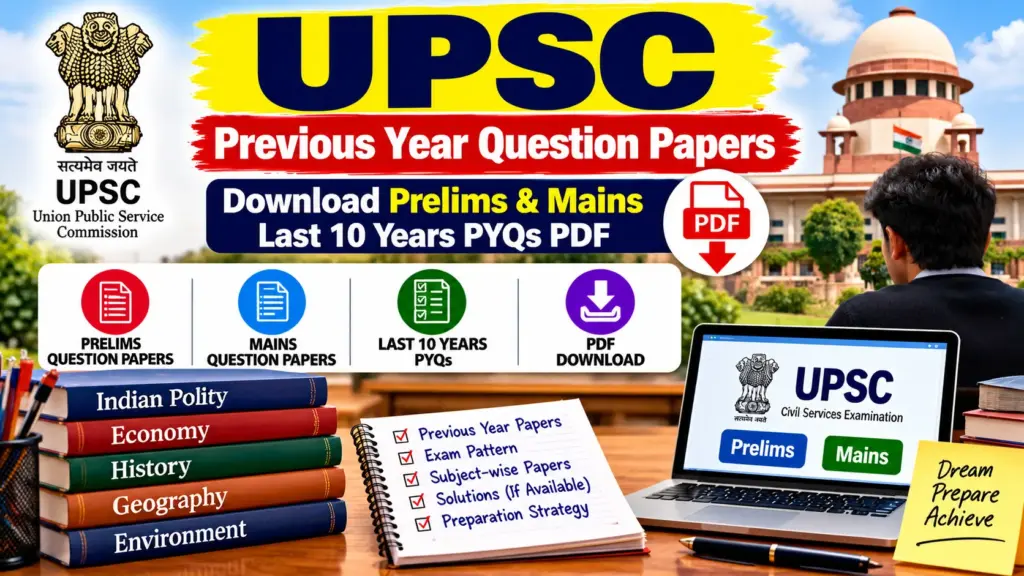
UPSC Previous Year Question Papers: Download Prelims & Mains Last 10 Years PYQs PDF.Preparing for the UPSC Civil Services Examination is not just about completing books and revising the syllabus. At some point, every serious aspirant needs to understand how UPSC actually asks questions. This is where UPSC Previous Year Question Papers (PYQs) become an important part of preparation.
Previous year papers help candidates understand the question pattern, identify important areas, improve time management and get familiar with the level of the examination. For Prelims and Mains, however, PYQs need to be used in different ways.
The available collection includes UPSC Prelims GS Paper I, CSAT, Mains General Studies papers and Essay papers from multiple years.
UPSC Previous Year Question Papers
A syllabus tells you what you are expected to study, but previous year papers show how that syllabus is tested in the actual examination.
For Prelims, candidates can use PYQs to practise objective questions, understand options and improve accuracy. For Mains, the focus should be on understanding the demand of the question and developing the habit of writing clear and relevant answers.
The available archive contains UPSC Prelims papers from several years, including papers dating back to 2009, along with a collection of Mains papers.
UPSC Prelims Previous Year Papers
The UPSC Prelims examination consists of two papers:
- General Studies Paper I
- General Studies Paper II (CSAT)
Previous year papers for both papers are available for multiple years.
UPSC Prelims PYQs – Year Wise
Candidates can start with recent papers and then move towards older papers for additional practice.
UPSC Prelims 2026 Question Papers
The latest available collection includes the UPSC Prelims 2026 GS Paper I and CSAT Paper II.
Candidates preparing for a future attempt can use these papers to understand the recent question style. However, don’t treat the paper simply as another mock test.
After completing it, spend time analysing every question. Questions that were answered incorrectly, guessed correctly or left unanswered can all provide useful information about your preparation.
UPSC CSAT Previous Year Question Papers
CSAT should not be ignored until the final stage of preparation. Regular practice can help candidates become more comfortable with comprehension, reasoning and numerical aptitude.
Previous CSAT papers are particularly useful for understanding the type of questions asked and for checking your speed under examination conditions.
A good approach is to attempt a complete CSAT paper with a timer instead of solving only random individual questions.
UPSC Mains Previous Year Question Papers
The preparation strategy changes considerably for Mains.
The previous year collection includes:
- Essay
- General Studies Paper I
- General Studies Paper II
- General Studies Paper III
- General Studies Paper IV
Mains PYQs help candidates understand how broad syllabus topics are converted into analytical and descriptive questions.
UPSC Mains GS Previous Year Papers
GS Paper I
GS Paper I covers areas such as history, culture, society and geography.
GS Paper II
GS Paper II deals with polity, governance and international relations.
GS Paper III
GS Paper III includes areas such as economy, technology, environment and security.
GS Paper IV
GS Paper IV focuses on ethics, integrity, aptitude and case studies.
Going through questions from all four papers gives candidates a better understanding of the overall demands of Mains preparation.
UPSC Mains Essay Previous Year Papers
Essay preparation needs a different approach from General Studies.
Previous Essay papers can help candidates understand the range of themes asked in the examination and practise developing a logical flow of ideas.
Instead of simply reading old essay topics, choose one topic and write a complete essay within the required time. Afterwards, review the introduction, arguments, examples, transitions and conclusion.
Why Are UPSC Previous Year Papers Important?
Previous papers are useful because they connect your preparation with the actual examination.
Understand How Questions Are Framed
A topic may appear simple while studying from a book, but UPSC can test the same concept in a more analytical or indirect manner.
Identify Important Themes
Studying several years of papers together can help candidates notice broader themes and concepts that have appeared in different forms.
Understand the Level of the Examination
PYQs provide a practical reference for the type of preparation required instead of relying only on assumptions.
Improve Time Management
Attempting complete papers under a time limit helps candidates understand their speed and identify where they are spending too much time.
Find Weak Areas
A paper can quickly reveal topics where your preparation is not as strong as you thought.
How to Use UPSC PYQs Effectively
Simply downloading ten years of papers is not enough. The real benefit comes from analysing them properly.
Start With Recent Papers
Begin with the latest available papers and gradually move towards older ones.
Attempt Before Checking Answers
For Prelims, complete the paper before checking the answers.
For Mains, write your own answer before looking at any model answer.
Analyse Your Mistakes
After finishing the paper, ask yourself:
- Which questions were wrong?
- Which answers were guesses?
- Which questions took too much time?
- Which concepts were unclear?
- Which topics need another revision?
Connect Questions With the Syllabus
Try to identify the syllabus topic behind each question. This makes preparation more focused.
Maintain an Error Notebook
Keep a simple record of difficult questions, mistakes, important concepts and topics that require another revision.
Reattempt Difficult Questions
After revising the related topic, return to questions that caused problems earlier. This helps you check whether your understanding has improved.
Prelims PYQs vs Mains PYQs
The two types of papers should not be approached in exactly the same way.
| Prelims PYQs | Mains PYQs |
|---|---|
| Objective questions | Descriptive questions |
| Focus on accuracy | Focus on answer quality |
| Practise elimination | Practise question interpretation |
| Improve speed | Improve writing speed |
| Analyse options | Analyse the demand of the question |
For Mains, simply reading a question and its solution cannot replace actually writing the answer yourself.
How Many Years of UPSC PYQs Should You Solve?
There is no fixed number of papers that every candidate must complete.
A practical starting point is the last 5–10 years. Once these papers have been properly analysed, candidates can move towards older papers for additional practice.
The important thing is not how many PDFs you finish. The quality of analysis after each paper matters much more.
Common Mistakes While Solving UPSC PYQs
Candidates often make a few mistakes while using previous year papers:
- Solving papers only once
- Checking answers too early
- Focusing only on the final score
- Ignoring questions answered through guessing
- Memorising questions instead of understanding concepts
- Leaving CSAT preparation until the last stage
- Reading Mains questions without writing answers
- Not connecting PYQs with the syllabus
- Solving many papers without analysing mistakes
Previous year papers should be used to understand the nature of the examination, not simply to predict the next paper.
Simple UPSC PYQ Strategy
A straightforward preparation cycle can be:
Study the Topic → Solve PYQs → Analyse Mistakes → Revise → Reattempt
For Prelims:
Timed Paper → Check Answers → Analyse Mistakes → Update Error Notes
For Mains:
Read the Question → Understand Its Demand → Write the Answer → Review → Improve
Following this cycle regularly can make PYQs a natural part of UPSC preparation.