
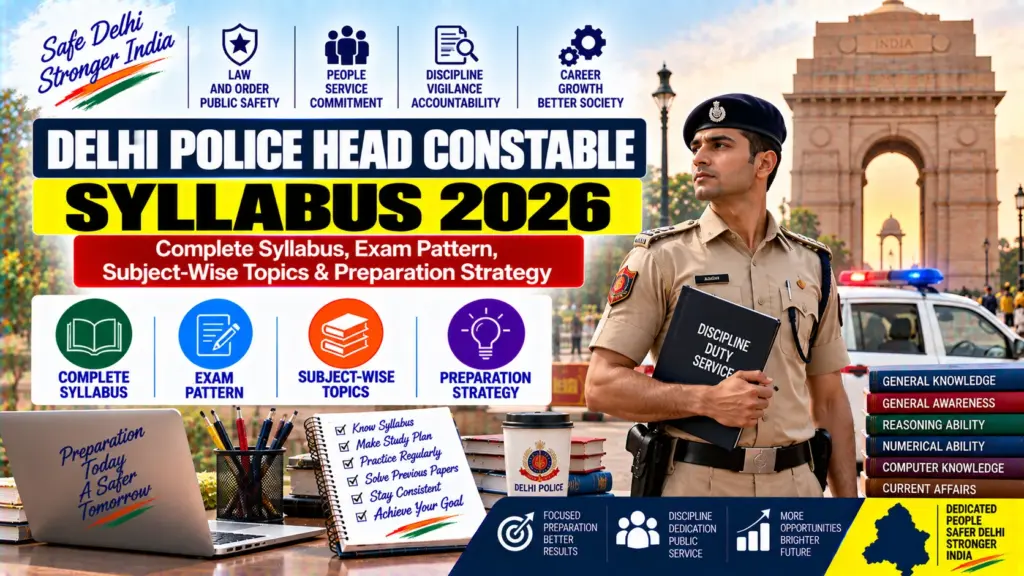
Delhi Police Head Constable Syllabus 2026: Complete Syllabus, Exam Pattern, Subject-Wise Topics & Preparation Strategy.The Delhi Police Head Constable Syllabus 2026 is an important document for candidates preparing for the Head Constable recruitment. Before starting preparation, candidates should have a clear idea about the subjects, number of questions, marking scheme and the stages that come after the written examination.
The syllabus is different for Head Constable Ministerial (HCM) and Head Constable AWO/TPO posts. While the Ministerial exam includes English Language, the AWO/TPO exam includes General Science instead.
The Computer-Based Test consists of 100 questions for 100 marks, and candidates get 90 minutes to complete the paper. Apart from the written exam, candidates may also have to qualify physical, typing, trade and computer-related tests depending on the post.
In this article, we have explained the Delhi Police Head Constable Syllabus 2026 in simple language so that candidates can plan their preparation properly.
Delhi Police Head Constable Syllabus 2026: Overview
| Particulars | Details |
|---|---|
| Exam Name | Delhi Police Head Constable 2026 |
| Posts | Head Constable Ministerial, AWO/TPO |
| Conducting Body | Staff Selection Commission |
| Exam Mode | Computer-Based Test |
| Question Type | Objective Type |
| Total Questions | 100 |
| Total Marks | 100 |
| Exam Duration | 90 Minutes |
| HCM Subjects | General Awareness, Quantitative Aptitude, General Intelligence, English, Computer Fundamentals |
| AWO/TPO Subjects | General Awareness, General Science, Mathematics, Reasoning, Computer Fundamentals |
Delhi Police Head Constable Exam Pattern 2026
The written examination is conducted online and consists of objective-type questions. The paper pattern is slightly different for HCM and AWO/TPO candidates.
HCM Exam Pattern
For the Head Constable Ministerial post, the CBT consists of five sections.
| Subject | Questions | Marks |
|---|---|---|
| General Awareness | 20 | 20 |
| Quantitative Aptitude | 20 | 20 |
| General Intelligence | 25 | 25 |
| English Language | 25 | 25 |
| Computer Fundamentals | 10 | 10 |
| Total | 100 | 100 |
The total time available is 90 minutes.
Negative Marking
The uploaded references contain different figures regarding negative marking. One detailed pattern specifies 0.25 marks for each wrong answer, while another reference mentions 0.50 marks. Candidates should follow the negative-marking provision mentioned in the final applicable recruitment notification.
Delhi Police Head Constable AWO/TPO Exam Pattern
The AWO/TPO paper has a different subject combination. General Science is included instead of English.
| Subject | Questions | Marks |
|---|---|---|
| General Awareness | 20 | 20 |
| General Science | 25 | 25 |
| Mathematics | 25 | 25 |
| Reasoning | 20 | 20 |
| Computer Fundamentals | 10 | 10 |
| Total | 100 | 100 |
The examination is conducted for 90 minutes.
Important: Candidates preparing for AWO/TPO should not follow the HCM syllabus blindly because General Science is a major part of the AWO/TPO paper.
Delhi Police Head Constable Selection Process 2026
The selection process depends on the post applied for.
For HCM
The selection stages mentioned in the supplied material are:
- Computer-Based Examination
- Physical Endurance & Measurement Test
- Typing Test
- Computer Formatting Test
- Document Verification
The typing test carries 25 marks, while the computer formatting test is qualifying in nature.
For AWO/TPO
The selection process includes:
- Computer-Based Examination
- Physical Endurance & Measurement Test
- Trade Test
- Computer Proficiency Test
- Document Verification/other applicable stages
Therefore, candidates should prepare for the complete recruitment process instead of concentrating only on the CBT.
Delhi Police Head Constable HCM Syllabus 2026
1. General Awareness
General Awareness is a broad section covering current events as well as static topics related to India and the world.
Candidates should prepare the following topics:
- History
- Indian Culture
- Geography
- Indian Economy
- General Polity
- Indian Constitution
- Scientific Research
- Countries and Currencies
- Abbreviations
- Science – Inventions and Discoveries
- Current Important Events
- National and International Current Affairs
- Awards and Honours
- Financial and Economic News
- Banking News
- Books and Authors
- Important Days and Dates
- Sports-related awareness
Preparation Tip
General Awareness becomes easier when studied regularly. Instead of trying to cover everything in the final week, spend some time every day on current affairs and revise important static GK topics alongside them.
2. Quantitative Aptitude
The Quantitative Aptitude section mainly focuses on basic arithmetic and school-level mathematical concepts.
Important Topics
- Number System
- Whole Numbers
- Decimals
- Fractions
- Percentage
- Ratio and Proportion
- Square Roots
- Average
- Simple Interest
- Compound Interest
- Profit and Loss
- Discount
- Partnership
- Mixture and Alligation
- Time and Distance
- Time and Work
- Algebra
- Basic Algebraic Identities
- Elementary Surds
- Linear Equations
- Geometry
- Triangles
- Congruence and Similarity
- Circles
- Chords and Tangents
- Quadrilaterals
- Regular Polygons
- Mensuration
- Trigonometry
- Heights and Distances
- Statistical Charts
- Bar Graphs
- Pie Charts
- Frequency Polygon
- Data Interpretation
Exam Tip: Mathematics is not only about getting the answer right. You also need to solve questions quickly. Make a habit of practising questions with a timer.
3. General Intelligence
General Intelligence tests logical thinking, observation and problem-solving skills. This section can become a scoring area with regular practice.
Important Topics
- Analogy
- Similarities and Differences
- Classification
- Number Series
- Alphabet Series
- Figural Series
- Coding-Decoding
- Logical Sequence
- Arithmetical Reasoning
- Problem Solving
- Decision Making
- Judgment
- Direction Sense
- Ranking
- Data Sufficiency
- Venn Diagrams
- Space Orientation
- Space Visualization
- Visual Memory
- Drawing Inferences
- Punched Hole/Folding and Unfolding
- Embedded Figures
- Critical Thinking
- Syllogism
- Statement and Conclusion
- Word Building
- Numerical Operations
- Symbolic Operations
- Blood Relations
- Seating Arrangement
- Emotional Intelligence
- Social Intelligence
How to Prepare
Do not simply read reasoning concepts. Learn a concept and immediately solve questions based on it. Once your accuracy improves, start working on speed.
4. English Language
English is an important section in the HCM examination. The questions are mainly based on grammar, vocabulary and comprehension.
Topics Covered
- Reading Comprehension
- Jumbled Sentences
- Spot the Error
- Fill in the Blanks
- Sentence Improvement
- Phrase Replacement
- Cloze Test
- Spelling Correction
- Synonyms
- Antonyms
- Homonyms
- Idioms and Phrases
- One-Word Substitution
- Active and Passive Voice
- Direct and Indirect Speech
- Tenses
- Subject-Verb Agreement
- Articles
- Conjunctions
- Adverbs
- Nouns
- Verbs
- Phrasal Verbs
- Infinitives
- Gerunds
- Participles
- Sentence Pattern
Preparation Tip: Read a short English passage every day and revise grammar rules through practice questions. This will help improve both comprehension and accuracy.
5. Computer Fundamentals
The Computer section may have only 10 questions, but candidates should not ignore it because the questions are generally based on basic concepts and commonly used computer applications.
Important Topics
- Basics of Computers
- Computer Operations
- Word Processing
- MS Word
- MS Excel
- Spreadsheet
- Editing Cells
- Functions and Formulas
- Internet
- WWW
- Web Browsers
- URL
- HTTP
- FTP
- Websites
- Search Engines
- Internet Services
- Chat
- Video Conferencing
- E-Banking
- Computer Shortcuts
- Document Formatting
Candidates preparing for HCM should also get comfortable with practical use of MS Word and MS Excel.
Delhi Police Head Constable AWO/TPO Syllabus 2026
The AWO/TPO syllabus is different from the Ministerial syllabus. General Science and Mathematics have significant weightage in this examination.
1. General Awareness
The section covers general knowledge about India, neighbouring countries, current events and important national topics.
Topics
- Current Affairs
- National and International Events
- Indian History
- Indian Culture
- Indian Geography
- World Geography
- Climate
- Natural Resources
- Indian Economy
- Economic Policies
- Banking System
- Government Schemes
- Indian Constitution
- Indian Polity
- Scientific Developments
Candidates should also keep themselves updated with important national and international developments.
2. General Science
General Science includes basic concepts from Physics, Chemistry and Biology.
Physics
Important topics include:
- Thermodynamics
- Newton’s Laws of Motion
- Gravity
- Motion
- Pressure
- Units of Measurement
- Sound
- Heat and Temperature
- Electronics
- Magnetism
- Ohm’s Law
- Fibre Optics
- Modes of Communication
Chemistry
Candidates should cover:
- Chemistry in Everyday Life
- Commonly Used Chemicals
- Chemical Reactions
- Catalysts
- Commercial Applications of Chemicals
- Physical and Chemical Changes
- Acids
- Sulphuric Acid
- Hydrochloric Acid
- Atomic Number
- Elements and Symbols
- Electrochemistry
Biology
Important areas include:
- Human Anatomy
- Human Physiology
- Plant Physiology
- Animal Physiology
- Health Sciences
- Basic Biology
Preparation Tip: Focus on basic concepts and everyday applications of science. Avoid spending too much time on advanced topics that are outside the prescribed level.
3. Mathematics
The AWO/TPO Mathematics section covers arithmetic along with algebra, geometry and data interpretation.
Important Topics
- Number System
- Percentage
- Simple Interest
- Compound Interest
- Profit and Loss
- Discount
- Algebra
- Geometry
- Mensuration
- Time, Distance and Work
- Ratio and Proportion
- Average
- Trigonometry
- Data Interpretation
- Sequence and Series
- Permutation and Combination
- Simplification
A formula notebook can be very useful for the final revision.
4. Reasoning
The Reasoning section contains both verbal and non-verbal reasoning topics.
Important Topics
- Non-Verbal Reasoning
- Analogy
- Alphanumeric Series
- Number Series
- Critical Thinking
- Logical Reasoning
- Input-Output
- Blood Relations
- Syllogism
- Tables
- Directions
- Ranking
- Venn Diagrams
- Seating Arrangement
- Coded Inequalities
- Data Sufficiency
- Coding-Decoding
The best way to improve this section is to practise different question patterns regularly.
5. Computer Fundamentals
The Computer section for AWO/TPO includes basic computer and internet-related topics.
Topics to Prepare
- Computer Basics
- MS Word
- MS Excel
- Word Processing
- Spreadsheet
- Functions and Formulas
- Communication
- Internet
- WWW
- Web Browsers
- Search Engines
- Internet Services
- Computer Shortcuts
- Basic Cybersecurity Awareness
Delhi Police Head Constable Physical Test
Physical preparation should begin early for candidates who have to appear for the physical stage. Waiting until after the CBT can make the preparation unnecessarily difficult.
The supplied material gives the following physical endurance standards:
Male Candidates
| Age | Race | Long Jump | High Jump |
|---|---|---|---|
| Up to 30 Years | 1600 m in 7 minutes | 12.5 ft | 3.5 ft |
| Above 30 to 40 Years | 1600 m in 8 minutes | 11.5 ft | 3.25 ft |
| Above 40 Years | 1600 m in 9 minutes | 10.5 ft | 3 ft |
Female Candidates
| Age | Race | Long Jump | High Jump |
|---|---|---|---|
| Up to 30 Years | 800 m in 5 minutes | 9 ft | 3 ft |
| Above 30 to 40 Years | 800 m in 6 minutes | 8 ft | 2.5 ft |
| Above 40 Years | 800 m in 7 minutes | 7 ft | 2.25 ft |
Physical Measurement
The supplied material mentions:
- Male Height: 165 cm, with applicable relaxation
- Male Chest: 78–82 cm with minimum expansion
- Female Height: 157 cm, with applicable relaxation
Candidates should verify the exact standards and category-wise relaxation applicable to their recruitment notification.
Delhi Police Head Constable Typing Test
The typing test is particularly important for HCM candidates.
As mentioned in the supplied material, the typing test carries 25 marks. Candidates can be tested in English or Hindi.
The indicated typing speed is:
- English – 30 words per minute
- Hindi – 25 words per minute
Do not leave typing practice for the last month. Even 15–20 minutes of daily practice can gradually improve speed and accuracy.
Computer Formatting Test
The Computer Formatting Test is qualifying in nature.
Candidates should be comfortable with:
- MS Word
- MS PowerPoint
- MS Excel
- Text formatting
- Document presentation
- Spreadsheet operations
- Basic computer functions
For HCM candidates, practical computer knowledge is therefore just as important as preparing computer theory.
How to Prepare for Delhi Police Head Constable 2026
A simple and consistent study routine is more useful than studying for very long hours occasionally.
Start With the Basics
First understand the complete syllabus and exam pattern. Divide the syllabus into small topics and set weekly targets.
Practise Mathematics and Reasoning Daily
These subjects require practice. Try to solve questions without immediately looking at the solution.
Keep General Awareness in Your Daily Routine
Read current affairs regularly and revise important information every week.
Give Special Attention to Your Post
HCM candidates should focus more on English and computer skills, while AWO/TPO candidates should give additional attention to General Science and Mathematics.
Take Mock Tests
Once you have covered the basic syllabus, start attempting full-length tests. After every mock, spend time analysing your mistakes.
Don’t Ignore Physical Preparation
Candidates who need to qualify the physical stage should start running and other physical activities early.
90-Day Study Plan
First 30 Days
Focus on building your basics.
- Mathematics fundamentals
- Reasoning concepts
- English grammar for HCM
- General Science for AWO/TPO
- General Awareness
- Computer basics
Days 31–60
Complete the remaining syllabus and increase question practice.
- Advanced Mathematics
- Reasoning practice
- English comprehension
- Current Affairs
- Science
- Computer
- Previous-year questions
Days 61–75
Move towards exam-oriented preparation.
- Full-length mock tests
- Sectional tests
- Previous-year questions
- Speed practice
- Weak-topic revision
- Formula revision
Days 76–90
Use this period mainly for revision.
Revise your short notes, formulas, current affairs, computer concepts and frequently repeated question types.
Avoid collecting new study material during the final days. Focus on revising what you have already studied.
Daily Study Routine
| Subject | Suggested Time |
|---|---|
| Mathematics | 1 Hour |
| Reasoning | 1 Hour |
| General Awareness | 1 Hour |
| English/HCM Preparation | 45 Minutes |
| General Science/AWO-TPO | 1 Hour |
| Computer | 30 Minutes |
| MCQs/Mock Test | 1 Hour |
| Revision | 30 Minutes |
The timetable can be adjusted according to your strengths and weaknesses.
Important Tips for Delhi Police Head Constable Exam
- Understand the syllabus before starting preparation.
- Make short notes for General Awareness and Current Affairs.
- Practise Mathematics with a timer.
- Solve reasoning questions regularly.
- Read English passages daily for HCM preparation.
- Revise computer shortcuts and MS Office basics.
- Attempt mock tests regularly.
- Analyse your mistakes instead of only checking your score.
- Start physical preparation early.
- Practise typing regularly if you are preparing for HCM.
- Keep the final days for revision rather than learning everything from scratch.
Common Mistakes Candidates Should Avoid
One common mistake is studying only the written examination and ignoring the later stages. Candidates should remember that the recruitment process also includes physical and post-specific skill stages.
Another mistake is collecting too many books and study materials. It is better to study one reliable set of notes thoroughly and revise it multiple times.
Candidates should also avoid spending excessive time on a single question during the CBT. Since the exam has a fixed 90-minute duration, time management is an important part of preparation.