
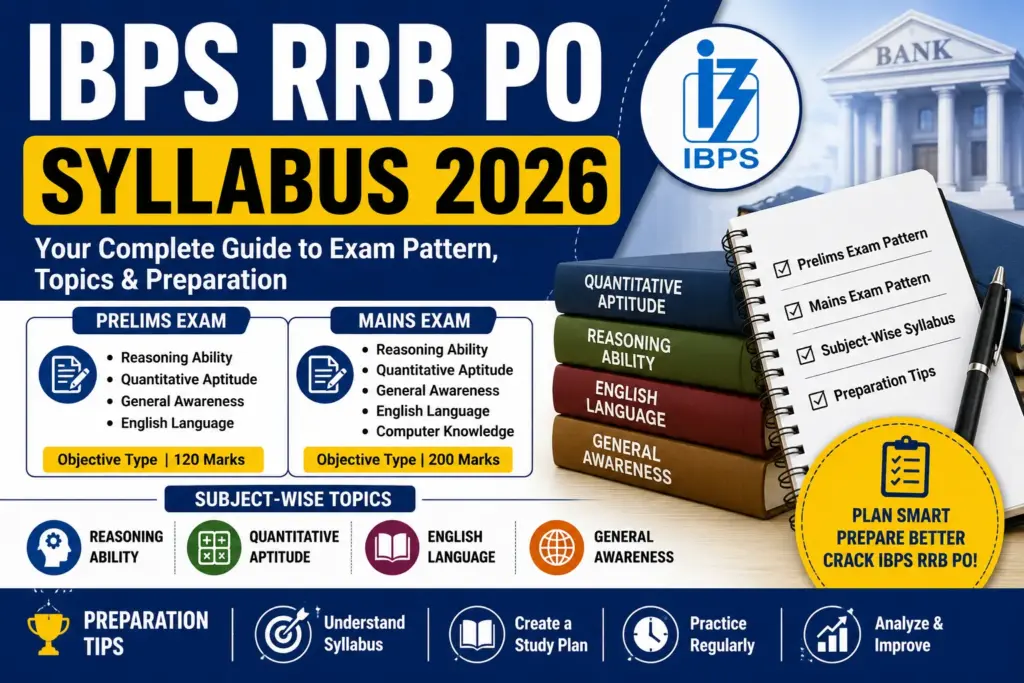
IBPS RRB PO Syllabus 2026: Check Prelims & Mains Exam Pattern, Subject-Wise Topics and Preparation Tips.If you are preparing for IBPS RRB PO 2026, understanding the syllabus should be the first step of your preparation. The examination is conducted for the Officer Scale-I post in Regional Rural Banks, and the selection process consists of Prelims, Mains and Interview.
The Prelims exam focuses on Reasoning Ability and Quantitative Aptitude, while the Mains examination covers Reasoning, Quantitative Aptitude, General Awareness, English/Hindi Language and Computer Knowledge.
This article covers the IBPS RRB PO Syllabus 2026, exam pattern, important topics and a practical preparation strategy in simple language.
Overview of IBPS RRB PO Syllabus 2026
| Particulars | Details |
|---|---|
| Exam Name | IBPS RRB Officer Scale-I |
| Popular Name | IBPS RRB PO |
| Conducting Body | Institute of Banking Personnel Selection |
| Recruitment Cycle | CRP RRB-XV 2026 |
| Exam Mode | Online |
| Selection Process | Prelims, Mains & Interview |
| Prelims Subjects | Reasoning Ability, Quantitative Aptitude |
| Mains Subjects | Reasoning, Quantitative Aptitude, General Awareness, English/Hindi, Computer Knowledge |
| Prelims Marks | 80 |
| Mains Marks | 200 |
| Negative Marking | 0.25 marks for each wrong answer |
IBPS RRB PO Prelims Exam Pattern 2026
The Preliminary Examination has two sections — Reasoning Ability and Quantitative Aptitude. Candidates have to attempt 80 questions in 45 minutes.
| Section | Questions | Marks | Time |
|---|---|---|---|
| Reasoning Ability | 40 | 40 | 25 Minutes |
| Quantitative Aptitude | 40 | 40 | 20 Minutes |
| Total | 80 | 80 | 45 Minutes |
There is negative marking of 0.25 marks for every wrong answer. Sectional timing also applies, so candidates need to be careful about how they use the allotted time.
IBPS RRB PO Prelims Syllabus 2026
Reasoning Ability
Reasoning is one of the most important sections in the Preliminary exam. Regular practice is essential because speed improves mainly through solving different types of questions.
Important topics include:
- Alphabet, Number and Symbol Series
- Inequality
- Syllogism
- Coding-Decoding
- Blood Relations
- Direction Sense
- Order and Ranking
- Alphabet Test
- Number Test
- Seating Arrangement
- Linear Arrangement
- Circular Arrangement
- Triangular Arrangement
- Rectangular Arrangement
- Square Arrangement
- Floor-Based Puzzles
- Box-Based Puzzles
- Day, Month and Year-Based Puzzles
- Data Sufficiency
- Input-Output
- Statement and Assumption
- Statement and Conclusion
- Cause and Effect
- Decision Making
- Analogy
- Series Test
Quantitative Aptitude
The Quantitative Aptitude section requires both conceptual understanding and calculation speed.
Important topics include:
- Simplification
- Approximation
- Number System
- Number Series
- Quadratic Equations
- Inequality
- HCF and LCM
- Percentage
- Ratio and Proportion
- Average
- Profit and Loss
- Simple Interest
- Compound Interest
- Partnership
- Mixture and Allegation
- Problems on Ages
- Time and Work
- Pipes and Cisterns
- Time, Speed and Distance
- Boats and Streams
- Trains
- Mensuration
- Probability
- Permutation and Combination
- Data Interpretation
- Data Sufficiency
Data Interpretation can include tables, bar graphs, line graphs, pie charts and caselet-based questions.
IBPS RRB PO Mains Exam Pattern 2026
Candidates who qualify for the Prelims appear for the Mains examination. Unlike Prelims, the Mains covers five sections.
The exam consists of 200 questions for 200 marks, with a total duration of 120 minutes.
| Section | Questions | Marks | Time |
|---|---|---|---|
| Reasoning Ability | 40 | 50 | 30 Minutes |
| Quantitative Aptitude | 40 | 50 | 30 Minutes |
| General Awareness | 40 | 40 | 15 Minutes |
| English/Hindi Language | 40 | 40 | 30 Minutes |
| Computer Knowledge | 40 | 20 | 15 Minutes |
| Total | 200 | 200 | 120 Minutes |
Candidates can choose English or Hindi for the language section. Negative marking of 0.25 marks is applicable for incorrect answers.
IBPS RRB PO Mains Syllabus 2026
Reasoning Ability
The Mains Reasoning section includes the topics asked in Prelims but can involve more complicated puzzles and logical reasoning.
Candidates should prepare:
- Advanced Puzzles
- Seating Arrangements
- Floor and Flat Puzzles
- Box-Based Puzzles
- Input-Output
- Syllogism
- Inequality
- Coding-Decoding
- Blood Relations
- Direction Sense
- Order and Ranking
- Data Sufficiency
- Statement and Assumption
- Statement and Conclusion
- Statement and Inference
- Cause and Effect
- Course of Action
- Statement and Argument
- Decision Making
- Critical Reasoning
The best way to improve in this section is to practise regularly rather than simply memorising tricks.
Quantitative Aptitude
The Mains Quantitative Aptitude section includes arithmetic, advanced calculations and Data Interpretation.
Important topics are:
- Simplification
- Approximation
- Number Series
- Double Pattern Series
- Quadratic Equations
- Number System
- Percentage
- Ratio and Proportion
- Average
- Profit and Loss
- Simple Interest
- Compound Interest
- Partnership
- Mixture and Allegation
- Time and Work
- Pipes and Cisterns
- Time, Speed and Distance
- Boats and Streams
- Trains
- Mensuration
- Probability
- Permutation and Combination
- Quantity Comparison
- Data Sufficiency
- Data Interpretation
Candidates should particularly practise different types of DI sets, including table, bar, line, pie, caselet, missing and mixed DI.
General Awareness
General Awareness is a Mains-only section and can make a major difference to the overall score.
Important areas include:
- National Current Affairs
- International Current Affairs
- Banking Awareness
- Banking News
- Economy
- Financial Awareness
- RBI-related Updates
- Government Schemes
- Government Policies
- Sports
- Awards and Honours
- Important Appointments
- Books and Authors
- Reports and Rankings
- Defence News
- Science and Technology
- Important Days
- Summits
- Static Awareness
- Agriculture
- Banking History
- Countries and Currencies
- National Parks and Wildlife Sanctuaries
How to Prepare General Awareness?
Instead of trying to study everything at the last moment, spend some time every day on current affairs.
Make short notes covering banking, RBI updates, government schemes, economy, important reports, appointments, awards and major national and international events.
This makes revision much easier before the Mains examination.
English Language Syllabus
Candidates opting for English should prepare:
- Reading Comprehension
- Sentence Rearrangement
- Phrase Rearrangement
- Word Swap
- Match the Column
- Connectors
- Starters
- Fill in the Blanks
- Cloze Test
- Error Detection
- Error Correction
- Phrase Substitution
- Synonyms
- Antonyms
- One-Word Substitution
- Idioms and Phrases
- Spelling Errors
- Word Usage
Reading newspapers, articles and editorials regularly can help improve comprehension and vocabulary.
Hindi Language Syllabus
Candidates choosing Hindi should prepare:
- अपठित गद्यांश
- समानार्थक शब्द
- विलोम शब्द
- रिक्त स्थान
- गद्यांश आधारित रिक्त स्थान
- वाक्य त्रुटि
- शब्द एवं वर्तनी त्रुटि
- वाक्यांश के लिए एक शब्द
- मुहावरे
- लोकोक्तियाँ
Regular reading and practice can help improve both vocabulary and comprehension.
Computer Knowledge Syllabus
Computer Knowledge is included in the Mains examination and can be a scoring section with proper preparation.
Important topics include:
- Computer Fundamentals
- History of Computers
- Hardware
- Software
- Input and Output Devices
- Computer Memory
- Number Systems
- Computer Languages
- Networking
- Internet
- MS Office
- Database
- DBMS
- Computer Security
- Security Tools
- Shortcut Keys
Candidates should first understand the basics and then practise objective questions.
IBPS RRB PO Prelims vs Mains
| Subject | Prelims | Mains |
|---|---|---|
| Reasoning Ability | Yes | Yes |
| Quantitative Aptitude | Yes | Yes |
| General Awareness | No | Yes |
| Banking Awareness | No | Yes |
| Computer Knowledge | No | Yes |
| English/Hindi | No | Yes |
| Interview | No | After Mains |
This difference is important because many candidates focus completely on Prelims and postpone the Mains syllabus. That can create unnecessary pressure after the Prelims result.
IBPS RRB PO Interview 2026
Candidates who qualify in the Mains are called for the Interview stage.
Interview preparation should cover:
- Banking Awareness
- Regional Rural Banks
- Rural Economy
- Agriculture
- Current Affairs
- Financial Awareness
- Basic Banking Terms
- Communication Skills
- Questions related to education and background
It is a good idea to develop awareness about banking and rural financial systems while preparing for the written examination itself.
How to Prepare for IBPS RRB PO 2026?
A good preparation strategy doesn’t mean studying all day. What matters is consistent study, regular practice and proper revision.
1. Understand the Syllabus
Start by making a checklist of all the topics. This will help you track your preparation and prevent unnecessary repetition.
2. Build Strong Basics
Before attempting difficult puzzles or advanced DI, make sure your fundamentals are clear.
3. Practise Reasoning and Quant Daily
These are practice-based subjects. Solving questions regularly will gradually improve your speed and accuracy.
4. Improve Calculation Speed
Practise basic calculations, percentages, fractions, squares and other frequently used concepts. Faster calculations can save valuable time during the exam.
5. Start Mains Preparation Early
Don’t wait for the Prelims result to start General Awareness, Computer Knowledge and Language preparation. Even 30–60 minutes daily can make a big difference over time.
6. Solve Previous-Year Questions
Previous-year questions are useful for understanding the difficulty level and identifying frequently tested concepts.
7. Attempt Mock Tests
Start with sectional tests and gradually move to full-length mocks.
After every mock, check:
- Which questions took too much time?
- Where did you make mistakes?
- Which topics are weak?
- Did you make unnecessary guesses?
- How was your time management?
Mock-test analysis is often more useful than simply checking the final score.
Simple Daily Study Plan
A practical daily routine could look like this:
| Activity | Time |
|---|---|
| Reasoning | 60 Minutes |
| Quantitative Aptitude | 60 Minutes |
| General Awareness | 30 Minutes |
| English/Hindi | 30 Minutes |
| Computer/Banking Awareness | 20–30 Minutes |
| Mock/PYQ Practice | 30 Minutes |
You can change the timings according to your schedule. The important thing is to maintain consistency.